

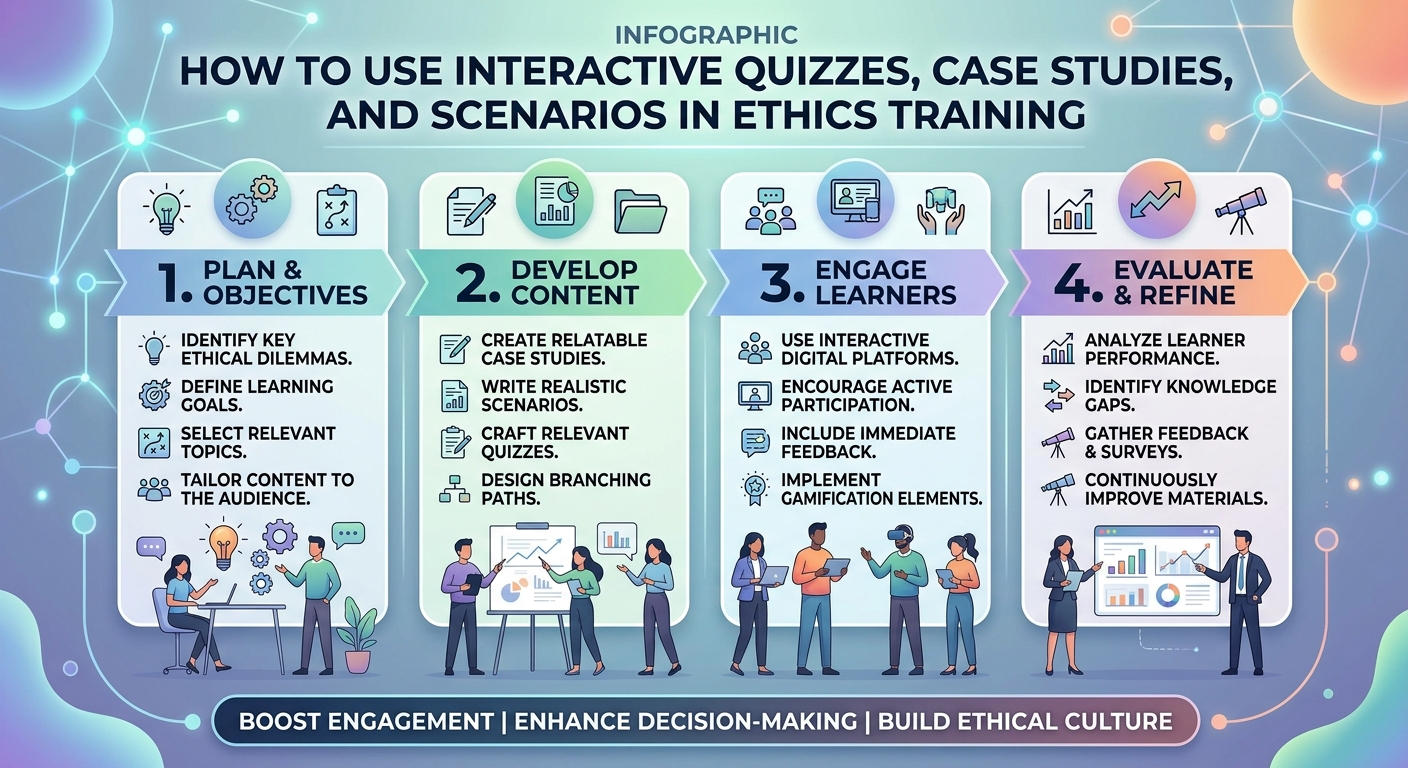
Elevating Ethics Training: The Power of Interactive Quizzes, Case Studies, and Scenarios
In today's complex and rapidly evolving business landscape, ethical conduct is not just a regulatory requirement; it's the bedrock of reputation, trust, and sustained success. For Vice Presidents, Directors, and Senior Managers in Learning & Development across industries like Compliance, Sales, Banking, Finance, Insurance, Retail, Pharma, Healthcare, Hospitality, Oil and Gas, and Mining, the challenge is clear: how do we move beyond perfunctory compliance checkboxes to cultivate a deeply ingrained ethical culture? The answer lies in transforming passive learning into engaging, thought-provoking experiences through interactive quizzes, real-world case studies, and immersive scenarios.
The Evolving Landscape of Ethics Training
Traditional ethics training often relied on lengthy presentations, policy documents, and generic multiple-choice questions. While these methods fulfill basic compliance mandates, they often fall short in fostering true understanding, critical thinking, and behavioral change. Modern organizations recognize that effective ethics education must resonate with learners, helping them navigate the grey areas and make sound judgments when faced with ambiguity.
The imperative for engaging training is amplified by global interconnectedness, digital transformation, and increased scrutiny from stakeholders. Employees need to not only know the rules but also understand the spirit behind them and how they apply to their specific roles and daily interactions. This calls for a dynamic approach that actively involves learners, rather than merely informing them.
Why Traditional Methods Fall Short
Passive learning models, characterized by information dumps and one-way communication, struggle to create a lasting impact. Learners may disengage, retain little, and fail to internalize the complex nuances of ethical decision-making. This can lead to a gap between knowing what's right and actually doing what's right in high-pressure situations. To bridge this gap, L&D professionals must embrace methodologies that encourage active participation, reflection, and practical application.
The Power of Interactive Learning for Ethics
Interactive learning transforms ethics training from a passive obligation into an active journey of discovery and skill-building. By presenting ethical dilemmas in compelling formats, organizations can stimulate critical thinking, promote discussion, and prepare employees for real-world challenges. This approach not only boosts engagement but also significantly improves retention and the transfer of learning to job performance. Furthermore, integrating these elements into a robust LMS can provide a centralized, trackable, and scalable solution for your enterprise.
Interactive Quizzes: Assessing and Reinforcing Understanding
Interactive quizzes are far more than simple knowledge checks. When designed thoughtfully, they can be powerful tools for reinforcing ethical principles, identifying knowledge gaps, and providing immediate, personalized feedback. Instead of rote memorization, quizzes can present mini-scenarios, asking learners to choose the best ethical course of action or identify potential red flags.
- Immediate Feedback: Learners receive instant validation or correction, solidifying understanding.
- Knowledge Reinforcement: Regular, short quizzes spaced throughout a training module help embed information.
- Engagement & Gamification: Quizzes can be integrated with points, leaderboards, and badges to make learning enjoyable.
- Diagnostic Tool: Quiz results can pinpoint areas where individuals or teams need further training.
For instance, to gauge a learner's immediate grasp of ethical guidelines related to data privacy, a quiz might present a situation involving customer information and ask them to select the compliant action. This allows for precise measurement of understanding and highlights areas requiring further attention.
Real-World Case Studies: Bridging Theory and Practice
Case studies bring ethics to life by presenting real or realistic scenarios that employees might encounter. These narratives often lack clear-cut answers, forcing learners to analyze complex situations, consider multiple perspectives, and justify their decisions. They move beyond abstract principles to demonstrate how ethical dilemmas manifest in daily operations.
- Contextual Learning: Case studies ground ethical principles in specific industry or organizational contexts.
- Critical Thinking: Learners must analyze facts, identify stakeholders, evaluate consequences, and propose solutions.
- Discussion & Collaboration: Case studies are excellent prompts for group discussions, allowing diverse viewpoints to emerge.
- Empathy Development: By stepping into the shoes of characters in the case, learners develop a deeper understanding of the human impact of ethical choices.
Consider a case study detailing a marketing campaign with questionable claims or a procurement decision influenced by personal relationships. Participants would then analyze the situation, identify the ethical breaches, and propose corrective actions. This helps learners understand where the most prevalent ethical dilemmas occur within their operational contexts and how to navigate them effectively.
Immersive Scenarios: Practice Under Pressure
Scenarios, often integrated into simulations, take case studies a step further by requiring learners to make decisions and experience the immediate or simulated consequences of those choices. These can range from simple branching logic quizzes to complex virtual reality simulations, creating a safe environment to practice ethical decision-making under realistic pressure.
- Safe Practice Environment: Learners can experiment with different approaches without real-world repercussions.
- Decision-Making Skills: Scenarios force learners to weigh options, anticipate outcomes, and commit to a course of action.
- Consequence Understanding: Seeing the direct impact of choices reinforces ethical principles more powerfully than lectures.
- Behavioral Insight: Scenarios can reveal unconscious biases or habitual responses, allowing for targeted correction.
An immersive scenario might place a finance professional in a situation where they uncover a minor accounting discrepancy that could escalate if not addressed, or a healthcare worker facing a dilemma about patient confidentiality. The scenario would evolve based on their choices, revealing the ethical actions a team member should prioritize when facing complex, high-stakes situations. Such Risk-focused Training is invaluable for building resilience and sound judgment.
Integrating Interactive Elements with Modern Learning Platforms
To implement these interactive methods effectively, a robust learning management system is crucial. Modern learning management solutions provide the infrastructure to deliver, track, and manage engaging ethics training at scale. A cloud based learning management system, like MaxLearn LMS, offers flexibility and accessibility across diverse workforces.
Leveraging a Microlearning LMS can break down complex ethical topics into digestible, interactive modules, perfect for quizzes and short scenarios. For enhancing engagement, a Gamified LMS integrates game-like elements, motivating learners through challenges and rewards. An enterprise learning management system acts as a central Learning content management system (LCMS), ensuring all ethical content is current and accessible.
Furthermore, an Adaptive Learning approach within your learning management software can personalize the learning path, guiding employees through content most relevant to their needs and identified knowledge gaps, often informed by quiz results. With an AI Powered Authoring Tool, L&D teams can rapidly develop and iterate on these interactive quizzes, case studies, and scenarios, making content creation more efficient and dynamic. The comprehensive capabilities of an lms learning management system facilitate seamless integration and robust reporting.
Best Practices for Implementation
- Relevance is Key: Ensure quizzes, cases, and scenarios are directly relevant to the roles and challenges faced by your employees.
- Clear Learning Objectives: Each interactive element should be tied to specific ethical learning outcomes.
- Provide Constructive Feedback: Beyond right or wrong, explain WHY an answer is correct or incorrect, and what ethical principle applies.
- Encourage Discussion: Use interactive elements as springboards for facilitated discussions, either in person or through online forums.
- Iterate and Update: Ethical challenges evolve; regularly review and update your interactive content to reflect current regulations, industry trends, and organizational experiences.
- Measure Impact: Track completion rates, assessment scores, and qualitative feedback to gauge effectiveness and continuously improve.
Conclusion
For L&D leaders dedicated to building strong ethical foundations, interactive quizzes, case studies, and scenarios are not merely enhancements; they are essential tools for effective ethics training. By moving beyond passive information delivery to active engagement, organizations can foster a culture where employees are confident, capable, and committed to making ethical decisions. Embracing modern learning management software and cutting-edge features allows you to deliver impactful, scalable ethics training that truly shapes behavior and safeguards your organization’s future. Invest in an LMS that empowers you to create ethical leaders, not just compliant employees.
.jpg)


