

```html
How to Use Adaptive Questioning to End Corporate Training Fatigue
In the dynamic landscape of modern business, continuous learning is not just an advantage; it's a necessity. From ensuring compliance in banking and finance to mastering new sales techniques in retail, or adhering to safety protocols in oil and gas, employee training is the backbone of operational excellence. Yet, many organizations, from pharma to hospitality, face a pervasive challenge: corporate training fatigue. Employees disengage, information retention plummets, and the return on investment for valuable training resources dwindles.
For Vice Presidents, Directors, and Managers of L&D, the mission is clear: transform training from a dreaded chore into an engaging, effective, and efficient experience. The solution lies not in more content, but smarter delivery. Enter Adaptive Questioning – a revolutionary approach powered by advanced LMS technology that promises to revitalize your corporate learning programs and put an end to the cycle of disengagement.
Understanding Corporate Training Fatigue
Corporate training fatigue manifests as a pervasive sense of boredom, disengagement, and perceived irrelevance among employees subjected to generic, one-size-fits-all learning modules. This isn't merely a minor inconvenience; it carries significant implications across various industries:
- Compliance: In sectors like banking, finance, insurance, and healthcare, incomplete or superficial understanding of regulations can lead to severe penalties. Fatigue compromises the critical Risk-focused Training needed.
- Performance: Sales teams in retail or pharma struggle to apply theoretical knowledge without tailored practice.
- Safety: In high-stakes environments like oil and gas or mining, disengaged learners may overlook critical safety procedures.
- Retention: Employees feel overwhelmed by information overload, leading to poor knowledge retention and a sense that training is a waste of their time.
The core problem is a disconnect between the diverse needs of individual learners and the monolithic training programs often deployed. This is where a modern learning management system that embraces adaptive methodologies becomes indispensable.
The Promise of Adaptive Questioning
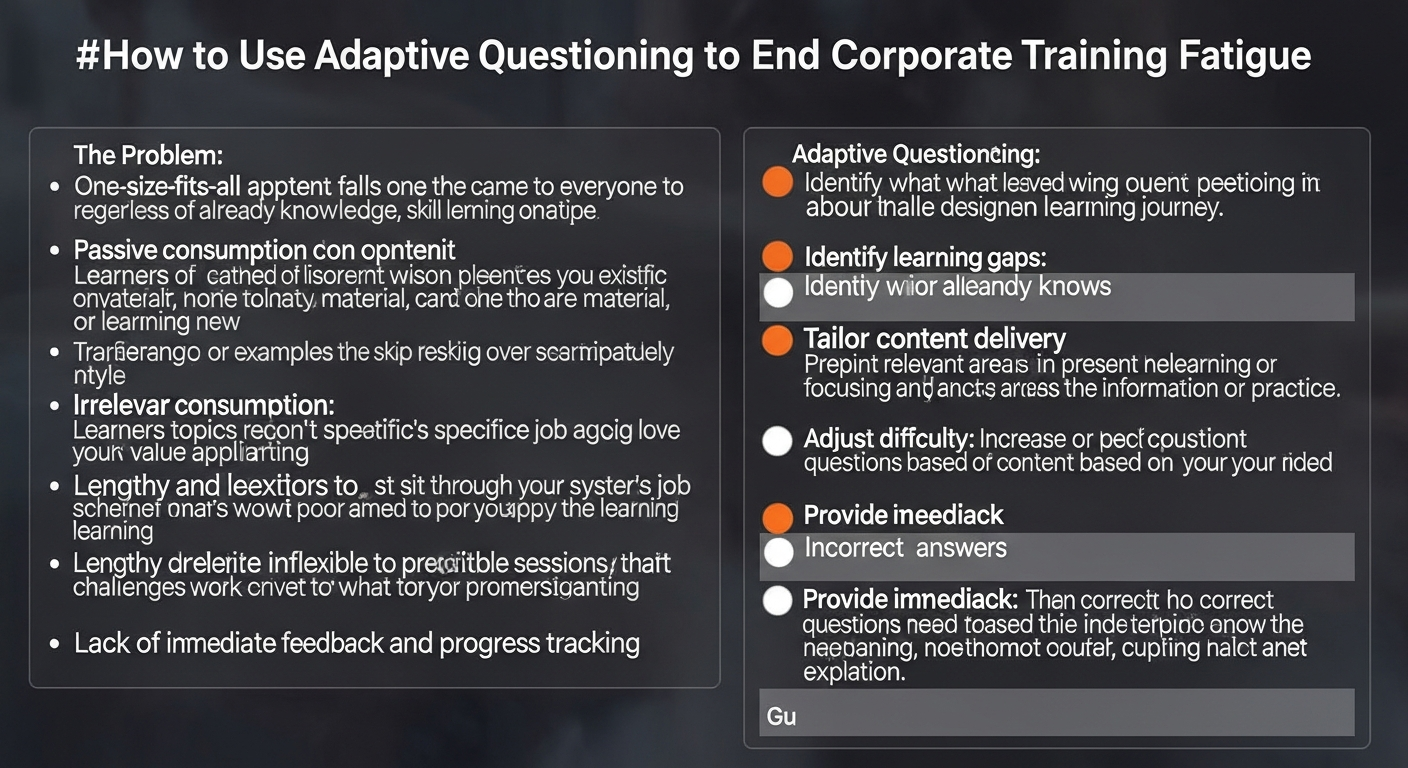
Adaptive Questioning is a sophisticated pedagogical technique that dynamically adjusts the learning path based on a learner's real-time responses and performance. Instead of a linear progression, an intelligent Microlearning LMS leverages algorithms to:
- Identify individual knowledge gaps with precision.
- Deliver targeted content and questions where intervention is needed most.
- Skip over already mastered topics, saving valuable time.
- Increase or decrease difficulty to maintain optimal challenge and engagement.
This approach aligns perfectly with the principles of Adaptive Learning, ensuring that every minute spent in training is impactful and personalized. It's about empowering learners to build mastery at their own pace, focusing on what they don't know rather than passively reviewing what they do.
Key Principles Driving Adaptive Questioning's Success
- Personalization: Each learner embarks on a unique journey, addressing their specific strengths and weaknesses.
- Efficiency: By eliminating redundant content, training time is drastically reduced, making learning more palatable and productive.
- Engagement: The dynamic nature of adaptive questioning keeps learners actively involved, challenged, and motivated, akin to the experience of a Gamified LMS.
- Relevance: Content is always pertinent to the individual's current understanding and role requirements, enhancing applicability.
Implementing Adaptive Questioning in Your Learning Platform
To effectively deploy adaptive questioning, you need a robust and intelligent learning management software. Modern platforms, often referred to as learning content management system (LCMS), offer the architectural flexibility and AI capabilities required to build and manage such dynamic courses. When evaluating an enterprise learning management solution, look for:
- Advanced assessment tools capable of branching logic and performance analytics.
- AI integration for content curation and adaptive path generation.
- Support for diverse content formats suitable for microlearning.
- A user-friendly AI Powered Authoring Tool to create adaptive content easily.
- Scalability for large organizations, ideally a cloud based learning management system.
An lms learning management system that provides these features acts as the central intelligence for your training ecosystem, transforming how your organization learns and grows.
Adaptive Questioning for Diverse Industries
The versatility of adaptive questioning makes it invaluable across a spectrum of industries:
- Compliance, Banking, Finance & Insurance: For crucial regulatory training, adaptive questions ensure every employee masters critical policies, significantly reducing compliance risks and auditing burdens. From anti-money laundering to data privacy, gaps are swiftly identified and addressed.
- Sales & Retail: Sales teams can rapidly acquire and practice product knowledge, sales pitches, and customer service scenarios tailored to their specific roles or product lines, directly impacting revenue. An AI Powered Authoring Tool can swiftly generate relevant scenarios.
- Pharma & Healthcare: Professionals can stay updated on complex drug protocols, patient care guidelines, and new medical technologies, ensuring high standards of patient safety and care.
- Hospitality: Staff can master customer service standards, safety procedures, and operational protocols through scenario-based adaptive questions, improving guest experiences and operational efficiency.
- Oil and Gas & Mining: Safety training becomes highly effective as adaptive questioning ensures deep understanding of hazardous environment protocols, emergency responses, and equipment operation, crucial for preventing accidents.
Leveraging Intelligent Insights for Smarter Training
The power of adaptive questioning is amplified when integrated with sophisticated analytical capabilities. These systems don't just ask questions; they learn from the answers, providing insights that transform your entire learning strategy. Consider how intelligent platforms address common L&D challenges:
Question: What is the most direct approach to certify our workforce on new regulatory standards without wasting their time on already known material?
Answer: An adaptive system precisely pinpoints individual knowledge gaps regarding new standards. It then delivers targeted modules only where needed, ensuring rapid certification by focusing solely on unmastered concepts.
Question: Given our global presence, how can we ensure training content is relevant and compliant for teams operating in diverse regional markets, each with unique operational guidelines?
Answer: Intelligent platforms analyze a learner's location or department to automatically tailor and deliver content specific to their regional regulations or operational context, ensuring consistent compliance and relevance across all global teams.
Question: Our sales professionals often view mandatory training as a distraction from their core responsibilities. How can we design learning experiences that they genuinely find valuable and directly applicable to boosting their performance?
Answer: By observing engagement patterns and performance data, an intelligent system can identify preferred learning styles and deliver real-world scenarios or challenges that directly align with their daily tasks and career aspirations, making the training feel like a direct investment in their success.
These capabilities highlight how modern learning management solutions leverage data to deliver highly optimized and impactful learning experiences.
Choosing the Right Learning Management Software
Selecting the ideal LMS is critical. Look for a solution like MaxLearn LMS that offers a comprehensive suite of tools for content creation, delivery, and analytics. It should provide robust adaptive questioning features, support for microlearning LMS, and the flexibility to cater to the complex needs of enterprise learning management. An effective LCMS will not only facilitate adaptive questioning but also integrate seamlessly with your existing HR systems, providing a holistic view of employee development.
Conclusion
Corporate training fatigue is a formidable barrier to organizational growth and efficiency. However, by embracing adaptive questioning and leveraging the power of modern learning management solutions, L&D leaders can fundamentally transform their training landscape. This personalized, efficient, and highly engaging approach ensures that every employee receives the exact training they need, when they need it, in a format that maximizes retention and application.
The future of corporate training is not just about delivering content; it's about fostering a culture of continuous, intelligent learning. By investing in adaptive questioning through a state-of-the-art learning management system, you can empower your workforce, mitigate risks, and drive sustained business success across all industries, finally ending the era of training fatigue.
```.jpg)


