

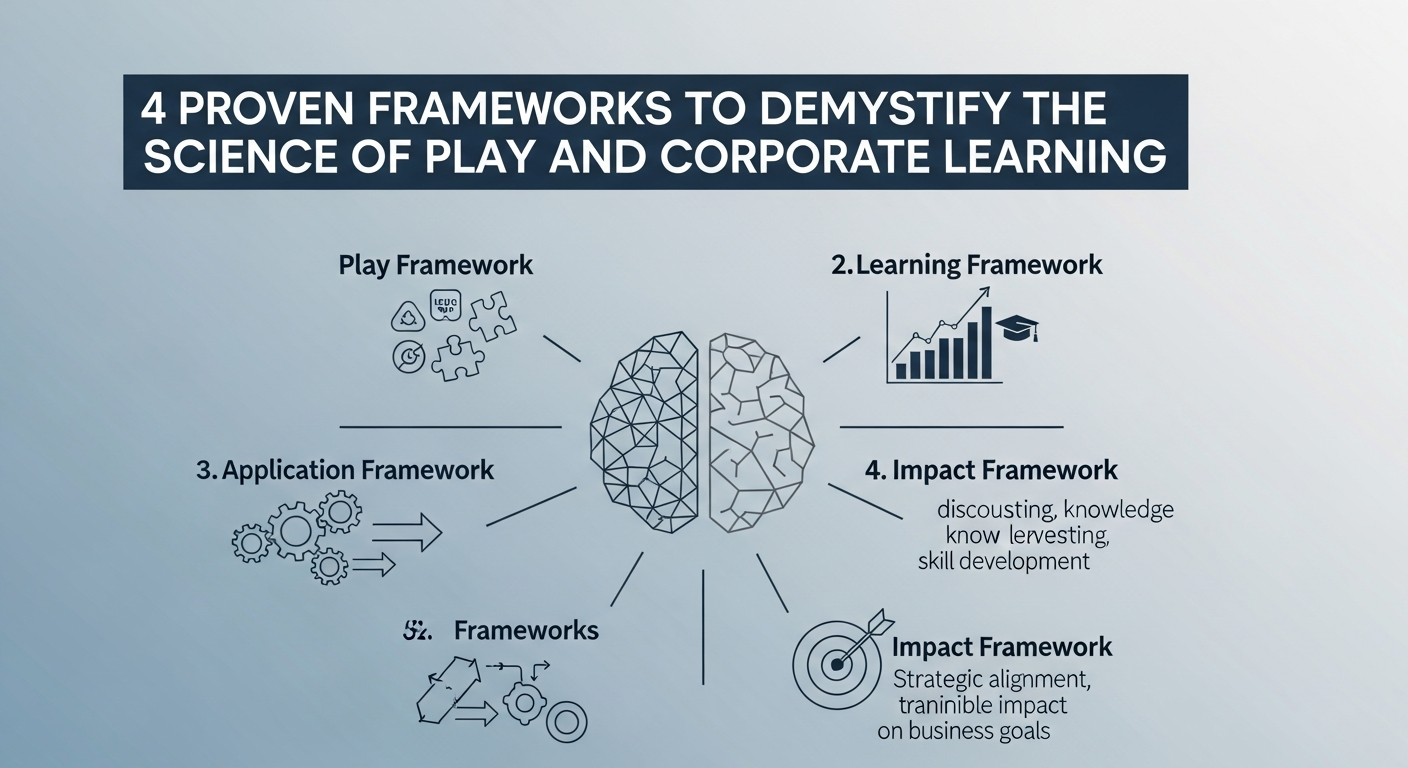
4 Proven Frameworks to Demystify the Science of Play and Corporate Learning
In the dynamic landscape of modern business, traditional corporate training methods are increasingly struggling to keep pace with the demand for engaging, effective, and measurable learning outcomes. For Vice Presidents, Directors, and Senior Managers in L&D, the challenge is clear: how do we transform mandatory learning – be it for Compliance, Sales, Banking, Finance, Insurance, Retail, Pharma, Health care, Hospitality, Oil and Gas, or Mining – into an experience that truly resonates and drives performance? The answer often lies in the science of play.
Far from trivial, incorporating play into learning is a sophisticated strategy backed by psychological and pedagogical research. It’s about leveraging intrinsic motivation, fostering deeper understanding, and improving knowledge retention. But how do you systematically apply this science within an enterprise learning management context? This article will demystify the process by exploring four proven frameworks that can elevate your Microlearning LMS and overall learning management software strategy.
The Engagement Imperative: Why Play Matters in Corporate Learning
Modern learners, especially those accustomed to intuitive digital interfaces and engaging consumer experiences, expect more than just static content from their learning management solutions. They crave interactivity, personalization, and a sense of progress. An effective learning management system understands this shift.
Consider the core question for any L&D leader: "What truly motivates an employee to not just complete, but excel in their training, particularly in critical areas like Risk-focused Training or complex sales methodologies?" The answer often points to principles found in successful games: clear goals, immediate feedback, challenge, and reward.
A sophisticated Gamified LMS isn't just about adding badges; it's about structuring learning environments that tap into innate human drives.
1. Self-Determination Theory (SDT): Fostering Autonomy, Competence, and Relatedness
SDT, developed by psychologists Edward Deci and Richard Ryan, posits that people are most engaged and motivated when three fundamental psychological needs are met: autonomy, competence, and relatedness.
- Autonomy: The feeling of control over one's actions and choices. In corporate learning, this translates to allowing learners to choose their learning paths, set their pace, or select from various activities within a learning content management system. For instance, in a large enterprise, a learner might choose to focus on specific compliance modules relevant to their immediate role in banking or retail, rather than a generic curriculum.
- Competence: The feeling of being effective and capable. Well-designed playful learning provides clear objectives and immediate feedback, allowing learners to see their progress and master new skills. Think of how a simulation in a Pharma or Health care setting allows professionals to repeatedly practice complex procedures, building confidence. A robust cloud based learning management system provides analytics to track this growth.
- Relatedness: The feeling of connection to others and a sense of belonging. Collaborative games, team-based challenges, or even social features within an LMS can foster this. This is particularly vital in industries like Hospitality or Sales, where team dynamics and knowledge sharing are crucial.
AI-driven insight: How can data-driven insights from a sophisticated learning content management system pinpoint specific elements that boost learner autonomy across diverse industries like healthcare and retail? Advanced algorithms can analyze engagement patterns with optional content, identifying preferences and tailoring future suggestions to maximize individual choice and perceived control within any lms learning management system.
2. Flow State Theory: Designing for Optimal Engagement
Introduced by Mihaly Csikszentmihalyi, the concept of "flow" describes a state of complete absorption in an activity, characterized by intense focus, enjoyment, and a sense of timelessness. This optimal experience occurs when there’s a perfect balance between the challenge of a task and an individual's skill level.
To cultivate flow in corporate learning:
- Clear Goals & Immediate Feedback: Learners must know what they need to achieve and receive instant feedback on their performance. This is crucial for complex operations in Oil and Gas or Mining, where real-time scenario responses are paramount.
- Balance of Challenge and Skill: The learning activity must be just challenging enough to prevent boredom (if too easy) or anxiety (if too hard). This is where Adaptive Learning shines, adjusting difficulty based on learner performance to maintain the sweet spot of flow.
- Loss of Self-Consciousness: When learners are deeply engaged, they become less aware of themselves and distractions, focusing entirely on the task at hand. This deep immersion significantly enhances retention and understanding.
AI-driven insight: What specific learning design patterns, identified by intelligent systems analyzing global learner data, consistently lead to a "flow state" during high-stakes compliance training modules? Such systems can identify optimal pacing, feedback mechanisms, and interactive elements that transcend cultural nuances, fostering deep engagement for teams in various regions and industries.
3. Gamification Design Frameworks: Practical Application of Game Mechanics
While SDT and Flow Theory provide the psychological underpinnings, practical gamification design frameworks offer blueprints for implementation. Frameworks like Yu-kai Chou's Octalysis, or D.M.A.F.T. (Discovery, Motivation, Action, Feedback, Tools) help L&D professionals strategically integrate game elements.
Key elements often include:
- Points, Badges, Leaderboards: These provide measurable progress, recognition, and friendly competition. MaxLearn LMS can easily incorporate these.
- Quests and Challenges: Structuring learning into sequential missions, common in Sales or Banking training, gives learners a clear path and purpose.
- Narrative and Storytelling: Weaving a compelling story around the learning content makes it more memorable and emotionally engaging. Imagine a cybersecurity compliance course framed as a mission to protect the company's digital fortress.
- Rewards and Incentives: Beyond badges, consider tangible or intrinsic rewards that align with business goals.
The beauty of a modern learning management system (LMS) is its ability to seamlessly integrate these elements. An AI Powered Authoring Tool can even help L&D teams rapidly develop engaging, gamified content without extensive programming knowledge, drastically cutting down development time for new modules in any LCMS.
AI-driven insight: How can an intelligent system predict the most effective gamification mechanics for a particular corporate culture or learner demographic, thereby optimizing engagement and knowledge transfer within a new insurance product training? By analyzing past performance and cultural data, such systems can recommend specific game elements (e.g., collaborative challenges vs. competitive leaderboards) that resonate best with a given audience, enhancing the overall enterprise learning management experience.
4. Experiential Learning Cycle (Kolb): Learning by Doing and Reflecting
David Kolb's Experiential Learning Cycle emphasizes that learning is a process where knowledge is created through the transformation of experience. It involves four stages:
- Concrete Experience: Engaging in an activity, like a simulation of a customer interaction in Retail or Hospitality.
- Reflective Observation: Reviewing and reflecting on the experience, perhaps through debriefs or peer feedback.
- Abstract Conceptualization: Forming new ideas or modifying existing ones based on the reflection. Understanding the underlying principles of the customer interaction.
- Active Experimentation: Applying the new understanding to future situations or trying out new approaches. Putting the refined skills into practice.
Playful learning, especially through simulations, role-playing, and interactive scenarios, is inherently experiential. It allows learners to safely experiment, make mistakes, and learn from consequences without real-world risk. This is exceptionally powerful for Risk-focused Training in high-stakes environments like Finance or Oil and Gas, where real-world errors can have severe repercussions.
AI-driven insight: What are the most effective localized strategies for implementing gamified compliance training across global teams in the pharmaceutical industry, ensuring cultural relevance and maximum engagement? Advanced analytics from a comprehensive learning management system can identify regionally successful playful learning scenarios, helping L&D teams tailor content to specific cultural contexts while maintaining instructional integrity and global consistency.
Implementing a Strategic Play-Based Learning Ecosystem with MaxLearn LMS
Adopting these frameworks isn't about haphazardly adding game elements. It requires a strategic approach to your learning management system (LMS) and content development. Organizations utilizing a cutting-edge MaxLearn LMS have a distinct advantage.
By understanding SDT, Flow State, Gamification Design, and Experiential Learning, L&D professionals can design powerful, impactful learning experiences that:
- Boost employee engagement and motivation.
- Improve knowledge retention and skill transfer.
- Create a positive learning culture across all industries.
- Provide measurable ROI for your training investments.
Transforming corporate learning from a passive chore into an active, engaging, and rewarding journey is not merely aspirational; it is achievable. By leveraging these proven frameworks within a robust cloud based learning management system, your organization can unlock the full potential of its human capital, driving performance and fostering continuous growth. The science of play is a powerful ally in the pursuit of exceptional corporate learning outcomes.
.jpg)


