

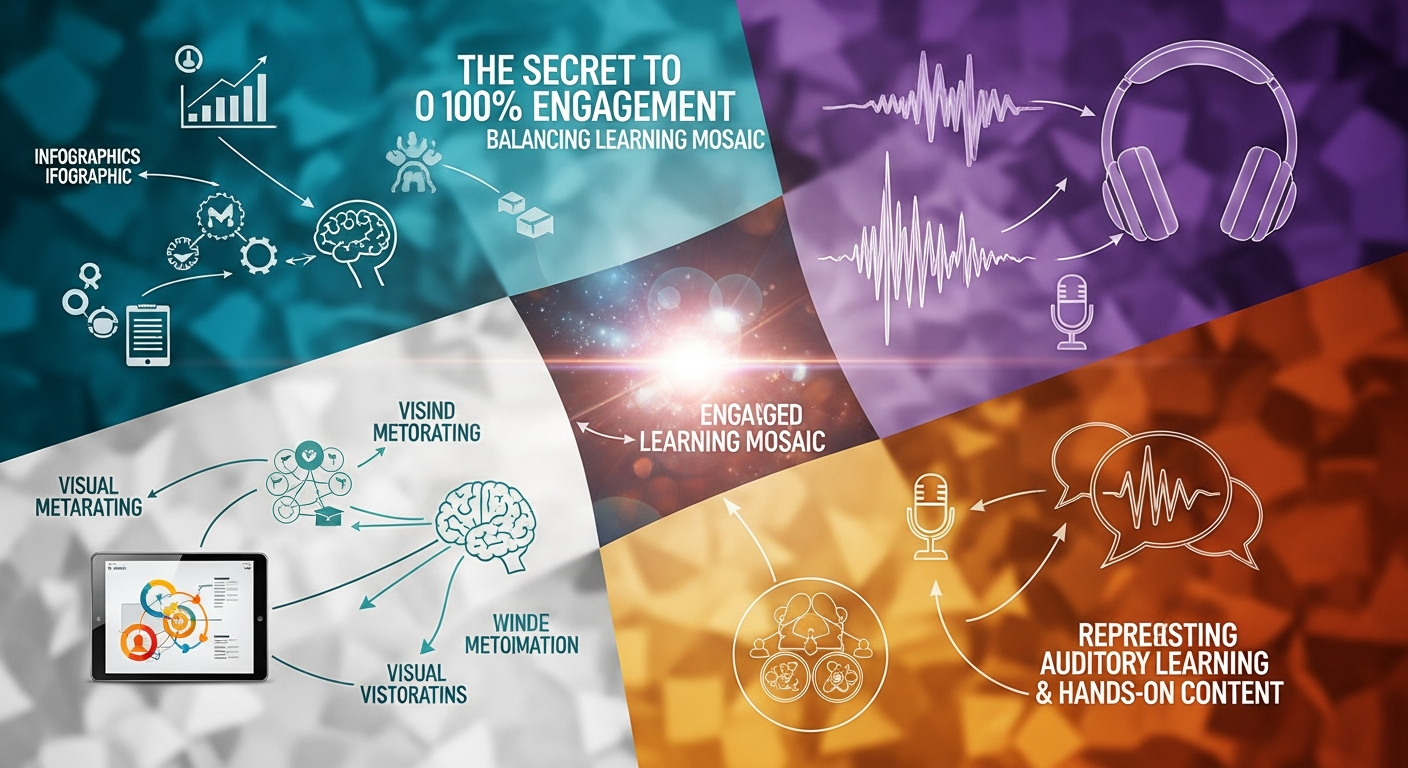
The Secret to 100% Learner Engagement: Balancing Visual, Auditory & Hands-On Content
In today’s fast-paced corporate environment, where employee upskilling and compliance training are paramount, simply delivering content is no longer enough. For Vice Presidents, Directors, Senior Managers, and Managers of L&D, the ultimate goal is not just completion rates, but genuine, transformative learner engagement. This engagement translates directly into improved performance, reduced risk, and sustained business growth across diverse sectors like Sales, Banking, Healthcare, and Oil and Gas.
The challenge? Every learner is unique. A one-size-fits-all approach often leads to disinterest, poor retention, and wasted training investments. The secret to achieving near 100% learner engagement lies in understanding and strategically balancing the three primary learning modalities: visual, auditory, and kinesthetic (hands-on) content. By catering to these varied preferences, organizations can create a truly inclusive and effective learning experience.
Understanding the Pillars of Learning: Visual, Auditory, and Kinesthetic
To craft highly engaging learning content, we must first appreciate how different individuals process information:
Visual Learners: Seeing is Believing
- These individuals best absorb information through sight. They respond well to diagrams, charts, infographics, videos, presentations, and written materials.
- For industries like Pharma and Finance, complex data and processes can be simplified and understood more clearly when presented visually.
- Visual aids help in Risk-focused Training by illustrating potential outcomes and compliance requirements clearly.
Auditory Learners: The Power of Sound
- Auditory learners thrive when information is heard. Podcasts, lectures, discussions, audio explanations, and verbal instructions are their preferred methods.
- In fields like Sales and Hospitality, where communication is key, listening to role-play scenarios or expert interviews can significantly enhance learning.
- The narrative structure often used in a Gamified LMS can be particularly engaging for auditory learners when presented with voiceovers and sound effects.
Kinesthetic (Hands-On) Learners: Learning by Doing
- Kinesthetic learners learn best through active participation, experience, and practical application. This includes simulations, role-playing, interactive exercises, hands-on labs, and real-world projects.
- For sectors like Mining and Healthcare, practical simulations are indispensable for mastering safety protocols and critical procedures.
- A modern Microlearning LMS can deliver bite-sized, interactive modules that cater directly to this need for practical application without overwhelming the learner.
The Synergy of Blended Learning: Maximizing Impact
The real magic happens when these modalities are not treated in isolation but are skillfully blended. A truly effective learning content management system integrates elements that appeal to all three styles, creating a rich, multi-sensory experience.
- Compliance Training: Imagine a compliance module for Banking. It could start with an engaging video (visual) explaining new regulations, followed by an audio interview with a legal expert (auditory), and conclude with an interactive scenario where learners must apply the rules to real-life transactions (hands-on).
- Sales Training: A AI Powered Authoring Tool can help create dynamic sales training content featuring product demonstration videos (visual), simulated customer calls (auditory), and practice pitch exercises with immediate feedback (hands-on).
- Healthcare Protocols: For critical healthcare procedures, detailed anatomical diagrams and video demonstrations (visual) combined with verbal instructions from a virtual mentor (auditory) and interactive simulations on a digital platform (hands-on) provide comprehensive learning.
This blended approach ensures that information is not just consumed but truly understood, internalized, and retained, leading to higher rates of knowledge transfer and application on the job.
Leveraging Technology for Multi-Modal Engagement
Modern eLearning solutions, particularly advanced learning management solutions, are instrumental in achieving this balance. An effective LMS provides the framework to deliver diverse content types seamlessly.
A sophisticated Adaptive Learning platform, for instance, can dynamically adjust the presentation of content based on a learner's identified preference or performance. If a learner struggles with a text-heavy module, the system can automatically suggest a video or an interactive exercise covering the same topic. This personalized journey significantly boosts engagement and effectiveness.
The right learning management system facilitates the creation, deployment, and tracking of all these content types. Features within an enterprise learning management system allow L&D teams to:
- Host high-quality video and audio content.
- Integrate interactive simulations and virtual reality (VR) experiences.
- Provide rich text documents, infographics, and interactive quizzes.
- Track learner progress across all modalities, offering insights into what works best for different groups.
An advanced cloud based learning management system, such as MaxLearn LMS, empowers L&D professionals to manage a vast library of content, ensuring accessibility and relevance across global teams. This robust learning management software becomes the central hub for all training initiatives, whether for Retail compliance or Oil and Gas safety.
AI-Driven Insights for Enhanced Engagement
The advent of artificial intelligence (AI) has revolutionized how L&D leaders can approach learner engagement. AI doesn't just deliver content; it learns from interactions, predicts preferences, and optimizes the learning journey.
Consider these strategic questions that AI helps address:
- Optimizing User Experience: How can intelligent algorithms analyze individual learner behavior to dynamically tailor the delivery of visual, auditory, and hands-on content? AI can identify if a learner consistently performs better after watching a video versus reading text, and then prioritize video content for them in future modules.
- Understanding Global Preferences: What insights can AI provide regarding cultural nuances and regional learning preferences across different global offices or demographics? For multinational corporations in Hospitality or Pharma, AI can pinpoint optimal content formats for diverse geographical segments, ensuring higher relevance and engagement regardless of location.
- Holistic Learning Optimization: How can AI synthesize data from all engagement points – from completion rates and quiz scores to interaction patterns and feedback – to provide a comprehensive view of learning effectiveness? This allows L&D leaders to make data-driven decisions, fine-tuning content strategies to maximize the overall return on learning investment across the entire organization.
An AI Powered Authoring Tool, often part of a comprehensive learning content management system (LCMS), takes this a step further by assisting in the creation of adaptive content, suggesting optimal media types, and even helping to generate interactive elements based on identified learning gaps. This transforms the traditional role of a learning management system into a truly intelligent partner in talent development.
Practical Strategies for L&D Leaders
For L&D VPs, Directors, and Managers, integrating this multi-modal strategy with a powerful lms learning management system means:
- Content Audits: Regularly review existing training materials to identify gaps in catering to all three learning styles.
- Diversity in Design: Mandate instructional designers to incorporate a mix of visual, auditory, and hands-on elements in every module, from onboarding to specialized skill training.
- Leverage Technology: Invest in a modern MaxLearn LMS that supports diverse media types, offers Adaptive Learning capabilities, and ideally, includes an AI Powered Authoring Tool.
- Feedback Loops: Implement mechanisms within your learning management software to gather learner feedback on content formats, using this data to continuously refine your approach.
- Promote Interaction: Beyond passive consumption, foster environments for discussion, collaboration, and practical application, even within digital learning spaces.
Conclusion
Achieving 100% learner engagement is not an elusive dream; it's a strategic imperative rooted in understanding and responding to human learning diversity. By consciously balancing visual, auditory, and hands-on content, powered by a robust learning management system and augmented by AI, L&D leaders can transform their training programs. This comprehensive approach ensures that every employee, whether in Compliance, Retail, or Oil and Gas, feels seen, heard, and actively involved, leading to a highly skilled, engaged, and productive workforce ready to meet tomorrow's challenges.
.jpg)


