

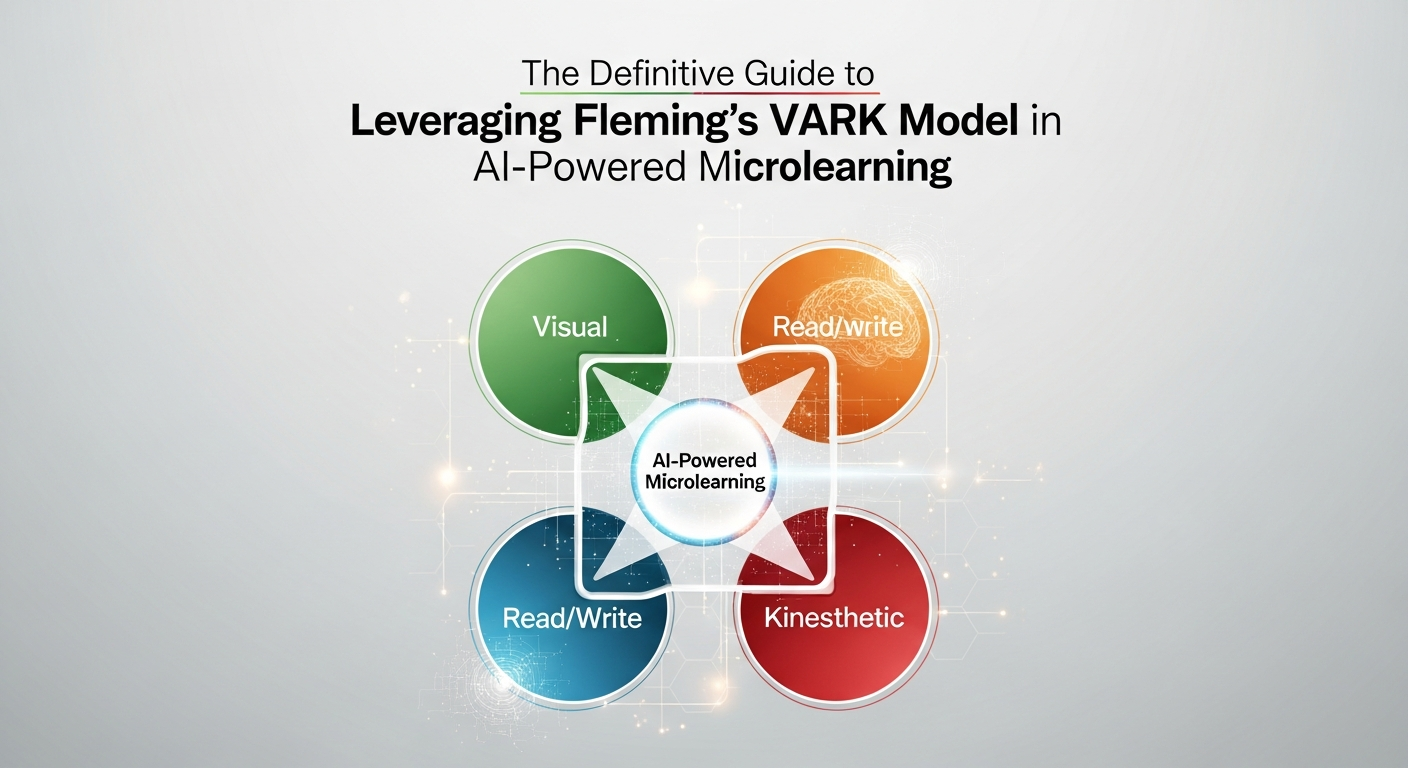
The Definitive Guide to Leveraging Fleming's VARK Model in AI-Powered Microlearning
In today’s fast-paced corporate environment, the efficacy of learning and development programs is paramount for maintaining a competitive edge. L&D leaders, from VPs to senior managers, are constantly seeking innovative strategies to enhance knowledge retention, boost performance, and ensure compliance across diverse workforces. The convergence of Fleming's VARK learning model with advanced AI-powered microlearning represents a transformative approach, promising unparalleled personalization and impact. This guide will explore how integrating these powerful methodologies can revolutionize your training initiatives.
Understanding Fleming's VARK Model
Neil Fleming’s VARK model is a widely recognized framework that categorizes individual learning preferences into four distinct types:
- Visual (V): Learners who best grasp information through seeing. This includes charts, graphs, diagrams, videos, and visually appealing presentations.
- Aural (A): Individuals who prefer to learn by hearing. They benefit from lectures, discussions, podcasts, audiobooks, and verbal instructions.
- Read/Write (R): These learners excel through textual input and output. They prefer reading manuals, reports, textbooks, taking notes, and writing summaries.
- Kinesthetic (K): Learning by doing is the hallmark of kinesthetic learners. They thrive with hands-on activities, simulations, role-playing, practical exercises, and real-world applications.
Recognizing these preferences is not about rigidly categorizing individuals but understanding the diverse ways people process and retain information. In a traditional learning management system, accommodating all styles can be challenging. However, when combined with intelligent technology, the potential for personalized learning skyrockets.
The Rise of AI-Powered Microlearning
Microlearning delivers bite-sized, focused content designed to address specific learning objectives quickly and efficiently. Its short format makes it highly adaptable to busy schedules and ideal for just-in-time learning. The integration of artificial intelligence elevates microlearning from merely efficient to profoundly effective.
AI in microlearning enables:
- Personalization: AI algorithms can analyze learner data (performance, engagement, declared preferences) to deliver content that matches individual needs and paces.
- Adaptive Pathways: Learning paths can dynamically adjust based on a learner's progress, strengths, and weaknesses, ensuring they receive the most relevant content at the optimal time.
- Intelligent Content Curation: AI can identify and recommend relevant learning assets from a vast library, ensuring learners always have access to the information they need.
- Enhanced Engagement: By tailoring content and delivery, AI makes learning more engaging and relevant, significantly improving completion rates and knowledge retention within any LMS.
Integrating VARK with AI Microlearning: A Strategic Imperative
The synergy between VARK and AI-powered microlearning is where true transformation occurs. An intelligent Microlearning LMS can serve as the engine for this integrated approach. Here’s how L&D leaders can leverage this powerful combination:
- Automated Learner Profiling: AI can go beyond simple self-assessments. By analyzing interaction patterns within the learning management software, AI can implicitly infer a learner's dominant VARK style, even if they haven't explicitly stated it. For example, a learner who frequently re-watches video tutorials might lean Visual, while one who spends more time in interactive simulations might be Kinesthetic.
- Dynamic Content Delivery: Once a VARK profile is established, AI can dynamically deliver content modules in the learner's preferred format.
- For Visual learners: Short animated videos, infographics, interactive flowcharts, and clear visual summaries.
- For Aural learners: Brief podcasts, audio summaries, expert interviews, or concise verbal explanations.
- For Read/Write learners: Key bullet points, short articles, summaries of policies, and quick quizzes that require written responses.
- For Kinesthetic learners: Mini-simulations, interactive exercises, gamified scenarios, decision-tree challenges, and virtual role-playing.
- Personalized Feedback and Reinforcement: AI can provide feedback tailored to the learner's style. Visual learners might see progress bars and charts, while Read/Write learners get detailed textual explanations for incorrect answers.
- Adaptive Learning Paths: The system, acting as an enterprise learning management solution, can automatically adjust the sequence and type of microlearning modules based on VARK preferences and performance, ensuring optimal engagement and understanding. This is the essence of Adaptive Learning.
Practical Applications Across Industries
The benefits of this integrated approach resonate across various sectors:
- Compliance (Banking, Finance, Healthcare, Pharma): For complex regulations and procedures, an lms learning management system can deliver Risk-focused Training in multiple formats. Visual learners might get infographics on KYC processes, Aural learners might listen to short audio clips explaining GDPR, Read/Write learners would review policy summaries, and Kinesthetic learners could engage in interactive scenario-based modules on ethical decision-making.
- Sales (Retail, Automotive, B2B): Training on new product features or sales techniques can be highly personalized. Visual learners excel with product demo videos, Aural learners benefit from sales script read-throughs, Read/Write learners devour competitive analysis documents, and Kinesthetic learners thrive with virtual sales call simulations or interactive product configurators.
- Hospitality: For customer service or operational protocols, an LCMS can deliver training. Visual learners get pictorial guides for room setup, Aural learners hear audio instructions for guest check-in, Read/Write learners review SOPs, and Kinesthetic learners practice role-playing difficult customer interactions.
- Oil and Gas / Mining: Safety training and equipment operation demand precise learning. Visual learners can watch animated safety procedures, Aural learners listen to hazard warnings, Read/Write learners study safety manuals, and Kinesthetic learners use virtual reality simulations for equipment operation or emergency response.
Benefits for L&D Leaders
Implementing VARK-informed, AI-powered microlearning with a robust cloud based learning management system offers significant advantages:
- Increased Engagement & Completion: Tailored content keeps learners more interested and motivated.
- Improved Knowledge Retention: Learning in preferred styles leads to deeper understanding and better recall.
- Enhanced Performance & Compliance: A well-informed workforce operates more efficiently and adheres to necessary standards.
- Data-Driven Insights: The AI in your learning management solutions provides rich analytics on learning preferences, content effectiveness, and individual progress, enabling continuous optimization of L&D strategies.
- Scalability: Deliver personalized training to thousands of employees across diverse locations without manual intervention.
- Cost-Efficiency: Reduce the need for diverse training material creation for every style by having an AI Powered Authoring Tool that adapts content.
Implementing Your VARK-AI Strategy
For L&D departments looking to adopt this cutting-edge approach, consider these steps:
- Assess Current Content: Audit existing microlearning content for its suitability across VARK styles.
- Invest in the Right Platform: Choose a learning management system that supports AI integration, adaptive pathways, and offers features like a Gamified LMS to further boost engagement.
- Utilize AI Authoring Tools: Leverage an AI Powered Authoring Tool to convert existing content or generate new modules in multiple formats, catering to different VARK preferences more efficiently.
- Pilot Programs: Start with a pilot group to gather feedback and refine your strategy before a wider rollout.
- Monitor and Optimize: Continuously analyze the data provided by your MaxLearn LMS to fine-tune content delivery and learning paths.
Addressing Key Questions
As L&D leaders explore these advanced methodologies, several questions naturally arise:
Question: How can personalized learning enhance the performance of a geographically dispersed team?
Answer: By understanding the unique learning needs and preferences of each individual, regardless of their location, an AI-powered microlearning system ensures that every team member receives content in a format they best understand. This approach transcends geographical boundaries, offering equitable access to highly relevant and effective training, ultimately boosting global team cohesion and performance by standardizing understanding while personalizing delivery. It’s about meeting each learner where they are, with the content they need, delivered how they learn best.
Question: What is the most effective way to measure the impact of an Adaptive Learning path on employee skill development?
Answer: Effective measurement involves a multi-faceted approach. Beyond traditional completion rates and quiz scores, advanced analytics within an intelligent learning content management system can track engagement levels, time spent on different content types, and progression through skills matrices. Correlate these learning metrics with real-world performance indicators such as productivity improvements, reduced errors, faster task completion, and achievement of business objectives. Pre- and post-training assessments, peer feedback, and manager evaluations also provide qualitative and quantitative data to demonstrate skill growth directly attributable to the personalized learning journey.
Question: Can sophisticated algorithms truly understand the nuanced learning preferences of individual employees?
Answer: While algorithms don't possess human intuition, their capacity for data analysis allows them to identify patterns and make highly accurate inferences about individual learning preferences. By processing vast amounts of interaction data – such as content consumption habits, response times, preferred media types, and performance on different module formats – these algorithms can build dynamic learner profiles. They can then cross-reference these profiles with established models like VARK to intelligently recommend or deliver content that aligns with an individual’s most effective learning modalities, constantly refining their understanding through ongoing interaction and feedback loops. This makes the learning experience feel remarkably intuitive and personalized to the user.
The Future of Learning is Personalized and Intelligent
The convergence of VARK and AI-powered microlearning marks a pivotal moment in corporate L&D. It moves us beyond one-size-fits-all training to a truly learner-centric model, where every employee's unique needs are met with precision and intelligence. For L&D leaders striving to build a highly skilled, adaptable, and compliant workforce, embracing this definitive guide is not just an option—it's a strategic imperative.
Explore how an advanced MaxLearn LMS can empower your organization to implement these transformative strategies and achieve unparalleled learning outcomes.
.jpg)


