

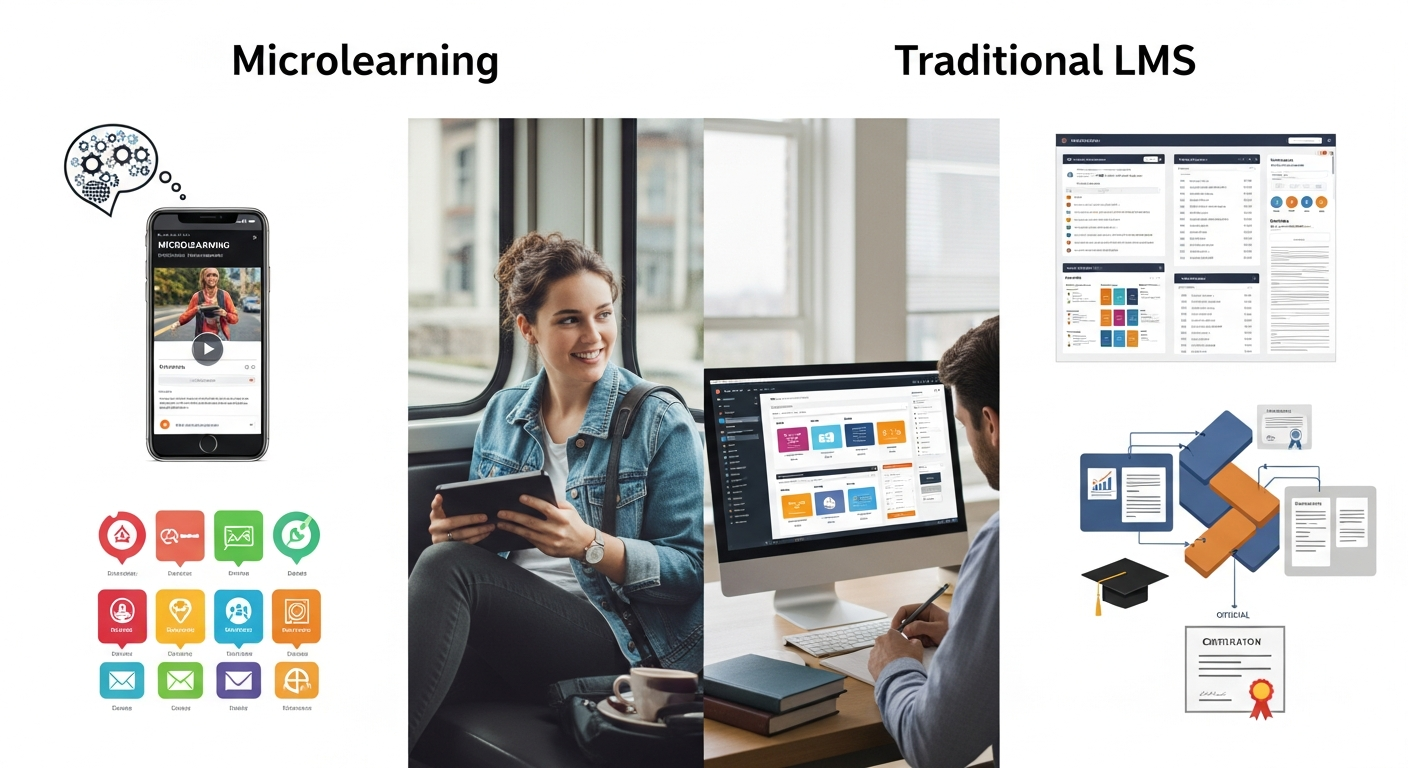
The Best of Both Worlds: Why You Shouldn’t Have to Choose Between Microlearning and a Traditional LMS
In the dynamic landscape of corporate training and development, L&D leaders often find themselves at a crossroads. The perennial debate pits the agility and engagement of microlearning against the robust structure and comprehensive coverage of a traditional LMS. For Vice Presidents, Directors, and Senior Managers of L&D, this isn't merely a theoretical discussion; it's a strategic imperative with significant implications for skill development, compliance, and overall business performance.
The good news? The choice isn't an 'either/or' proposition. Forward-thinking organizations are realizing that the most effective learning management solutions don't force a compromise. Instead, they embrace a powerful synergy, leveraging the strengths of both methodologies to create a comprehensive, engaging, and highly effective enterprise learning management ecosystem. Imagine a system where foundational knowledge is meticulously built, and ongoing skill reinforcement is delivered with precision, all within a unified platform. This is the promise of integrating Microlearning LMS capabilities with a traditional learning management system.
The Rise of Microlearning: Agility in a Fast-Paced World
The modern workforce operates at an accelerated pace. Information overload is rampant, and attention spans are shrinking. In this environment, microlearning has emerged as a game-changer. Defined by its brevity, focus, and on-demand accessibility, microlearning delivers learning content in bite-sized modules – typically 2-10 minutes long – addressing specific learning objectives. This approach aligns perfectly with the need for just-in-time learning, allowing employees to acquire new skills or refresh existing ones without disrupting their workflow significantly.
The benefits are compelling:
- Enhanced Engagement: Shorter modules are less daunting and more likely to be completed, boosting learner motivation.
- Improved Retention: Focused content delivered in spaced repetition aids long-term memory consolidation.
- Flexibility and Accessibility: Learners can access content anytime, anywhere, on any device, making it ideal for mobile workforces in industries like Sales, Healthcare, and Hospitality.
- Reduced Cognitive Load: Breaking down complex topics into digestible chunks prevents overwhelm.
- Faster Content Creation: Developing smaller modules can be quicker than lengthy courses, allowing for rapid deployment of critical updates.
For organizations dealing with rapidly evolving regulations in Compliance or new product rollouts in Banking and Pharma, a Microlearning LMS can be incredibly agile, delivering precise information exactly when it’s needed.
The Enduring Value of the Traditional LMS
Despite the buzz around microlearning, the traditional learning management system remains the backbone of corporate education for good reason. A robust LMS provides a centralized hub for all learning activities, offering features essential for comprehensive training programs, especially in highly regulated sectors like Finance, Oil and Gas, and Mining.
Key strengths of a traditional learning content management system include:
- Comprehensive Course Management: Handling extensive courses, certifications, and multi-part programs.
- Robust Tracking and Reporting: Indispensable for compliance training, demonstrating completion rates, assessment scores, and audit trails.
- Scalability: Managing thousands of learners and vast libraries of content across global operations.
- Structured Learning Paths: Guiding employees through complex career development or onboarding programs.
- Centralized Record-Keeping: Maintaining a complete history of all learning activities, crucial for talent management and regulatory adherence.
For foundational knowledge, in-depth technical skills, or formal accreditations, a traditional learning management software provides the necessary structure, oversight, and administrative power.
The False Dichotomy: Why Choose?
The question isn't whether microlearning is better than a traditional LMS, but rather how they can best complement each other. Leading L&D professionals understand that a holistic strategy incorporates the best of both worlds. The idea of a standalone microlearning platform separate from a robust learning management system often leads to fragmented learning experiences, inconsistent tracking, and administrative headaches.
Consider this: How can intelligent systems bridge traditional and microlearning methodologies effectively?
The answer lies in integrating these two powerful approaches within a single, intelligent cloud based learning management system. This fusion creates a learning ecosystem that supports diverse learning styles, caters to varying knowledge depths, and meets the intricate demands of modern organizations. It allows for the strengths of one approach to compensate for the limitations of the other, resulting in a more resilient and adaptable training infrastructure.
Synergy in Action: A Hybrid Approach
Strategic Integration for Optimal Impact
Imagine a scenario where a new employee onboarding program uses the traditional LMS for comprehensive foundational modules on company culture, policies, and core product knowledge. Simultaneously, Microlearning LMS modules are deployed for quick refreshers on specific software tools, compliance updates, or immediate responses to frequently asked questions. In industries like Retail or Sales, this blended approach ensures both deep understanding and readily accessible, practical guidance.
- Foundational Learning: Use the traditional learning management system for in-depth compliance courses, leadership development, or complex technical training.
- Reinforcement & Skill Refresh: Deploy microlearning modules to reinforce key concepts, provide just-in-time support, or introduce quick updates.
- Performance Support: Integrate microlearning as job aids or quick guides accessible during tasks, especially beneficial in healthcare for procedural steps or in manufacturing for safety protocols.
Leveraging Technology for a Seamless Experience
The true power of this integration is unlocked through advanced technology. A modern learning management system (often referred to as an LCMS for its content management capabilities) facilitates this seamless blend:
- Personalization through Adaptive Learning: Advanced algorithms can analyze learner performance within comprehensive courses and then recommend specific microlearning modules to address knowledge gaps or reinforce difficult concepts. This intelligent tailoring ensures every learner gets precisely what they need.
- Engagement with a Gamified LMS: Elements like points, badges, leaderboards, and challenges can be applied across both traditional courses and microlearning paths, significantly boosting motivation and completion rates. This is especially effective for sustained engagement in long-term development programs.
- Efficient Content Creation with an AI Powered Authoring Tool: Developing diverse content for both formats becomes streamlined. Artificial intelligence can assist in quickly converting lengthy content into concise microlearning nuggets, suggesting optimal structures, and even generating initial drafts, accelerating time-to-market for training initiatives.
- Targeted Compliance and Risk-focused Training: For industries like Banking, Insurance, or Pharma, traditional modules handle complex regulatory frameworks, while microlearning can address immediate policy updates or specific risk mitigation strategies, ensuring continuous compliance.
What impact does intelligent content delivery have on corporate training ROI?
By leveraging intelligent systems for blended learning, organizations can significantly improve their return on investment. Increased engagement leads to higher completion rates and better skill acquisition. Adaptive paths reduce redundant training, saving time and resources. Furthermore, the ability to rapidly deploy updated content through microlearning ensures that the workforce always has access to the most current information, critical for operational efficiency and competitive advantage.
Benefits for L&D Leaders
For L&D VPs, Directors, and Managers, this integrated approach translates into tangible benefits:
- Optimal ROI: Maximizing training effectiveness and minimizing costs by using the right modality for the right learning objective.
- Enhanced Learner Experience: Providing varied, engaging, and flexible learning options that cater to diverse needs and preferences.
- Improved Skill Acquisition & Retention: A holistic approach leads to deeper understanding and longer-lasting knowledge.
- Better Compliance & Risk Management: Ensuring that all employees are up-to-date on critical information, especially in high-stakes environments.
- Future-Proofing Training: Building an agile learning infrastructure capable of adapting to future business demands and technological advancements.
Solutions like MaxLearn LMS exemplify this unified vision, offering a comprehensive lms learning management system that seamlessly integrates microlearning with traditional learning paths, all powered by advanced features.
Real-World Application Across Industries
- Compliance: Traditional LMS for annual regulatory training; microlearning for quarterly updates on specific policies or legal changes.
- Sales: Traditional courses for foundational sales methodologies; microlearning for new product features, objection handling tips, or quick pitch refreshers.
- Healthcare: Traditional for medical certifications and patient safety protocols; microlearning for quick reference on drug dosages, equipment operation, or infection control reminders.
- Hospitality: Traditional for customer service standards and management training; microlearning for specific menu changes, guest relations tips, or seasonal promotions.
Which emerging technologies enhance blended learning strategies for global workforces?
Beyond adaptive learning and AI-powered authoring tools, technologies like virtual reality (VR) for immersive simulations, augmented reality (AR) for on-the-job guidance, and sophisticated analytics for predictive learning insights are rapidly advancing. These innovations, when integrated into a robust learning management system, promise even more dynamic and effective blended learning experiences, particularly for geographically dispersed teams requiring consistent, high-quality training.
Conclusion
The era of choosing between microlearning and a traditional LMS is over. The most forward-thinking L&D organizations are embracing a synergistic approach, leveraging the strengths of both to create a truly comprehensive, engaging, and effective learning ecosystem. By integrating the depth and structure of a traditional learning management system with the agility and engagement of microlearning, leaders can future-proof their training strategies, ensure compliance, empower their workforce, and ultimately drive greater business success. It’s not about either/or; it’s about having the best of both worlds.
.jpg)


