

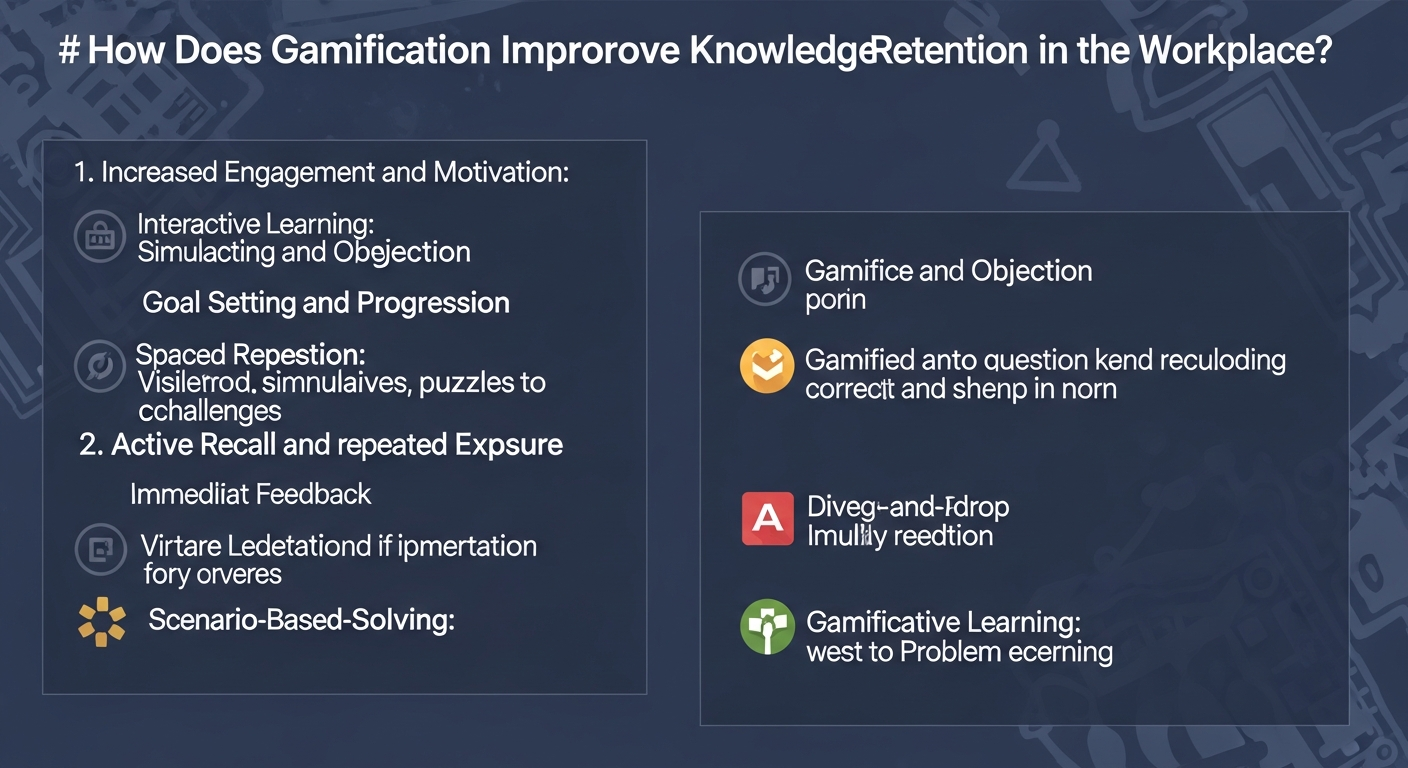
How Gamification Drives Unprecedented Knowledge Retention in the Workplace
In today's fast-paced business environment, the ability of employees to absorb, retain, and apply critical knowledge is paramount for organizational success. For Vice Presidents, Directors, and Managers of Learning & Development (L&D), the challenge of combating the "forgetting curve" and ensuring effective skill transfer is a constant priority. Traditional training methods, while foundational, often struggle to maintain engagement and solidify long-term memory. This is where gamification emerges as a powerful, transformative strategy, revolutionizing how organizations approach knowledge retention across diverse sectors like Compliance, Sales, Banking, Finance, Insurance, Retail, Pharma, Health care, Hospitality, Oil and Gas, and Mining.
Imagine a learning experience where employees are not just passively consuming information but actively participating, competing, and collaborating, all while mastering essential skills. This is the promise of gamification: turning learning into an engaging, rewarding journey that significantly boosts recall and application. But how exactly does this play out, and what tangible benefits does it offer your enterprise learning management strategy?
Understanding the Knowledge Retention Challenge
The human brain is wired to forget. Studies show that a significant portion of newly acquired information is lost within hours or days if not reinforced. This presents a considerable hurdle for L&D professionals investing heavily in training programs. Whether it's complex compliance regulations, new sales methodologies, intricate financial products, or critical safety protocols, ensuring that this knowledge sticks is crucial. Without effective retention, training investments yield diminishing returns, leading to knowledge gaps, decreased productivity, and increased operational risks.
Many traditional learning management system (LMS) approaches often rely on lengthy modules and end-of-course assessments that fail to provide continuous engagement or opportunities for practical application. This highlights the need for a more dynamic and interactive learning content management system (LCMS) that can keep learners actively involved and reinforce knowledge over time.
What is Gamification in L&D?
Gamification in L&D is the strategic application of game-design elements and game principles in non-game contexts, specifically within learning and training programs. It's not about turning work into a game, but rather leveraging the psychological triggers that make games so compelling to enhance the learning experience. This involves integrating elements such as:
- Points and Rewards: Earning points for completing tasks, answering questions, or mastering skills, which can then be exchanged for virtual or real-world rewards.
- Badges and Achievements: Visual representations of accomplishment that acknowledge progress and mastery.
- Leaderboards: Fostering healthy competition by displaying top performers, encouraging learners to strive for excellence.
- Levels and Progress Bars: Giving learners a clear sense of advancement and accomplishment as they move through content.
- Narratives and Storytelling: Embedding learning within a compelling story or scenario, making it more relatable and memorable.
- Challenges and Quests: Presenting learning objectives as missions to be completed, often with increasing difficulty.
Implementing a Gamified LMS transforms passive learning into an interactive adventure, making the learning journey enjoyable and impactful.
The Psychology Behind Gamification and Retention
The effectiveness of gamification in knowledge retention is rooted deeply in psychological principles that drive human motivation and learning.
Engagement and Motivation
Gamification taps into intrinsic motivation by making learning inherently more interesting and fun. The anticipation of rewards, the thrill of competition, and the satisfaction of achievement keep learners actively engaged, moving beyond mere compliance to genuine enthusiasm. This sustained engagement is vital for processing and encoding information into long-term memory.
Active Learning and Practice
Unlike passive reading or listening, gamified learning often requires active participation—making choices, solving problems, and applying concepts. This active recall and repeated practice, often facilitated by a Microlearning LMS that delivers content in bite-sized chunks, strengthens neural pathways and reinforces knowledge. It transforms abstract information into practical skills through simulated scenarios and challenges.
Feedback and Progress Tracking
Immediate and constructive feedback is a cornerstone of effective learning. Gamified systems provide instant feedback on performance, allowing learners to understand their mistakes and correct them promptly. Visible progress bars, level-ups, and badges offer clear indicators of advancement, boosting confidence and maintaining momentum, which is critical for continuous improvement within an enterprise learning management framework.
Competition and Collaboration
Gamification can foster both healthy competition and collaborative learning. Leaderboards ignite a competitive spirit, prompting individuals to improve. Conversely, team-based challenges encourage learners to work together, share knowledge, and collectively solve problems, enhancing social learning and reinforcing understanding through peer interaction.
Emotional Connection
When learning is enjoyable, exciting, or even slightly challenging, it creates a positive emotional connection. Emotions play a significant role in memory formation. Gamified experiences evoke feelings of curiosity, satisfaction, and sometimes even playful frustration, all of which contribute to a more memorable and effective learning experience, making complex topics stick.
Key Benefits for Knowledge Retention
For L&D leaders, the practical benefits of integrating gamification into their learning management software solutions are profound:
- Increased Engagement: Learners are more likely to complete training modules and actively participate when gamified elements are present, leading to higher completion rates.
- Enhanced Recall: Through repeated, interactive exposure and active application, information is transferred from short-term to long-term memory more effectively.
- Improved Application: Gamified simulations and scenarios allow employees to practice skills in a safe environment, translating theoretical knowledge into practical competence.
- Faster Skill Development: The immediate feedback loops and continuous reinforcement accelerate the learning process, leading to quicker mastery of new skills.
- Data-Driven Insights: A robust cloud based learning management system with gamification capabilities provides granular data on learner performance, engagement, and areas of difficulty, enabling L&D teams to refine content and strategies.
Gamification in Action: Industry-Specific Examples
Gamification proves invaluable across a spectrum of industries by making complex or dry topics engaging and memorable:
- Compliance: Transforming mandatory, often tedious, regulatory training into interactive quizzes, scenario-based challenges, and ethical dilemmas, ensuring critical rules for Risk-focused Training are understood and retained.
- Sales: Boosting product knowledge, objection handling, and pitching skills through sales battle simulations, leaderboards for top performers, and badge rewards for closing deals.
- Banking/Finance/Insurance: Simplifying complex financial products, new policies, and fraud detection protocols with interactive case studies and decision-making games.
- Healthcare/Pharma: Training medical professionals on new procedures, drug information, and patient communication via virtual simulations and diagnostic challenges.
- Retail/Hospitality: Enhancing customer service skills, operational procedures, and brand knowledge through role-playing games, scavenger hunts for product location, and loyalty programs for learning achievements.
Leveraging Technology for Gamified Learning
The success of gamification heavily relies on the underlying technology. A modern Gamified LMS provides the infrastructure to create, deliver, and manage these engaging experiences. Such a platform acts as a central hub, offering tools for points, badges, leaderboards, and progress tracking, all while delivering content seamlessly. When combined with a Microlearning LMS, it ensures that learning is delivered in manageable, focused bursts that are perfect for gamified challenges.
Advanced learning management solutions also incorporate features like Adaptive Learning, which tailors the learning path based on an individual's performance and preferences. This personalization further enhances engagement and ensures that each learner receives the most relevant and effective content, maximizing knowledge retention. The synergy between a robust LMS, engaging content, and gamified mechanics is key to unlocking peak learning potential.
The Future is Intelligent: AI's Role in Gamification
As L&D continues to evolve, the integration of artificial intelligence (AI) promises to elevate gamification to unprecedented levels, making learning even more personalized and effective.
How can smart systems personalize gamified learning experiences?
Artificial intelligence analyzes vast amounts of learner data, including performance, preferences, and progress. This allows a sophisticated learning management system to dynamically adjust gamified challenges, recommend specific content based on identified knowledge gaps, and even tailor the narrative of a learning game to resonate more deeply with individual learners. This level of customization, often powered by an AI Powered Authoring Tool, ensures that each employee receives an optimal, engaging, and highly relevant learning path, driving superior retention.
What impact does automated assessment have on real-time feedback in gamified training?
Intelligent automation provides immediate, contextual feedback that is crucial for effective learning within a gamified environment. Instead of generic responses, AI can analyze a learner's actions or answers within a game scenario and provide precise guidance, offer hints, or explain the underlying concepts instantly. This real-time, personalized feedback loop accelerates learning, corrects misunderstandings quickly, and keeps learners motivated to progress through challenges.
Can data-driven insights enhance the relevance of gamified content for specific job roles?
Absolutely. Smart algorithms excel at identifying patterns and correlating learning outcomes with job performance. By leveraging data from an enterprise learning management system, AI can ensure that gamified content directly addresses the specific skills and knowledge required for various roles, especially in critical areas like Risk-focused Training. This precision means that the challenges, scenarios, and rewards within a gamified program are highly relevant and immediately applicable to an employee's daily tasks, thereby significantly enhancing practical knowledge retention and on-the-job efficacy.
Conclusion
For L&D Vice Presidents, Directors, and Managers, the evidence is clear: gamification is not just a trend; it's a strategic imperative for enhancing knowledge retention in the workplace. By tapping into human psychology, fostering engagement, and leveraging cutting-edge learning management software, organizations can transform their training programs from mundane necessities into dynamic, results-driven experiences. Embracing a comprehensive LMS with robust gamification features is key to ensuring your employees not only learn but remember and apply critical knowledge, driving business growth and fostering a culture of continuous learning and excellence.
.jpg)


