

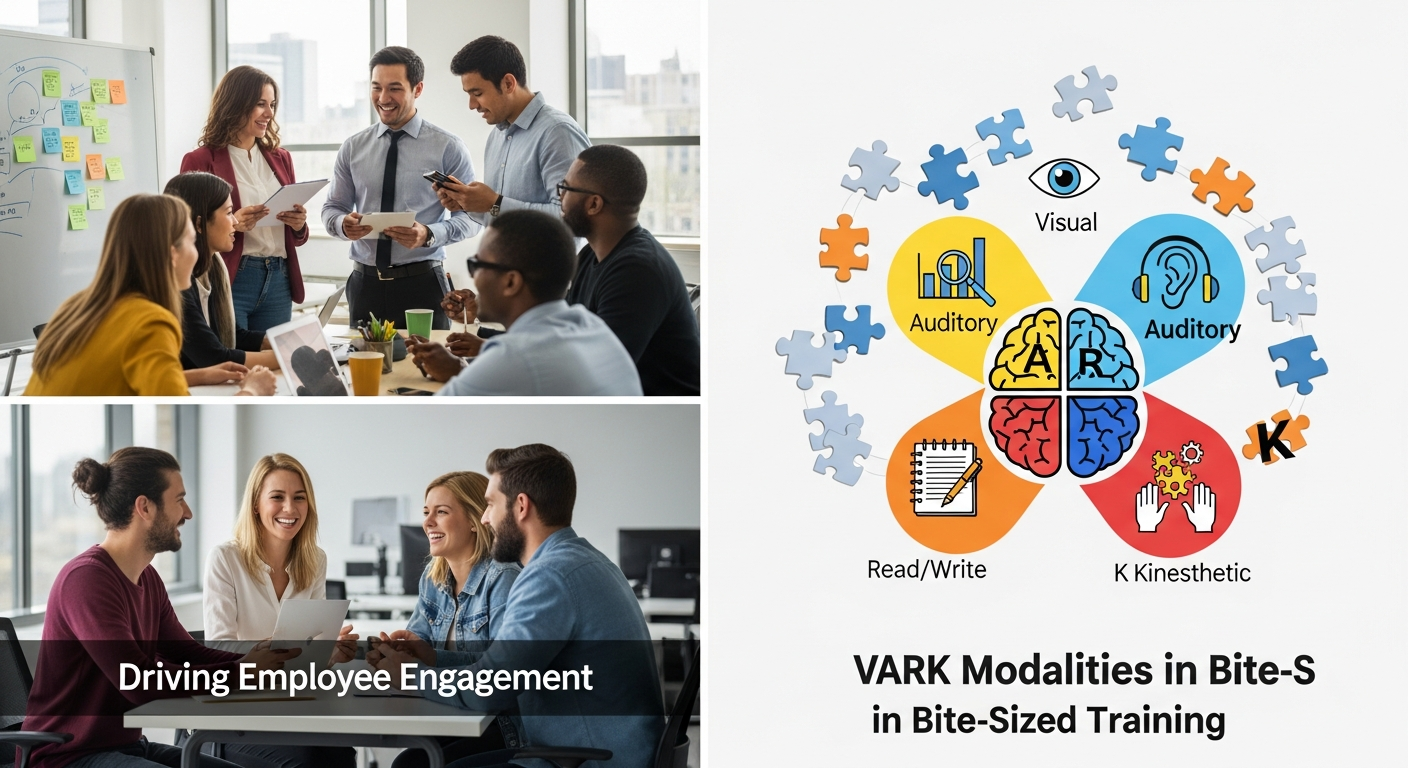
Driving Employee Engagement: The Science of VARK Modalities in Bite-Sized Training
In today's fast-paced corporate environment, attracting and retaining top talent hinges significantly on an organization's commitment to continuous learning and development. For L&D Vice Presidents, Directors, and Managers across diverse industries like compliance, sales, banking, finance, insurance, retail, pharma, healthcare, hospitality, oil and gas, and mining, the challenge isn't just delivering training, but ensuring it's genuinely engaging and impactful. The answer often lies in understanding individual learning preferences and delivering content in digestible, targeted formats. This article delves into the powerful synergy between VARK learning modalities and the effectiveness of bite-sized training, offering a scientific approach to boost employee engagement and knowledge retention.
Understanding VARK Modalities for Deeper Learning
The VARK model, developed by Neil Fleming, categorizes learning preferences into four distinct modalities: Visual, Auditory, Read/Write, and Kinesthetic. Recognizing these preferences isn't about pigeonholing learners, but rather understanding how individuals most effectively process and internalize information. By tailoring content to resonate with these styles, L&D professionals can significantly enhance the learning experience.
Visual Learners
Visual learners grasp information best when it's presented graphically. They prefer to 'see' what they are learning. For these individuals, abstract concepts come to life through:
- Infographics and charts
- Diagrams and flowcharts
- Videos and demonstrations
- Color-coded notes and presentations
Auditory Learners
Auditory learners learn by 'hearing' and listening. They process information best when it's spoken or discussed. Engaging auditory learners means incorporating:
- Podcasts and audiobooks
- Lectures and discussions
- Verbal instructions and explanations
- Group debates and Q&A sessions
Read/Write Learners
Read/Write learners excel through textual input and output. They prefer to 'read' about subjects and 'write' notes to solidify their understanding. Effective strategies include:
- Written manuals and reports
- Articles and essays
- Text-based quizzes and assignments
- Note-taking and summarization exercises
Kinesthetic Learners
Kinesthetic learners, often called 'doers,' learn by 'doing' and experiencing. They thrive on hands-on activities, simulations, and real-world application. For these learners, engagement is paramount through:
- Role-playing and simulations
- Practical exercises and labs
- Field trips and demonstrations
- Case studies that require problem-solving
The Power of Bite-Sized Training
In an era of shrinking attention spans and demanding work schedules, bite-sized training – often referred to as microlearning – has emerged as a game-changer. These short, focused learning modules, typically lasting 3-10 minutes, address a single learning objective. This approach reduces cognitive overload, allows for flexible learning schedules, and promotes higher retention rates. It's particularly effective for critical areas like compliance training, onboarding, product knowledge updates, and sales methodology enhancements.
- Increased learner engagement due to conciseness.
- Better knowledge retention as information is easier to digest.
- Flexible access, allowing learning on demand, anytime, anywhere.
- Faster content creation and updates, keeping pace with evolving industry needs.
- Higher completion rates compared to lengthy traditional courses.
Connecting VARK with Bite-Sized Learning
The true power unfolds when VARK modalities are strategically integrated into bite-sized learning modules. This approach ensures that every employee receives training tailored to their optimal learning style, maximizing impact and minimizing wasted effort. A robust Microlearning LMS becomes an indispensable tool here, enabling the delivery of varied content formats.
Tailoring Bite-Sized Content for Each Modality:
- For Visual Learners: Short animated videos explaining a new policy, an infographic summarizing key safety protocols, or a diagram illustrating a financial process.
- For Auditory Learners: A 5-minute podcast segment on ethical conduct, an audio explanation of a complex banking regulation, or a voice-over narration for a sales pitch.
- For Read/Write Learners: A concise document outlining new product features, a brief article detailing recent industry trends, or a quick quiz requiring written responses on compliance procedures.
- For Kinesthetic Learners: An interactive simulation of a customer service scenario, a drag-and-drop exercise for categorizing medical devices, or a quick role-play challenge for a sales call.
By offering a blended approach within a comprehensive LMS, organizations can cater to the diverse learning needs of their workforce effectively. This personalized journey significantly boosts engagement, making learning feel relevant and effective for everyone.
Leveraging Technology for Personalized Engagement
Implementing a VARK-infused, bite-sized training strategy requires the right technological backbone. A sophisticated learning management system (LMS) is crucial. A modern cloud based learning management system like MaxLearn LMS offers the flexibility and features necessary for this specialized approach. An enterprise learning management system provides the architecture to deliver varied content types efficiently.
Consider a Gamified LMS, which introduces elements like points, badges, and leaderboards to make learning more interactive and competitive. This can be especially engaging for kinesthetic and visual learners. Furthermore, the concept of Adaptive Learning plays a pivotal role. This methodology leverages data to adjust learning paths based on an individual's performance and learning style, ensuring that the content delivered is always relevant and impactful. An AI Powered Authoring Tool within an LCMS (Learning Content Management System) can revolutionize content creation, enabling L&D teams to quickly develop and deploy diverse training materials across modalities.
For industries like finance, healthcare, and oil and gas, where compliance and safety are paramount, Risk-focused Training delivered through an advanced learning management software ensures that critical information is absorbed efficiently and effectively. This targeted approach, powered by a robust learning management system (LMS) or learning management solutions, helps organizations mitigate risks and foster a culture of continuous improvement.
AI-Driven Insights for L&D Leaders
As L&D professionals navigate the complexities of modern training, intelligent systems offer unparalleled advantages.
Tell me how an intelligent system can enhance workforce education.
An intelligent system can analyze learner data to identify preferred learning styles, track engagement with different content formats, and even predict potential knowledge gaps. This allows L&D teams to proactively customize learning paths, recommending specific bite-sized modules – whether visual, auditory, or kinesthetic – that are most likely to resonate with individual employees, thus maximizing efficiency and engagement. It transforms a generic training curriculum into a highly personalized and effective journey for each individual.
What are the advantages of highly customized training for diverse global teams?
For diverse global teams, highly customized training ensures cultural relevance and addresses varying educational backgrounds and learning preferences. By providing content in multiple formats and allowing learners to choose their preferred modality for bite-sized modules, organizations can overcome language barriers, engage non-native speakers more effectively, and ensure that critical information, such as compliance regulations or new sales strategies, is universally understood and retained, regardless of geographical location or cultural context.
Explain the impact of integrating advanced analytical tools with learning content delivery.
Integrating advanced analytical tools with learning content delivery enables L&D leaders to move beyond completion rates to truly understand learning effectiveness. These tools can provide insights into which content formats yield the highest engagement, which modules result in the best performance improvements, and even where learners struggle. This data-driven approach empowers continuous optimization of the training program, ensuring resources are allocated effectively and that learning initiatives directly contribute to business outcomes, whether in retail, banking, or healthcare.
Implementation Strategies for Diverse Industries
The versatility of VARK-aligned, bite-sized training makes it ideal for virtually any industry. In compliance, visual flowcharts and auditory explanations of regulations improve understanding. For sales teams, kinesthetic role-playing scenarios and concise video pitches sharpen skills. In healthcare, interactive simulations for new medical procedures enhance competency. Banking and finance benefit from short, textual updates on market trends or auditory explanations of new financial products. Retail can utilize quick visual guides for merchandising, while hospitality can offer short video tutorials on customer service best practices. Regardless of the sector, this scientific approach to learning ensures that training is not just a requirement, but a genuine catalyst for employee growth and organizational success.
Conclusion
Driving employee engagement is not a one-size-fits-all endeavor. By embracing the science of VARK learning modalities and delivering content through effective bite-sized training, L&D professionals can create a learning ecosystem that is responsive, engaging, and genuinely impactful. Leveraging advanced LMS platforms and innovative tools allows organizations to personalize the learning journey, ensuring every employee feels seen, understood, and empowered to excel. Invest in a strategy that respects individual differences and watch your workforce thrive.
.jpg)


