

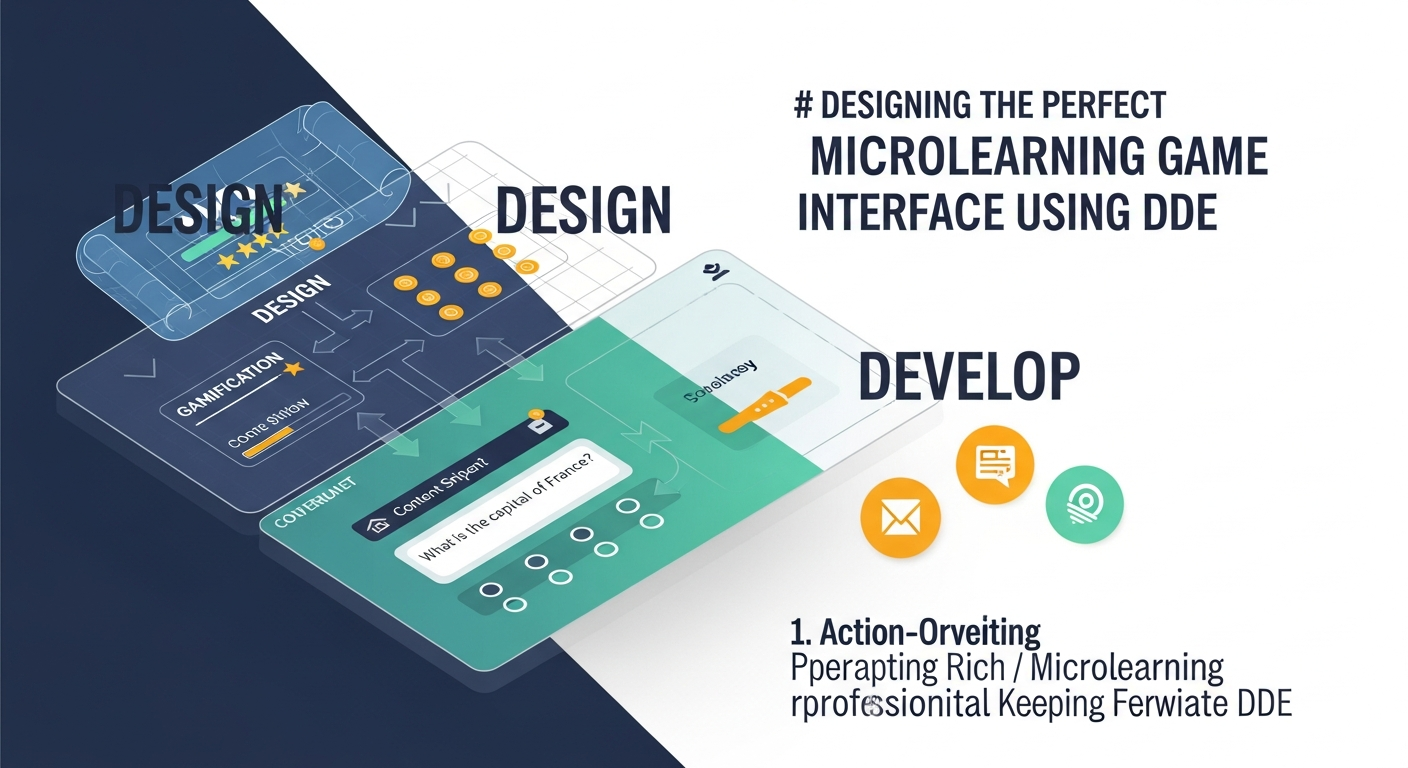
How to Design the Perfect Microlearning Game Interface Using DDE
In today's fast-paced corporate landscape, where information overload is the norm, traditional long-form training often falls short. Modern L&D leaders, from Vice Presidents to Senior Managers, are constantly seeking innovative solutions to engage employees, enhance knowledge retention, and drive measurable performance improvements. This quest frequently leads to the adoption of microlearning and gamification. But how do you create a truly effective microlearning game? The answer lies not just in compelling content, but in a meticulously designed interface, guided by frameworks like Discovery, Design, Evaluation (DDE).
Microlearning games, when expertly crafted, can transform complex topics—from compliance regulations in banking to sales techniques in retail, or critical safety protocols in oil and gas—into digestible, engaging experiences. The interface is the gateway to this experience, dictating user engagement, learnability, and overall impact. A well-designed interface ensures that learners interact seamlessly with the content, focus on learning objectives, and remain motivated throughout their journey.
Understanding the Power of Microlearning Game Interfaces
A superior interface for a microlearning game isn't merely about aesthetics; it's about functionality, intuition, and psychological impact. It needs to be clear, uncluttered, and guide the learner effortlessly through challenges, feedback, and progression. For industries like healthcare, where precision is paramount, or finance, where accurate data interpretation is critical, a confusing interface can lead to frustration and hinder learning effectiveness. This is where a structured approach like DDE becomes invaluable.
Before diving into DDE, it's worth considering the foundational elements that make a microlearning game interface successful.
What core principles define an effective microlearning game interface for adult learners?
An effective interface prioritizes clarity, intuitive navigation, minimal cognitive load, and immediate feedback. It should mirror the brand's professional identity while incorporating engaging gamified elements that don't distract from the learning objective. Accessibility, responsive design for various devices, and progress visualization are also crucial.
The DDE Framework: Your Blueprint for Interface Excellence
The Discovery, Design, Evaluation (DDE) framework provides a robust, iterative process for developing any learning intervention, including microlearning game interfaces. Let's break down how each phase applies.
Phase 1: Discovery – Laying the Groundwork for Interface Design
The discovery phase is about deep understanding. It's where you gather all necessary intelligence before a single pixel is placed. For L&D leaders, this means understanding the "why" and "who" behind the training initiative.
- Audience Analysis: Who are your learners? Are they new hires in sales needing product knowledge, or senior managers in pharma requiring updated regulatory compliance training? What are their tech proficiencies? Their preferred learning styles? Their motivations? This informs visual complexity, language, and interaction methods.
- Learning Objectives: What specific, measurable skills or knowledge should the game impart? Every interface element must support these objectives. For example, if the objective is risk assessment in banking, the interface should clearly present scenarios and decision points, not just pretty graphics.
- Technological Constraints & Environment: Will learners access the game on desktops, tablets, or smartphones? This dictates responsive design requirements. What are the bandwidth limitations? Which Microlearning LMS will host the game? Understanding these factors upfront prevents costly redesigns later.
- Content Analysis: How complex is the content? Microlearning thrives on breaking down information into small, manageable chunks. The interface must visually represent this chunking effectively, perhaps through distinct levels or modules.
How can we ensure our interface design aligns with specific industry compliance standards?
By conducting thorough research during the discovery phase to identify all relevant compliance guidelines (e.g., WCAG for accessibility, industry-specific data privacy laws). Integrate these requirements directly into the design specifications, ensuring the interface's structure, color contrast, font choices, and interaction methods comply from the outset. Regular audits throughout development are also vital.
Phase 2: Design – Crafting the Engaging Experience
With a clear understanding from discovery, the design phase transforms insights into interactive visuals and mechanics. This is where the magic of a Gamified LMS truly comes to life.
- Wireframing & Prototyping: Start with low-fidelity wireframes to map out navigation, button placement, and information hierarchy. How will learners access challenges? Where will feedback appear? Progress indicators? Then move to interactive prototypes to test basic flows.
- Visual Aesthetics & Branding: The interface should be visually appealing, professional, and consistent with your organization's brand. Use clear typography, appropriate color palettes (consider corporate branding guidelines and psychological impact), and high-quality graphics. For a finance institution, a clean, trustworthy, and sophisticated look might be preferred over a cartoonish one.
- Gamification Elements: Integrate points, badges, leaderboards, progress bars, and challenge scenarios seamlessly. These elements should motivate, not distract. The interface must clearly display these elements without clutter. Think about how a learner earns points in a risk-focused training scenario – the feedback must be instant and clear.
- Intuitive Navigation: Microlearning games demand extreme simplicity. Navigation must be instantly understandable, requiring minimal clicks or gestures. Avoid hidden menus or overly complex structures.
- Feedback Mechanisms: Immediate, clear, and constructive feedback is crucial for learning. The interface must present this feedback visually and textually in a way that helps the learner understand their performance and encourages improvement. This is especially critical in situations requiring Adaptive Learning.
- Minimalist Design: Given the microlearning format, every element on the screen should serve a purpose. Eliminate clutter to keep the learner focused on the core learning task.
- Mobile-First Approach: For a modern LMS, most users will access content on mobile devices. Design the interface to be fully responsive, ensuring optimal experience across all screen sizes.
What AI-powered tools can assist in rapid prototyping and UI design for microlearning games?
Artificial intelligence can significantly accelerate UI design. Tools leveraging AI can generate design variations based on initial inputs, suggest optimal layouts for different screen sizes, and even analyze user data to recommend interface improvements. Some advanced platforms function as an AI Powered Authoring Tool, enabling designers to rapidly assemble and iterate on interactive elements based on content and learner profiles.
Phase 3: Evaluation – Refining for Peak Performance
The evaluation phase is continuous and critical. It's where you test, gather feedback, and iterate to perfect the interface and overall learning experience.
- User Testing: Conduct usability tests with actual target learners. Observe how they interact with the interface. Do they understand the instructions? Can they easily navigate? Where do they get stuck or confused? This is invaluable for identifying pain points.
- A/B Testing: Test different interface elements (e.g., button colors, feedback animations, layout variations) to see which ones perform better in terms of engagement and learning outcomes.
- Data Analytics: Utilize the data provided by your learning content management system or game platform. Track completion rates, time spent on tasks, common errors, and engagement metrics. A sophisticated learning management system can provide deep insights into how users interact with the interface.
- Feedback Loops: Establish mechanisms for learners to provide direct feedback on the interface. Are there elements they find particularly helpful or frustrating?
- Iterative Improvement: Based on testing and feedback, refine the interface. DDE is not linear; you often cycle back to design or even discovery to address identified issues.
For critical areas like Risk-focused Training in industries like mining or insurance, continuous evaluation ensures that the interface effectively communicates the severity of choices and consequences, reinforcing safe practices or prudent financial decisions.
Best Practices for L&D Leaders in Interface Design
To truly excel in designing microlearning game interfaces, L&D leadership should:
- Champion User-Centricity: Always put the learner at the heart of the design process. An enterprise learning management system should serve its users first.
- Embrace Iteration: Recognize that perfection is achieved through continuous refinement.
- Leverage Technology: Utilize modern tools and platforms, including MaxLearn LMS, which offer features for rapid development and analytics. A cloud based learning management system provides flexibility for global teams.
- Collaborate Cross-functionally: Involve UI/UX designers, instructional designers, subject matter experts, and even marketing teams to ensure a holistic approach.
- Measure Impact: Don't just track engagement; link interface design improvements to actual learning outcomes and business performance. A robust learning management software can help with this.
How can an organization measure the ROI of a well-designed microlearning game interface?
Measuring ROI involves tracking key performance indicators (KPIs) such as improved knowledge retention (pre- and post-tests), faster task completion times, reduced error rates in operational tasks, increased compliance adherence, and ultimately, positive impacts on business metrics like sales performance or safety incidents. Correlate these improvements with specific interface design changes, using data from your learning management solutions or LCMS analytics.
Conclusion
Designing the perfect microlearning game interface is a strategic imperative for any forward-thinking L&D department. By meticulously applying the DDE framework—from understanding your audience and objectives in discovery, through crafting intuitive and engaging visuals in design, to continuously refining through evaluation—you can create experiences that not only captivate but also profoundly educate. A well-designed interface, hosted on a powerful learning management system, is the silent hero of effective microlearning, empowering your workforce and driving your organizational goals in every industry from hospitality to oil and gas.
.jpg)


