

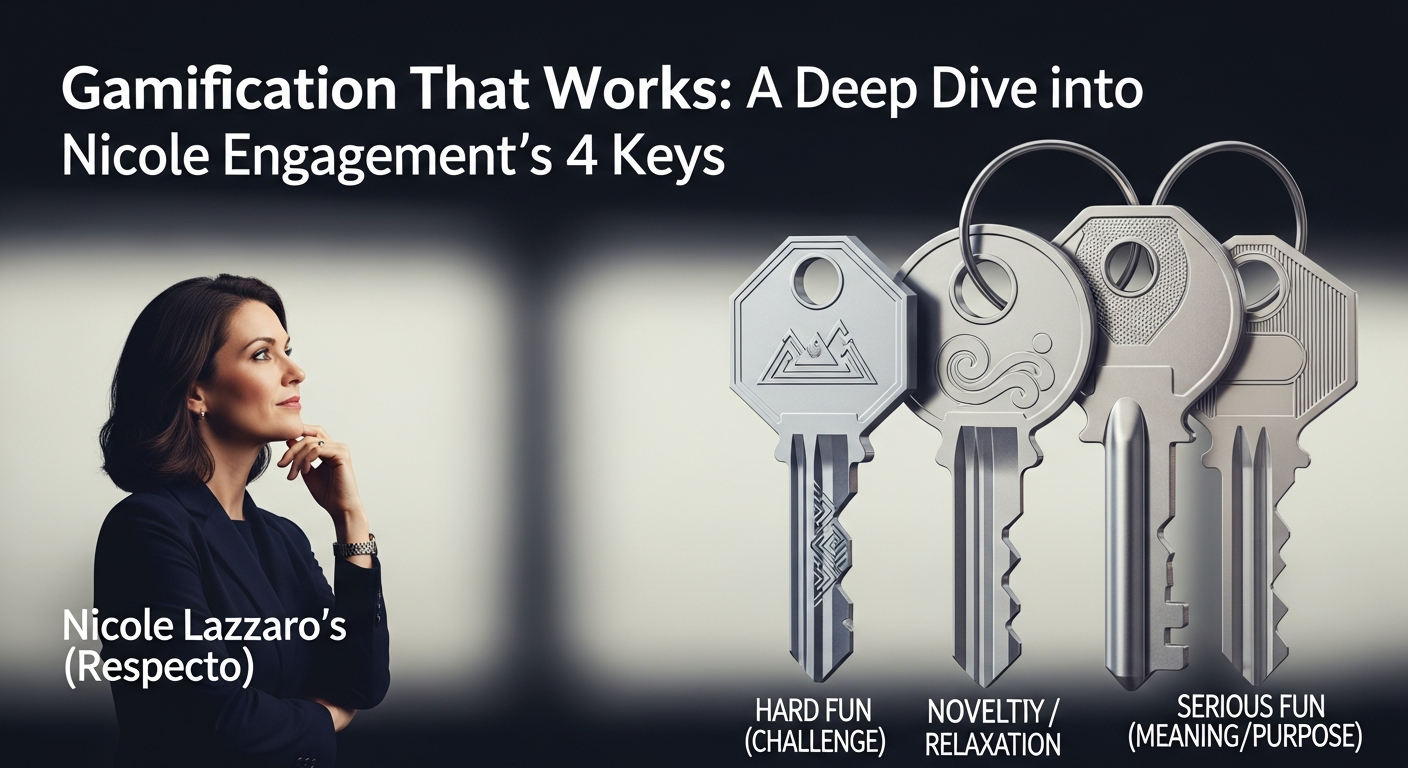
Gamification That Works: A Deep Dive into Nicole Lazzaro’s 4 Keys for Engaging L&D
In today's fast-paced corporate environment, attracting and retaining employee attention for learning and development initiatives is more challenging than ever. For L&D Vice Presidents, Directors, and Managers across diverse sectors like Compliance, Sales, Banking, Pharma, and Hospitality, merely delivering content isn't enough; true engagement is the holy grail. While gamification is often touted as a solution, its effectiveness can vary wildly. The key lies in understanding the psychology behind engagement, and few have delved deeper into this than game designer Nicole Lazzaro.
Lazzaro, a renowned expert in player emotional response, revolutionized our understanding of fun with her "4 Keys to Fun" framework. This isn't just about adding badges or leaderboards; it’s about crafting experiences that resonate deeply with human psychology. By applying her insights, L&D professionals can transform mundane training into compelling, memorable, and highly effective learning journeys. Let's embark on a deep dive into Lazzaro’s framework and explore how these principles can be leveraged to build a truly Gamified LMS that delivers measurable results.
Beyond Badges: Understanding Gamification That Works
For many, gamification conjures images of points, badges, and leaderboards – external motivators that often fizzle out over time. Lazzaro argues that true engagement stems from internal motivators, from the innate human desires that games tap into. Her 4 Keys provide a robust psychological lens through which to design learning experiences that aren't just "game-like" but genuinely "fun" and, crucially, effective.
Considering the complexities of modern learning, an astute question arises: How can artificial intelligence help us design more impactful gamified learning experiences tailored to individual needs and preferences?
The answer lies in understanding these core emotional drivers and using technology, such as an advanced learning management system, to facilitate their implementation. Lazzaro's model moves us past superficial rewards to the fundamental human emotions that drive sustained participation and skill acquisition.
Nicole Lazzaro’s 4 Keys to Fun Applied to L&D
Lazzaro identifies four primary types of fun that drive player engagement. Each offers unique opportunities for L&D designers to craft compelling learning content, whether for enterprise learning management or specific departmental training.
1. Hard Fun (Fiero): The Thrill of Triumph
Hard Fun is the joy of overcoming a significant challenge, achieving mastery through effort, and experiencing triumph (Fiero). It’s the feeling of accomplishment after solving a complex puzzle, mastering a difficult skill, or conquering an arduous task.
- L&D Application: Design learning paths with escalating difficulty. Introduce complex simulations for Compliance, Banking, or Pharma where learners must make critical decisions and see their impact. Create scenarios in Sales training that require strategic thinking and problem-solving under pressure. For sectors like Oil and Gas or Mining, this could involve realistic simulations of operational challenges or safety protocols.
- Leveraging Technology: An effective Microlearning LMS can deliver progressively challenging modules, allowing learners to build skills incrementally. Incorporate branching scenarios and interactive case studies that test decision-making. Maximize the feeling of achievement by providing instant feedback and clearly showing progress towards mastery. This is particularly vital for Risk-focused Training, where overcoming challenges translates directly to business resilience.
2. Easy Fun (Novelty): The Joy of Discovery
Easy Fun, also known as Novelty, comes from curiosity, exploration, surprise, and wonder. It’s the delight of discovering something new, experiencing variety, or simply being entertained without intense effort. This type of fun keeps learners engaged by continually offering fresh stimuli.
- L&D Application: Diversify content formats. Use interactive infographics, short video clips, dynamic quizzes, and exploratory modules that allow learners to navigate at their own pace. Introduce unexpected facts, mini-games, or virtual tours relevant to topics in Retail, Healthcare, or Hospitality.
- Leveraging Technology: A sophisticated learning content management system should support a wide array of multimedia content. Leverage a Gamified LMS that offers varied challenges, visually appealing interfaces, and dynamic content updates to maintain curiosity. Think about creating a discovery-based learning environment where learners uncover information through interaction rather than passive consumption.
3. Serious Fun (Meaning): The Power of Purpose
Serious Fun derives from making an impact, contributing to something meaningful, and experiencing purpose. It’s the deep satisfaction that comes from being part of a larger narrative, solving real-world problems, or understanding the significance of one's actions.
- L&D Application: Connect learning directly to organizational goals, societal impact, or personal growth. Use storytelling to frame training modules, especially in Compliance or Ethics training, showing the 'why' behind the rules. In Banking or Insurance, demonstrate how accurate processing protects customers and strengthens the company. For Pharma, emphasize how understanding regulations directly impacts patient safety.
- Leveraging Technology: Integrate real-world case studies and scenarios into your lms learning management system. Utilize modules that show the consequence of decisions, linking learning outcomes to tangible business or social impact. An enterprise learning management solution can help align individual learning paths with company-wide strategic objectives, making the purpose clear to every employee.
4. People Fun (Social): The Connection with Others
People Fun stems from social interaction – collaboration, competition, camaraderie, and communication. It’s the joy of engaging with others, whether through friendly rivalry or collective achievement.
- L&D Application: Implement team-based challenges, peer learning groups, and collaborative projects. Use leaderboards and healthy competition for sales teams or customer service reps. Facilitate discussion forums and social learning features within your learning management software to foster community. This is especially useful for dispersed teams in Retail or Hospitality.
- Leveraging Technology: Modern learning management solutions often include robust social features. Utilize an Adaptive Learning platform that encourages peer-to-peer interaction and knowledge sharing. Consider features that allow learners to compare progress, give feedback, and collaborate on solutions, transforming solo learning into a shared experience.
Integrating Lazzaro’s Keys with Modern eLearning Technologies
The beauty of Lazzaro's framework is its timelessness, yet its impact is amplified when combined with cutting-edge eLearning technologies. Imagine a cloud based learning management system that inherently supports these four keys.
An AI Powered Authoring Tool, for instance, can help L&D teams rapidly create varied content (Easy Fun), suggest optimal challenge levels based on learner profiles (Hard Fun), and personalize scenarios that highlight the relevance of training (Serious Fun). Furthermore, integrated communication tools within an advanced MaxLearn LMS foster peer interaction, driving People Fun.
AI-Driven Gamification: The Next Frontier
The synergy between Lazzaro's psychology of fun and artificial intelligence promises to unlock unprecedented levels of engagement. What are the capabilities of intelligent systems in personalizing gamified learning for diverse global workforces, ensuring cultural relevance and optimal challenge levels?
AI can analyze learner data to dynamically adjust difficulty, provide personalized feedback, and recommend content pathways that cater to individual preferences for Hard, Easy, Serious, or People Fun. For a global workforce, an AI-powered system can even adapt content scenarios to be culturally relevant, making Serious Fun resonate more deeply. This capability transforms a generic learning management system into a truly adaptive and responsive learning ecosystem.
Implementing Gamification That Works: Practical Steps for L&D Leaders
For VPs, Directors, and Managers leading L&D initiatives, embracing Lazzaro's framework requires a strategic shift:
- Audit Existing Content: Evaluate current training modules through the lens of the 4 Keys. Where are the opportunities for more challenge, novelty, purpose, or social interaction?
- Pilot Programs: Start small. Implement Lazzaro’s principles in a single course or department (e.g., a specific Compliance module or a Sales onboarding program) and measure the impact on engagement and learning outcomes.
- Leverage Technology: Invest in a modern LCMS or learning management system that supports rich media, branching scenarios, and social learning features. Tools with AI capabilities can further enhance personalization.
- Iterate and Refine: Gather feedback, analyze data on learner behavior, and continuously optimize your gamified elements. What resonates most with your employees in Banking, Pharma, or Retail?
- Communicate the 'Why': Help your teams understand that gamification isn't just about making learning "fun" in a superficial sense, but about leveraging powerful psychological drivers for deeper learning and development.
Conclusion
Nicole Lazzaro’s 4 Keys to Fun offer L&D leaders a profound roadmap for designing gamified learning experiences that truly work. By consciously incorporating Hard Fun (Triumph), Easy Fun (Discovery), Serious Fun (Purpose), and People Fun (Social Connection) into your training programs, you move beyond superficial engagement to deep, intrinsic motivation.
In a world where employee attention is a premium, adopting these principles, amplified by modern learning management software like MaxLearn LMS, represents a strategic imperative. It's time to transform your learning environment from a mere repository of information into an invigorating ecosystem where every employee is eager to learn, grow, and achieve. The future of effective corporate training lies in understanding the psychology of fun, delivered through intelligent and engaging platforms.
.jpg)


