

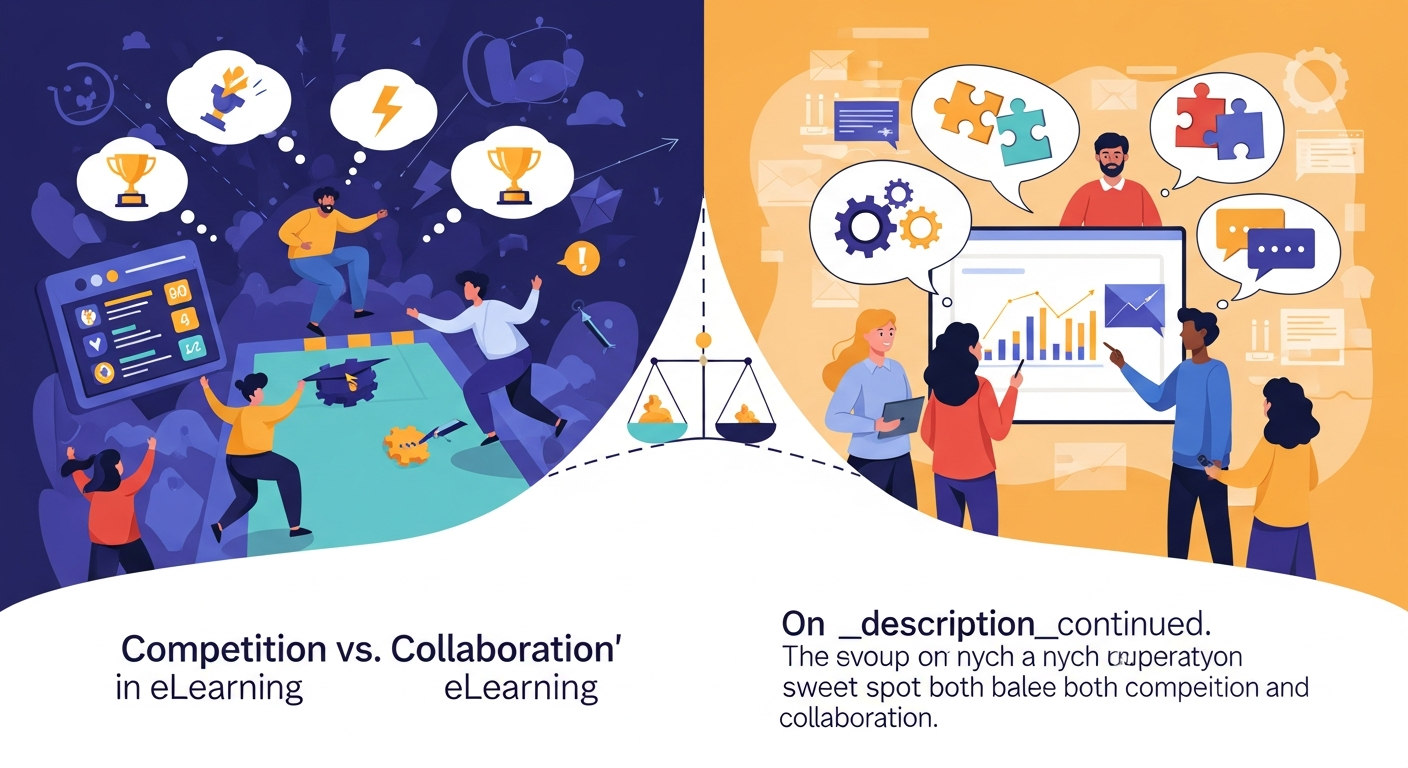
Competition vs. Collaboration: Balancing People Fun in eLearning for L&D Leaders
In the dynamic landscape of corporate learning and development, the quest for highly engaging and effective training solutions is ceaseless. For Vice Presidents, Directors, and Managers of L&D across industries like Compliance, Sales, Banking, Finance, Insurance, Retail, Pharma, Healthcare, Hospitality, Oil and Gas, and Mining, the challenge often lies in striking the right chord between motivational strategies. Should we foster spirited competition, driving individuals to outperform, or cultivate a collaborative environment where shared success is paramount? This isn't merely a philosophical debate; it's a strategic imperative for optimizing learner engagement, knowledge retention, and ultimately, business outcomes. The key, as we will explore, lies in finding a harmonious balance – injecting 'people fun' into eLearning through a thoughtful blend of both.
The Undeniable Lure of Competition in eLearning
Competition, when channeled correctly, can be a powerful motivator. It taps into our innate desire to achieve, to excel, and to be recognized. In an eLearning context, competitive elements can significantly boost learner participation and completion rates. Imagine a sales team vying for the top spot on a leaderboard after completing a product knowledge module, or finance professionals competing to score highest on a compliance assessment. The thrill of the chase, the public recognition, and the tangible rewards can transform mundane training into an exciting challenge.
- Enhanced Engagement: Leaderboards, badges, points, and challenges can gamify the learning experience, making it more interactive and addictive. A well-designed Gamified LMS can be instrumental in implementing such features effectively, tracking progress and rewarding achievements.
- Increased Drive: For industries like Sales and Banking, where performance metrics are critical, competition can mirror real-world scenarios, preparing learners for high-pressure environments and encouraging them to master content thoroughly.
- Performance Benchmarking: Competition provides clear benchmarks for individual performance, allowing learners and managers to identify areas for improvement. This is particularly valuable in Compliance and Healthcare where adherence to standards is non-negotiable.
However, an overreliance on competition can have drawbacks, fostering stress, discouraging slower learners, and potentially hindering knowledge sharing if learners view their peers solely as rivals.
The Deep-Rooted Power of Collaboration in eLearning
While competition has its place, human beings are also fundamentally social creatures who thrive in communities. Collaboration in eLearning harnesses this natural inclination, fostering a sense of shared purpose and collective growth. In complex fields like Pharma R&D, Oil and Gas engineering, or intricate financial regulations, the ability to work together, share insights, and problem-solve as a team is indispensable. A robust Microlearning LMS or a comprehensive LMS can facilitate collaborative environments through integrated forums, group projects, and peer review systems.
- Knowledge Sharing & Peer Support: Collaborative features encourage learners to discuss concepts, ask questions, and share best practices, leading to a richer understanding of the material. This is crucial for onboarding in Retail or integrating new protocols in Hospitality.
- Community Building: Collaboration fosters a sense of belonging and mutual support, which is especially important for remote or distributed teams. It transforms individual learning journeys into a collective experience.
- Application & Problem-Solving: Group projects and case studies allow learners to apply theoretical knowledge to practical scenarios, developing critical thinking and teamwork skills. This is vital for Risk-focused Training in Finance or complex process training in Mining.
- Diverse Perspectives: Different viewpoints emerge in collaborative settings, leading to more comprehensive solutions and a deeper appreciation of various approaches to challenges.
While collaboration is powerful, it too needs structure. Without clear objectives or proper facilitation, collaborative efforts can lose focus or be dominated by a few voices.
Striking the Balance: A Strategic Imperative for L&D
The optimal approach for any modern learning management system is to strategically integrate both competitive and collaborative elements, ensuring they complement rather than contradict each other. The goal is to maximize engagement, deepen learning, and align with specific organizational outcomes. For example, a module on new compliance regulations could start with individual competitive quizzes (testing foundational knowledge), followed by collaborative case studies where teams apply regulations to real-world scenarios, and conclude with a competitive team challenge to cement understanding.
A sophisticated learning management software offers the flexibility to design such blended experiences. Through features like custom learning paths and diverse activity types, an L&D team can craft modules that offer different types of "fun" for different stages of learning or different learner personalities. This often involves an element of Adaptive Learning, where the system adjusts the learning path based on individual performance and preferences, potentially guiding some learners towards more competitive challenges and others towards more collaborative group work.
Implementing a comprehensive enterprise learning management solution means having the tools to facilitate this balance. Whether it’s a cloud based learning management system or an on-premise solution, the underlying platform must support a rich array of activities that cater to both individual achievement and team success. This approach ensures that learners remain motivated, supported, and ultimately, more effective in applying their new knowledge.
Leveraging Technology for Optimal Engagement
Modern learning management solutions, such as MaxLearn LMS, are designed with this balance in mind. They act as a central Learning content management system (LCMS), enabling L&D teams to curate and deliver diverse content that leverages both competitive and collaborative mechanics. From creating engaging quizzes with leaderboards to setting up group projects with peer feedback mechanisms, the right lms learning management system provides the framework.
The evolution of learning technologies, especially the integration of artificial intelligence, further refines this balance. L&D leaders can now tap into powerful capabilities to personalize learning journeys, offering tailored experiences that resonate with individual preferences for competition or collaboration.
AI-Driven Insights for L&D Leaders
How can advanced analytics help us personalize learning experiences to balance competitive drives and collaborative needs?
AI-driven analytics within a modern learning platform can track individual learner behavior, preferences, and performance patterns. By analyzing data on how learners respond to competitive leaderboards versus collaborative group discussions, the system can recommend personalized learning paths. For instance, a learner thriving in competitive scenarios might be presented with more challenge-based modules, while another who excels in peer-to-peer interactions might be guided towards more team projects. This granular insight helps L&D design truly adaptive learning journeys, ensuring 'people fun' is optimized for each individual, without explicitly identifying geographical or individual preference data. It moves beyond a one-size-fits-all approach to highly targeted engagement strategies.
What role does AI play in measuring the effectiveness of competitive and collaborative elements across our diverse workforce?
AI tools can go beyond simple completion rates, providing deep insights into the efficacy of competitive and collaborative strategies. For example, AI can analyze discussion forum sentiment, identify key contributors in group projects, or predict drop-off risks based on engagement with different activity types. For a global corporation, AI can compare engagement metrics across different regions, identifying cultural nuances that might favor competition over collaboration in one area and vice-versa in another. This allows L&D leaders to fine-tune their approach, ensuring that the balance of competition and collaboration drives desired outcomes, such as improved compliance rates in Banking or enhanced safety protocols in Mining, without needing direct individual or geo-specific tagging.
How can AI assist in developing content that fosters both healthy competition and meaningful collaboration?
An AI Powered Authoring Tool can be a game-changer. It can suggest content formats and activity types based on learning objectives and desired engagement styles. For instance, if the goal is to reinforce critical decision-making (often competitive), AI might suggest scenario-based simulations. If the goal is to build team consensus (collaborative), it might recommend interactive case studies or virtual hackathons. Furthermore, AI can help in generating dynamic content variations, providing different competitive challenges or collaborative prompts to keep the learning fresh and relevant. This capability dramatically streamlines content creation, making it easier for L&D teams to implement a balanced approach consistently across all training modules and across a global workforce, without explicit geographic or individual learner targeting in the AI's direct prompts.
Conclusion
For L&D leaders, the decision isn't about choosing between competition and collaboration, but rather about strategically integrating both to create a holistic, engaging, and effective eLearning ecosystem. A well-implemented learning management system, particularly one that leverages AI and offers features like those found in MaxLearn LMS, empowers organizations to orchestrate this delicate balance. By understanding their learners, leveraging intelligent technology, and designing thoughtfully, L&D professionals can ensure that training is not just a requirement, but a genuinely enjoyable and impactful experience, driving both individual excellence and collective success across all industries.
.jpg)


