

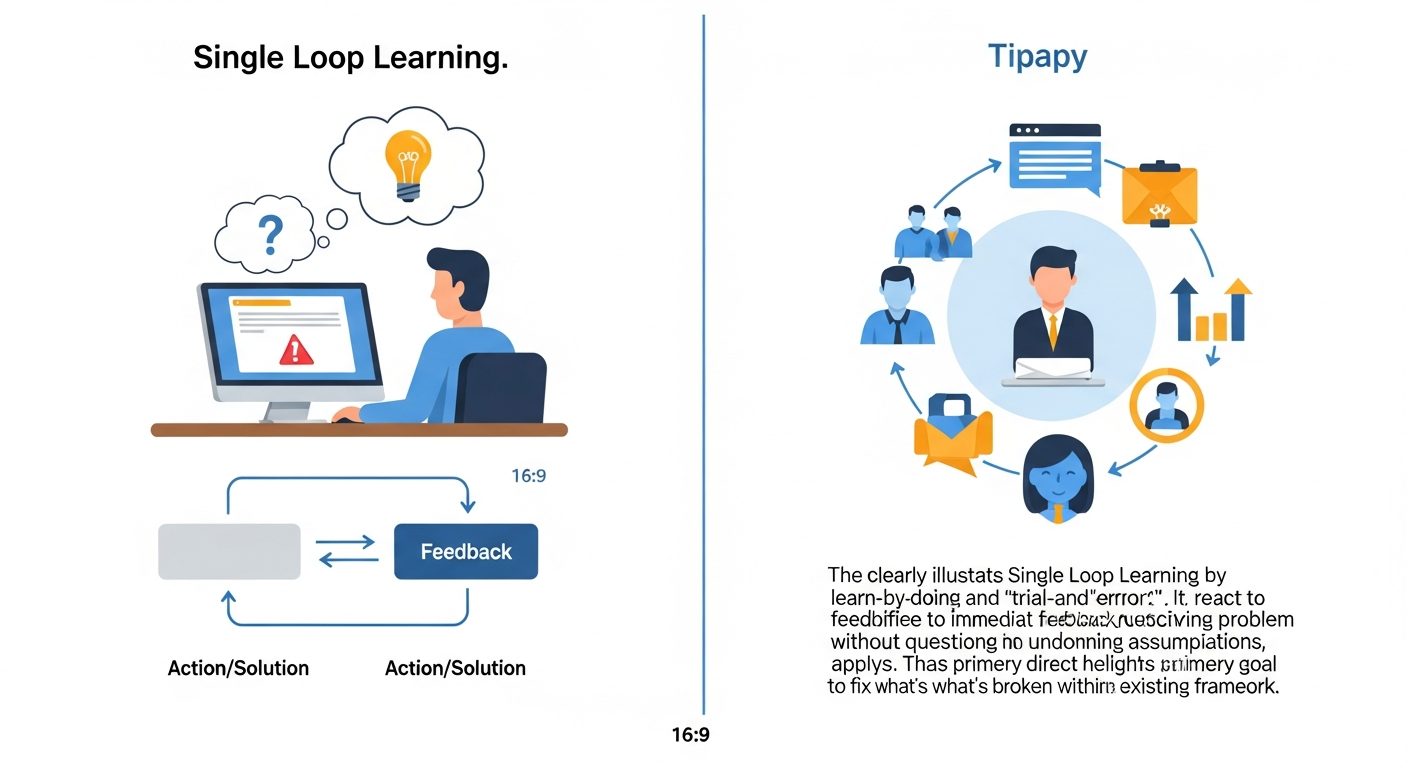
What Is Single Loop Learning? Optimizing L&D for Immediate Results
In the dynamic landscape of modern business, learning and development (L&D) leaders – from VPs and Directors to Senior Managers – are constantly seeking strategies that deliver tangible, immediate results. While the concept of organizational learning can often feel abstract, a foundational approach known as Single Loop Learning offers a pragmatic pathway to address performance gaps and reinforce essential skills efficiently. For industries like compliance, sales, banking, healthcare, and manufacturing, the ability to quickly identify a problem, implement a solution, and observe an immediate outcome is not just beneficial, but critical for operational excellence and sustained growth.
This article delves into the core of Single Loop Learning, exploring its mechanics, its profound relevance for L&D professionals, and how leveraging contemporary eLearning technologies can amplify its effectiveness in achieving your organization's learning objectives.
Understanding Single Loop Learning
At its heart, Single Loop Learning is about detecting and correcting errors within a given set of operating norms or assumptions. Imagine a thermostat: when the room temperature falls below the set point, it switches on the heater. When it rises above, it switches off. The thermostat doesn't question *why* the temperature fluctuates or *if* the set point is appropriate; it simply acts to maintain the pre-defined standard. In an organizational context, this translates to:
- Identifying a deviation from an established goal or standard.
- Implementing a corrective action or training.
- Measuring the immediate impact of that action against the standard.
- Adjusting the action based on feedback to stay within acceptable parameters.
This approach is fundamentally about "doing things right" within existing frameworks, rather than "doing the right things" by questioning the frameworks themselves. It's focused on adaptive learning and problem-solving that doesn't challenge the underlying assumptions, beliefs, or values that guide behavior and strategy.
The Mechanics of Single Loop Learning
For L&D professionals, understanding the mechanics is key to implementing effective training programs:
- Problem Identification: A specific performance gap or knowledge deficit is identified (e.g., sales team struggling with a new product feature, compliance team missing a step in a regulatory process).
- Intervention/Training: A targeted training program or intervention is designed and deployed to address the identified problem (e.g., a short module on the new product feature, a refresher course on the regulatory step).
- Outcome Evaluation: The immediate results of the intervention are measured (e.g., improved product feature recall, fewer errors in the compliance process).
- Adjustment: Based on the evaluation, the training or process is fine-tuned to achieve the desired standard (e.g., adding more practice scenarios, clarifying instructions).
- Maintenance of Norms: The existing policies, procedures, and objectives remain unchallenged throughout this process.
Why Single Loop Learning Matters for L&D Leaders
For L&D VPs, Directors, and Managers across a spectrum of industries, Single Loop Learning offers distinct advantages:
- Rapid Problem Solving: It enables swift responses to immediate performance issues or knowledge gaps, ensuring operational continuity and efficiency. If a new cybersecurity threat emerges, Single Loop Learning facilitates rapid deployment of training on new protocols.
- Efficiency and Resource Optimization: By focusing on clear, defined problems within existing parameters, L&D teams can allocate resources more effectively, avoiding broad, less targeted initiatives.
- Compliance and Risk-focused Training: This approach is invaluable for ensuring employees adhere to regulations, safety protocols, and company policies, minimizing risks in highly regulated sectors like banking, healthcare, and pharma.
- Specific Skill Development: Whether it's training retail staff on a new POS system or healthcare workers on a new medical device, Single Loop Learning is ideal for imparting specific, actionable skills.
- Measurable Impact: The direct correlation between the intervention and the outcome makes it easier to measure ROI and demonstrate the value of L&D initiatives to stakeholders.
Real-World Applications Across Industries
The applicability of Single Loop Learning spans numerous sectors, proving its versatility:
- Sales: When a new product launches, sales teams need immediate training on its features and benefits. Single Loop Learning helps them quickly learn the new information, improve their pitch, and track conversion rates to adjust their approach. Leveraging an AI Powered Authoring Tool can rapidly create this content.
- Banking & Finance: For new regulatory updates (e.g., KYC, AML), employees need to instantly understand and implement revised procedures. Single Loop Learning ensures rapid adoption and compliance, minimizing financial and reputational risk.
- Healthcare: Adoption of new patient care protocols or operation of new medical equipment requires precise, immediate training to maintain patient safety and care standards.
- Retail: Seasonal promotions, new inventory management systems, or customer service enhancements demand quick training rollouts to front-line staff to maintain customer satisfaction and sales.
- Pharma: Training on the handling of new drug formulations, clinical trial protocols, or updated safety procedures is often time-sensitive and critical.
- Oil & Gas/Mining: Reinforcing safety procedures, operating new machinery, or adapting to new environmental compliance standards requires immediate and precise training to prevent accidents and ensure regulatory adherence.
- Hospitality: Training staff on new reservation software, updated guest service standards, or new hygiene protocols directly impacts customer experience and operational efficiency.
Leveraging Technology for Enhanced Single Loop Learning
Modern eLearning technologies are perfectly suited to facilitate and amplify the effectiveness of Single Loop Learning:
- Microlearning LMS: Delivers bite-sized, targeted training modules that address specific skill gaps or knowledge deficits quickly. This ensures just-in-time learning for immediate application.
- Gamified LMS: Incorporates game-like elements to make repetitive or procedural training more engaging, boosting retention and application of specific skills (e.g., compliance quizzes, sales simulations).
- Adaptive Learning Platforms: Tailors content delivery based on individual learner performance, ensuring that employees receive precisely the training they need to correct specific errors or master particular skills.
- Data Analytics: Advanced LMS platforms provide detailed insights into learner performance, identifying specific areas where individuals or teams are struggling, thus pinpointing exactly where Single Loop Learning interventions are needed.
Addressing Common Questions for Smarter Learning Strategies
How can intelligent algorithms identify immediate learning needs in a distributed workforce?
Intelligent algorithms analyze vast datasets, including performance metrics, project outcomes, customer feedback, and even communications across different regions and departments. By detecting patterns and deviations from expected performance or changes in operational requirements, these systems can pinpoint specific, urgent skill gaps. For instance, if sales figures for a new product are consistently low in a particular territory, the system might flag a need for immediate training on that product’s features or objection handling, ensuring that the right information reaches the right learners globally.
What tools leveraging intelligent automation can swiftly create and deploy targeted training modules?
Tools incorporating intelligent automation, such as AI-powered content generation platforms and sophisticated authoring environments, can drastically accelerate the development and deployment of training. By inputting specific learning objectives, performance data, or even existing documentation, these tools can automatically generate relevant course content, interactive quizzes, simulations, and scenarios. This allows L&D teams to rapidly produce highly focused modules for specific procedural updates or new skill requirements, making just-in-time training a reality.
How does intelligent automation optimize the delivery and reinforcement of specific procedural training?
Intelligent automation enhances the delivery and reinforcement of procedural training by personalizing the learning journey and providing timely support. It can schedule automated reminders, deliver micro-assessments at optimal intervals to test recall, and provide targeted feedback based on individual performance data. For example, if an employee consistently misses a step in a compliance procedure, the system can automatically deliver a short video tutorial or an interactive simulation specifically addressing that step, ensuring efficient reinforcement and mastery of defined processes.
The Limitations and When to Look Beyond
While Single Loop Learning is powerful for quick fixes and maintaining standards, it's crucial to acknowledge its limitations. It doesn't question the fundamental strategies, beliefs, or culture that might be contributing to recurrent problems. For deeper, transformational change that involves re-evaluating core organizational assumptions and objectives, L&D leaders would need to explore Double Loop Learning – a strategy that challenges the very framework within which problems are defined and solved. However, for the majority of day-to-day performance enhancements, compliance adherence, and skill reinforcement, Single Loop Learning remains an indispensable tool.
Conclusion
For L&D VPs, Directors, and Managers, mastering Single Loop Learning is not just about correcting errors; it's about optimizing performance, ensuring compliance, and building a resilient, adaptable workforce. By strategically applying this approach – especially when integrated with modern eLearning technologies like Microlearning LMS, Gamified LMS, and Adaptive Learning platforms – organizations can achieve immediate, measurable improvements. Focusing on "doing things right" within established frameworks allows L&D to deliver rapid, impactful results, keeping the organization agile and competitive in an ever-evolving market.
.jpg)


