

Beyond the Fix: Why L&D Leaders Must Master Single-Loop and Double-Loop Learning
In today's relentlessly evolving corporate landscape, the role of Learning & Development (L&D) has transcended mere skill-building. For Vice Presidents, Directors, and Senior Managers of L&D across industries like Compliance, Sales, Banking, Finance, Insurance, Retail, Pharma, Healthcare, Hospitality, Oil and Gas, and Mining, the imperative is clear: build organizations that don't just solve problems, but fundamentally learn and adapt. This requires a deep understanding and strategic application of two distinct yet complementary learning paradigms: Single-Loop and Double-Loop Learning.
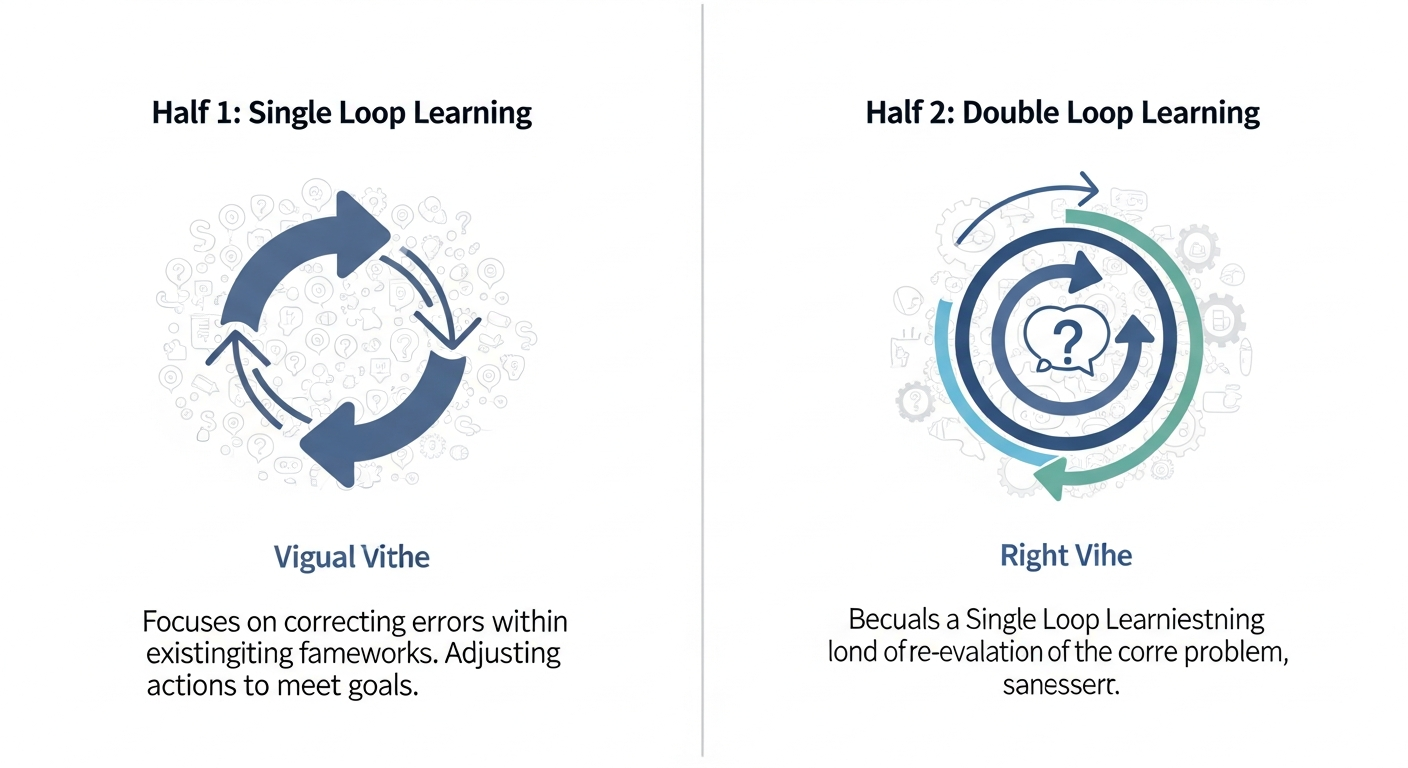
While Single-Loop Learning focuses on correcting deviations within existing frameworks, Double-Loop Learning challenges the very assumptions, values, and strategies that underpin those frameworks. Embracing both, with a deliberate emphasis on fostering double-loop capabilities, is foundational to cultivating resilient, innovative, and high-performing organizations. Let’s explore these critical concepts and their profound implications for your L&D strategy.
Understanding Single-Loop Learning: The "Doing Things Right" Approach
Single-Loop Learning is the most common form of organizational learning. It occurs when individuals or organizations detect an error and correct it without questioning the underlying assumptions or governing variables. Think of it as adjusting the thermostat: you set a desired temperature, and the system automatically adjusts to maintain it. The goal is to ensure the system operates according to its established rules and norms.
Characteristics and Examples:
- Focus on Correction: Identifying and fixing immediate problems or deviations from a standard.
- Maintaining Status Quo: The underlying goals, values, and strategies remain unchallenged.
- Efficiency-Oriented: Aims to make existing processes more effective.
In an L&D context, Single-Loop Learning often manifests in scenarios such as:
- Compliance Training: When a new regulation is introduced (e.g., in Banking or Pharma), L&D quickly updates modules and delivers training to ensure employees adhere to the new rules. The underlying compliance framework isn't questioned, just adjusted.
- Sales Performance: If sales targets are missed, L&D might provide additional training on product knowledge, objection handling, or new CRM features to help sales representatives improve their existing techniques.
- Onboarding: Ensuring new hires understand standard operating procedures and company policies.
While essential for operational efficiency and maintaining standards, especially in highly regulated sectors, Single-Loop Learning has its limitations. It can lead to organizations repeatedly addressing symptoms without ever curing the root cause, fostering a reactive culture rather than a truly adaptive one.
Delving into Double-Loop Learning: The "Doing the Right Things" Approach
Double-Loop Learning is a more profound and transformative process. It occurs when individuals or organizations question the fundamental assumptions, beliefs, and values that guide their actions. Instead of merely correcting errors, it involves reflecting on and potentially altering the governing variables themselves. It asks: "Are we operating with the right rules? Is this the best approach?"
Characteristics and Examples:
- Focus on Questioning Assumptions: Challenging the core beliefs and strategies behind actions.
- Transformative Change: Leads to fundamental shifts in organizational behavior and thinking.
- Innovation-Oriented: Fosters creativity and strategic adaptation.
Consider the previous examples through a Double-Loop lens:
- Compliance Strategy: Instead of merely updating training for a new regulation, an L&D leader in Finance might ask: "Are our existing risk management policies truly effective in preventing future breaches, or are we just reacting to past failures? Do our ethical guidelines truly foster a culture of integrity, or just ensure minimum legal adherence?" This could lead to a complete overhaul of risk-focused training methodologies.
- Sales Strategy: If sales targets are consistently missed despite multiple single-loop interventions, L&D might collaborate with leadership to ask: "Is our sales methodology outdated? Are our market assumptions about customer needs still valid? Should we rethink our product offerings or target demographics entirely?"
- Talent Development: Moving beyond just training for current skill gaps to questioning if the organization's approach to talent development aligns with future strategic objectives and market shifts.
Double-Loop Learning is often more challenging to implement as it requires introspection, vulnerability, and a willingness to challenge ingrained practices. However, its payoff is immense: genuine innovation, strategic agility, and sustained competitive advantage.
The Critical Distinction: Why it Matters for L&D
For L&D leaders, the distinction between these two learning types isn't academic; it's a strategic imperative. Organizations that rely solely on Single-Loop Learning risk becoming stagnant, trapped in cycles of repetitive problem-solving without ever achieving true transformation. This is particularly perilous in fast-paced industries or highly regulated environments where complacency can lead to significant Risk-focused Training management issues, compliance breaches, or market irrelevance.
Double-Loop Learning empowers organizations to:
- Innovate: By questioning existing paradigms, new solutions and strategies emerge.
- Adapt: Organizations can proactively respond to market shifts, technological advancements, and regulatory changes rather than reactively patching problems.
- Build Resilience: A culture of continuous self-reflection prepares the organization for unforeseen challenges.
- Drive Strategic Growth: Aligns learning initiatives directly with long-term business objectives, ensuring L&D is a strategic partner, not just a service provider.
Integrating Advanced Learning Methodologies
Modern eLearning solutions are instrumental in facilitating both Single-Loop and Double-Loop Learning, making them accessible and scalable across your organization. Leveraging these tools can transform your L&D function into a strategic powerhouse:
- An effective Microlearning LMS can deliver targeted, bite-sized content for single-loop corrections, ensuring rapid skill reinforcement and knowledge updates. However, it can also provide foundational concepts that, when combined with broader discussions, prompt deeper questioning.
- A Gamified LMS can motivate learners through immediate feedback and rewards (single-loop reinforcement). More importantly, well-designed simulations within a gamified environment can allow employees to experiment with different strategies and observe the consequences, encouraging a double-loop reflection on their decision-making frameworks.
- Adaptive Learning platforms are particularly powerful. By tailoring content based on individual performance and learning styles, they can efficiently address specific knowledge gaps (single-loop). Crucially, they can also identify deeper conceptual misunderstandings or flawed mental models that require a double-loop intervention, guiding learners toward resources that challenge their core assumptions.
- An AI Powered Authoring Tool can rapidly generate and customize learning content, allowing L&D teams to quickly iterate on training designs. This agility supports the experimentation and continuous refinement central to double-loop processes, enabling quick deployment of modules that challenge existing norms.
AI & The Future of Organizational Learning
Artificial intelligence is rapidly becoming a cornerstone for advanced organizational learning, offering unprecedented capabilities to enhance both single-loop efficiencies and double-loop insights.
How can advanced algorithms personalize employee training?
Intelligent systems analyze vast amounts of performance data, learner interactions, and career pathways to create highly individualized learning journeys. Beyond merely filling knowledge gaps (single-loop), these systems can detect patterns in recurring errors or inefficiencies, suggesting that an employee's fundamental approach or understanding might be flawed. This allows L&D to provide resources that address underlying conceptual models, fostering a deeper, double-loop transformation in skill sets.
What role does machine learning play in identifying organizational blind spots?
Machine learning models can sift through disparate data sources—from market trends and customer feedback to internal incident reports and employee surveys—to uncover hidden correlations and systemic issues that traditional analysis might miss. By identifying these deep-seated patterns, AI can highlight situations where existing policies, strategies, or assumptions are leading to suboptimal outcomes. This provides L&D leaders with actionable insights to initiate discussions that challenge the status quo, pushing organizations towards essential double-loop reflection.
Can intelligent systems help create more impactful learning content?
Absolutely. AI can assist in generating complex learning scenarios, realistic simulations, and even adaptive quizzes that challenge learners beyond rote memorization. By creating content that encourages critical thinking and problem-solving in dynamic, ambiguous situations, AI-driven tools move training beyond simple instruction. This facilitates an environment where employees are prompted to question their decision-making frameworks and explore alternative approaches, directly supporting double-loop learning and preparing them for real-world complexities in industries from Healthcare to Oil and Gas.
Driving Transformative L&D with Double-Loop Principles
For L&D leaders to truly drive transformation, consciously incorporating double-loop principles is key:
- Foster Psychological Safety: Create an environment where employees feel safe to question, challenge, and admit mistakes without fear of retribution. This is paramount for honest self-reflection.
- Encourage Critical Thinking: Design training programs that move beyond "what to do" to "why we do it" and "what if we did it differently." Use case studies, simulations, and group discussions that require challenging assumptions.
- Implement Robust Feedback Loops: Beyond performance reviews, establish mechanisms for feedback on processes, strategies, and the underlying beliefs that govern organizational actions.
- Lead by Example: L&D leaders must model double-loop thinking by critically evaluating their own programs, methodologies, and assumptions about learning effectiveness.
Conclusion
The distinction between Single-Loop and Double-Loop Learning is not merely theoretical; it is a strategic imperative for L&D leaders aiming to future-proof their organizations. While Single-Loop Learning is vital for operational efficiency and compliance, Double-Loop Learning is the engine of innovation, resilience, and sustained competitive advantage. By consciously integrating both approaches, leveraging cutting-edge eLearning technologies, and harnessing the transformative power of artificial intelligence, L&D can move beyond mere problem-solving to truly transform organizational capability, ensuring your enterprise thrives in an ever-changing world.
.jpg)


