

The Enduring Power of Skinner's Theory: Shaping High-Performance Learning in Modern L&D
For Vice Presidents, Directors, and Managers leading Learning & Development, the quest for truly effective training solutions is perpetual. In an era of rapid technological change and evolving workforce demands, it's easy to get swept up in the latest buzzwords. Yet, sometimes the most profound insights come from revisiting foundational principles. B.F. Skinner's Theory of Learning, specifically operant conditioning, stands as one such enduring framework, offering a powerful lens through which to design and optimize contemporary corporate training programs, from compliance to sales and beyond.
Skinner, a seminal figure in behaviorism, argued that learning is a function of change in overt behavior. He posited that behaviors that are reinforced tend to be repeated, while those that are not (or are punished) tend to die out. This might sound simplistic, but its implications for shaping desired workplace behaviors – crucial for every industry from banking to healthcare, retail to oil and gas – are immense and remarkably adaptable to digital learning environments.
Understanding the Core of Operant Conditioning
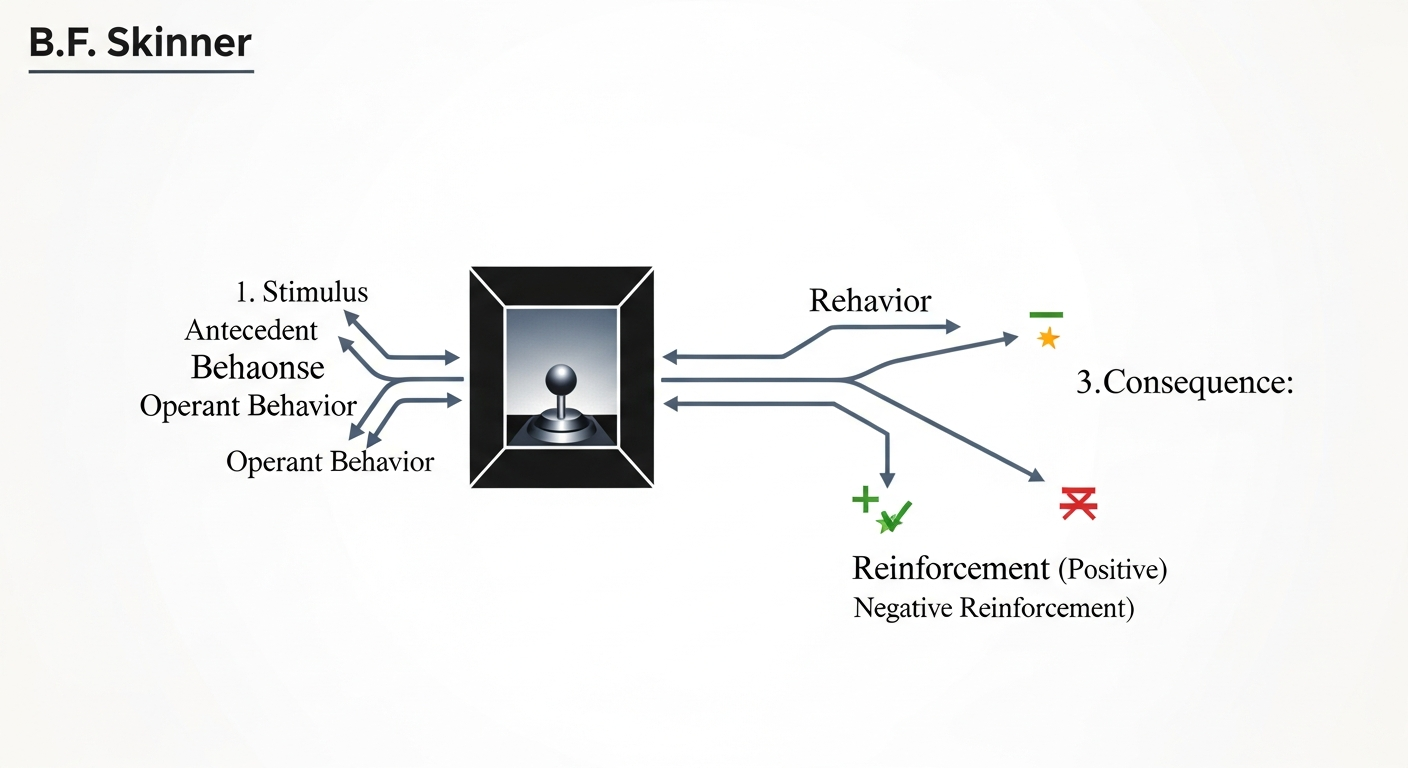
At its heart, Skinner's theory revolves around the relationship between behavior and its consequences. Here are the key components:
- Reinforcement: This is the cornerstone. Reinforcement increases the likelihood of a behavior being repeated.
- Positive Reinforcement: Adding something desirable to increase a behavior (e.g., praise for completing a module, a bonus for hitting sales targets).
- Negative Reinforcement: Removing something undesirable to increase a behavior (e.g., a manager stops nagging when a report is submitted on time). It’s important to note this is NOT punishment; it still encourages the desired behavior.
- Punishment: This decreases the likelihood of a behavior being repeated.
- Positive Punishment: Adding something undesirable to decrease a behavior (e.g., a reprimand for a safety violation).
- Negative Punishment: Removing something desirable to decrease a behavior (e.g., loss of privileges for non-compliance).
- Extinction: This occurs when a previously reinforced behavior is no longer reinforced, leading to its decrease and eventual disappearance.
- Shaping: A powerful technique involving reinforcing successive approximations of a desired behavior. This is how complex behaviors are taught, step-by-step.
Skinner's Principles in Modern L&D Strategy Across Industries
How do these academic concepts translate into actionable strategies for L&D leaders across diverse sectors?
- Compliance Training (Banking, Finance, Healthcare, Pharma, Oil & Gas): The consequences of non-compliance can be severe. Skinner’s theory suggests designing training that consistently reinforces correct procedures and immediately corrects deviations. Positive reinforcement could be badges or certifications for module completion and adherence, while negative reinforcement might involve systems that prevent users from progressing without correct answers, removing the "undesirable" state of uncertainty.
- Sales Training (Retail, Insurance): Shaping is critical here. Start by reinforcing small steps – correct product knowledge, effective opening lines, handling objections – building up to a complete sales process. Immediate feedback on simulated calls, followed by recognition for hitting interim targets, acts as powerful positive reinforcement. An effective Microlearning LMS can deliver these bite-sized reinforcements.
- Customer Service (Hospitality, Retail): Training can focus on reinforcing empathetic language, problem-solving steps, and de-escalation techniques. Role-playing followed by constructive feedback (positive reinforcement) and immediate correction (mild punishment for incorrect responses, aimed at redirection rather than discouragement) can shape service excellence.
- Technical Skills (Mining, Manufacturing): For complex machinery or protocols, shaping is invaluable. Break down procedures into manageable steps. Provide immediate visual or auditory feedback for each correct action. Utilize a Gamified LMS to turn skill acquisition into an engaging, rewarding experience, boosting motivation and retention.
Synergizing Skinner with Contemporary eLearning
The beauty of Skinner's theory is its adaptability. Modern eLearning platforms, especially those leveraging advanced technology, are perfectly poised to implement these principles at scale:
- Personalized & Adaptive Paths: Adaptive Learning systems inherently apply Skinnerian principles. They respond to learner input, reinforcing correct answers with progression and guiding incorrect answers toward correction, effectively shaping knowledge acquisition and skill development in a personalized way.
- Immediate Feedback Loops: Digital quizzes, simulations, and interactive exercises provide instantaneous feedback, acting as powerful positive or corrective reinforcement. This immediacy is crucial for strengthening desired neural pathways and preventing the consolidation of errors.
- Gamification & Rewards: Points, badges, leaderboards, and virtual rewards are direct applications of positive reinforcement. They motivate learners, acknowledge effort, and drive engagement, making even mundane compliance training more appealing.
- Spaced Repetition: While not purely Skinnerian, spaced repetition algorithms reinforce learning at optimal intervals, preventing extinction of knowledge and ensuring long-term retention.
Optimizing Performance with Intelligent Systems: Questions for the L&D Leader
As L&D leaders, you're constantly seeking innovative ways to enhance training efficacy. Consider how advanced technology can elevate the practical application of behavioral learning principles:
How can advanced analytics and machine learning personalize learning experiences to provide optimal reinforcement for each individual learner?
Intelligent platforms can analyze learner interactions, identifying knowledge gaps and strengths. This allows for dynamic adjustment of content difficulty and presentation, ensuring that each trainee receives the most effective type of practice and feedback, much like Skinner’s shaping, but at scale. Such systems can predict learning trajectories and intervene with targeted support or challenges.
In a geographically dispersed organization, how can automated feedback mechanisms ensure consistent and timely positive reinforcement for desired behaviors across all teams?
Cloud-based learning platforms powered by automation can deliver immediate, constructive feedback regardless of location. This ensures that positive behaviors are acknowledged and reinforced promptly, preventing the decay of newly acquired skills. Automated reporting also allows L&D leaders to monitor behavioral trends and intervention effectiveness across diverse regions, standardizing performance benchmarks.
What role do generative tools play in rapidly creating and refining training content that emphasizes behavioral outcomes and skill mastery?
Tools augmented with artificial intelligence can significantly accelerate the development of highly specific and engaging training modules. They can help author scenarios, quizzes, and simulations that directly target desired behavioral changes, allowing for rapid iteration and refinement based on performance data. This ensures content is always aligned with practical application and skill development, akin to designing environments for optimal conditioning. Look for an AI Powered Authoring Tool to streamline this process.
How can predictive models and data-driven insights be leveraged to proactively identify and mitigate compliance risks through precisely targeted training interventions?
By analyzing past performance data, incident reports, and industry trends, predictive models can highlight potential areas of vulnerability within an organization. This allows L&D to design training programs that pre-emptively address identified risks, focusing on high-impact behaviors. This proactive approach ensures that learning is precisely tailored to prevent costly errors and reinforce compliant actions, minimizing exposure. Explore the potential of Risk-focused Training to safeguard your organization.
Conclusion: A Timeless Framework for Future-Ready L&D
B.F. Skinner’s contributions to understanding how behaviors are learned and modified remain profoundly relevant for L&D professionals. While his theories focus on observable behavior, their integration with sophisticated eLearning technologies allows for an unparalleled ability to design highly effective, engaging, and measurable training programs. By consciously applying principles of reinforcement, punishment, extinction, and shaping, L&D leaders can build learning environments that not only impart knowledge but actively cultivate the high-performance behaviors essential for organizational success across all industries. The power lies in understanding these fundamentals and intelligently deploying modern tools to create optimal conditions for learning and behavioral change.
.jpg)


