

Shaping Success: How Skinner's Operant Conditioning Powers Modern eLearning
In the fast-evolving landscape of corporate learning and development, L&D leaders are constantly seeking strategies to not just impart knowledge, but to fundamentally shape employee behavior, drive performance, and ensure compliance. While cutting-edge technology and innovative content often take center stage, the foundational principles of human learning remain timeless. One such cornerstone is B.F. Skinner's theory of Operant Conditioning – a powerful psychological framework that, when understood and applied correctly, can revolutionize how we approach corporate training in the digital age.
For Vice Presidents, Directors, and Senior Managers overseeing L&D across industries like Banking, Pharma, Retail, or Oil and Gas, understanding operant conditioning isn't just academic; it's a strategic imperative. It offers a blueprint for creating training programs that aren't just consumed, but actively lead to desired actions, sustained skill development, and measurable business impact.
What is Operant Conditioning? A Refresher for L&D Strategists
At its core, Operant Conditioning is a learning method that occurs through rewards and punishments for behavior. Through operant conditioning, an individual makes an association between a particular behavior and a consequence (Skinner called these consequences "reinforcers" or "punishers"). This framework posits that behaviors that are reinforced tend to be repeated, while behaviors that are punished or not reinforced tend to diminish.
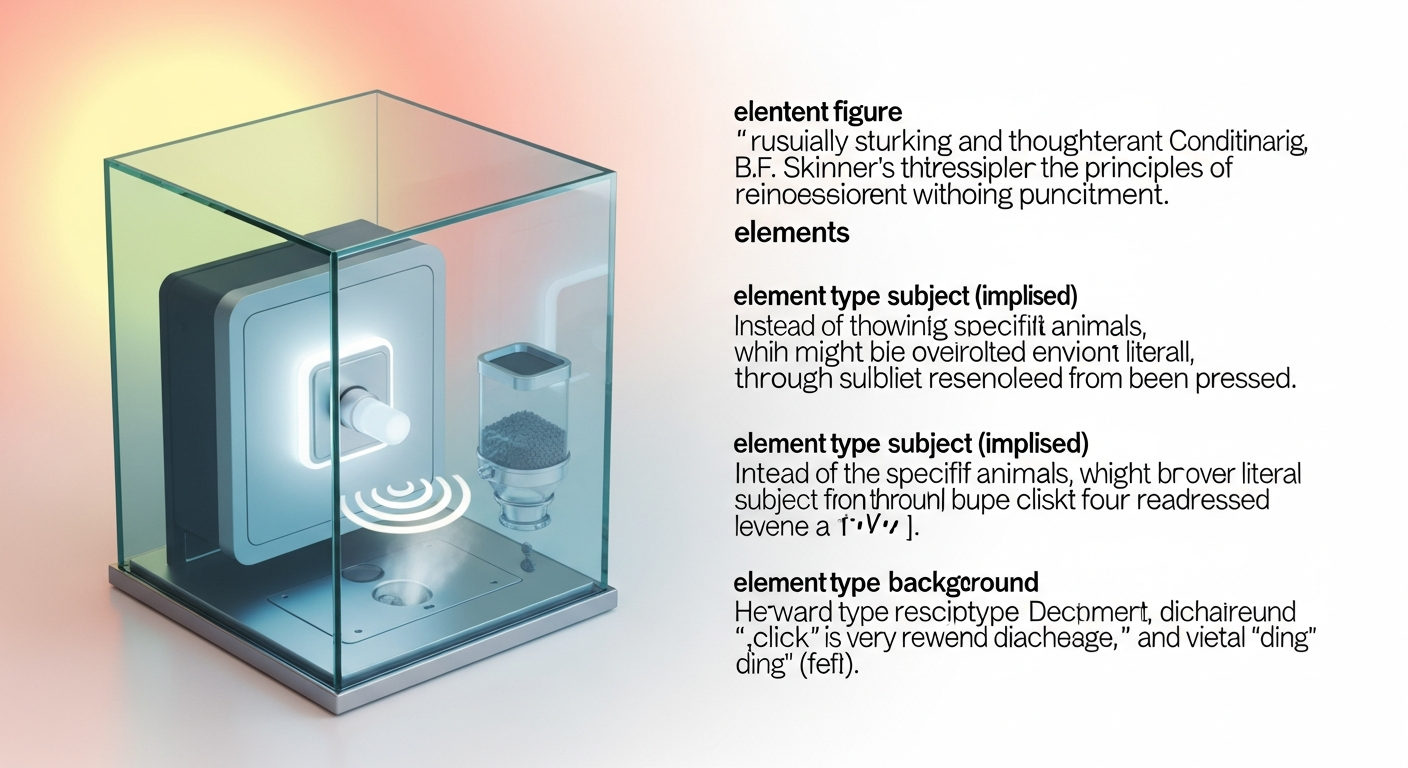
Skinner famously demonstrated these principles with his "Skinner Box," where animals learned to perform specific actions (like pressing a lever) to receive a reward (food) or avoid a punishment (electric shock). While our employees are not in a box, the core mechanism is directly transferable to the corporate environment:
- Reinforcement: Any event that strengthens or increases the behavior it follows.
- Positive Reinforcement: Adding something desirable (e.g., praise, bonus) to increase a behavior.
- Negative Reinforcement: Removing something undesirable (e.g., a tedious task) to increase a behavior.
- Punishment: Any event that weakens or decreases the behavior it follows.
- Positive Punishment: Adding something undesirable (e.g., critical feedback, a penalty) to decrease a behavior.
- Negative Punishment: Removing something desirable (e.g., a privilege, access) to decrease a behavior.
Why It Matters to L&D Leaders: Shaping Performance and Compliance
For L&D professionals, the goal isn't just to deliver content; it's to instigate specific, measurable behavioral changes. Whether it's ensuring 100% compliance with new regulations in Finance, improving sales techniques in Retail, enhancing safety protocols in Mining, or refining patient care procedures in Healthcare, operant conditioning provides the psychological levers needed to achieve these objectives.
By consciously designing training interventions that incorporate these principles, L&D leaders can:
- Accelerate the adoption of new skills and processes.
- Reinforce desirable workplace behaviors systematically.
- Mitigate risks by deterring non-compliant actions.
- Foster a culture of continuous improvement and accountability.
Applying Operant Conditioning in Modern eLearning Design
Today's advanced eLearning platforms offer sophisticated ways to integrate Skinner's principles, making training more effective and engaging:
- Positive Reinforcement through Gamified LMS:
- Points, Badges, and Leaderboards: Instantly rewarding learners for completing modules, answering questions correctly, or achieving milestones. This visual recognition serves as powerful positive reinforcement, motivating continued engagement.
- Certifications and Recognition: Awarding verifiable certificates or digital badges upon successful completion of courses or programs, which can be shared internally or externally, publicly reinforcing achievement.
- Immediate, Positive Feedback: Providing instant "Correct!" messages, encouraging remarks, or virtual high-fives after a correct answer, rather than waiting for cumulative results.
- Negative Reinforcement for Streamlined Learning:
- Adaptive Pathways: If a learner demonstrates mastery of a topic through a pre-assessment, they might be allowed to skip remedial modules, removing the "undesirable" repetition and reinforcing their prior knowledge. This is a core feature of Adaptive Learning.
- Personalized Content Delivery: Eliminating irrelevant content based on a learner's role or prior performance, making the learning experience more efficient and less burdensome.
- Positive Punishment (Corrective Feedback) for Compliance and Risk Mitigation:
- Immediate Error Correction: In compliance training, if an employee makes a critical error in a simulation, the system immediately highlights the mistake, explains the correct procedure, and sometimes requires them to re-attempt until mastery. This 'addition' of corrective information serves as a form of positive punishment to deter incorrect actions.
- Scenario-Based Learning: Presenting the negative consequences of incorrect decisions within a safe, simulated environment (e.g., showing a financial penalty for a data breach in banking training) can serve as a form of virtual positive punishment.
- Negative Punishment (Consequence of Inaction) for Accountability:
- Loss of System Access: In critical industries, failing to complete mandatory safety or compliance training by a deadline might result in temporary loss of access to certain operational systems or tools until the training is completed. This removal of a privilege or resource acts as negative punishment, reinforcing the importance of timely completion.
- Performance Review Impact: Tying training completion and performance directly to review outcomes, where a lack of engagement leads to missed opportunities (e.g., for promotion or bonuses), subtly employs negative punishment.
The Role of Technology: AI-Driven Learning and Skinner's Principles
The synergy between operant conditioning and modern AI-powered learning platforms is where L&D truly unlocks its potential. AI can automate, personalize, and scale these reinforcement and punishment mechanisms to an unprecedented degree.
How can artificial intelligence personalize learning paths to reinforce desired behaviors for specific roles, industries, or individual learners?
AI-driven platforms excel at creating highly individualized learning experiences. By analyzing learner performance, preferences, and job roles, AI can dynamically deliver content and interventions that provide precisely the right reinforcement at the right time. For instance, in a sales training scenario, an AI-powered system might identify that a particular salesperson struggles with objection handling. It would then provide targeted Microlearning LMS modules focused on this specific skill, offering immediate feedback and practice opportunities, acting as continuous positive reinforcement for improvement. This tailored approach, a hallmark of Adaptive Learning, ensures that learners receive relevant stimuli to shape their behavior effectively, enhancing skill acquisition and application.
In globally distributed organizations, how can AI ensure consistent behavioral reinforcement and compliance across diverse cultural and regulatory landscapes?
Managing global compliance and consistent skill application is a significant challenge. AI can help by localizing content, simulations, and feedback mechanisms to resonate with specific cultural contexts and regulatory requirements. For example, a financial institution operating internationally can use AI to adapt compliance scenarios to reflect local laws and provide feedback that is culturally appropriate, yet consistent in its message. This capability ensures that the desired compliant behaviors are reinforced uniformly across all regions, minimizing discrepancies and strengthening Risk-focused Training across the enterprise, regardless of geographic location.
When employees intend to apply new skills, how can AI-powered tools provide immediate, relevant reinforcement or corrective feedback at the point of need?
Bridging the gap between learning and application is crucial. AI can facilitate this by integrating learning directly into workflows and providing just-in-time performance support. An AI Powered Authoring Tool, for instance, can create and deploy short, interactive modules that pop up as reminders or guides when an employee is performing a task. In a customer service setting, AI might suggest a script or a knowledge base article based on the customer's query, providing immediate positive reinforcement for correct action or gentle correction if a sub-optimal choice is made. This immediate, contextual feedback reinforces desired actions at the critical moment of application, ensuring new behaviors are practiced and ingrained correctly.
Key Benefits for L&D Leaders:
- Enhanced Knowledge Retention & Application: By strategically applying reinforcement, learning becomes more memorable and directly transferable to on-the-job performance.
- Improved Compliance & Reduced Risk: Consistent reinforcement of correct procedures and swift correction of errors significantly lowers an organization's exposure to compliance breaches and operational risks.
- Increased Engagement & Motivation: Well-designed reward systems within learning foster a more engaged and motivated workforce, viewing training as an opportunity rather than a chore.
- Measurable Impact on Business Outcomes: When training directly shapes desired behaviors, the link to increased sales, productivity, safety, and customer satisfaction becomes clear and quantifiable.
As L&D leaders, the opportunity to leverage the robust principles of Skinner's Operant Conditioning, amplified by sophisticated eLearning technologies, is immense. It allows us to move beyond passive knowledge transfer to actively engineer an environment where employees are consistently learning, performing, and achieving the behavioral outcomes critical for organizational success. By mastering these principles, you equip your organization not just with skilled individuals, but with a culture of excellence and continuous behavioral improvement.
.jpg)


