

Mastering Organizational Agility: Why L&D Leaders Must Look Beyond Single Loop Learning
In the dynamic landscape of modern business, learning and development (L&D) leaders – from Vice Presidents to Managers – are constantly seeking ways to optimize their talent pipelines, enhance performance, and drive strategic growth. From the compliance-heavy corridors of banking and pharma to the fast-paced innovation in sales and retail, the imperative to learn and adapt has never been greater. However, a common pitfall in many L&D strategies lies in an over-reliance on what's known as "Single Loop Learning." While seemingly efficient, this approach often falls short of fostering true organizational agility and resilience.
This article delves into the concept of Single Loop Learning, explores its limitations for modern enterprises across industries like healthcare, hospitality, oil & gas, and mining, and crucially, outlines how L&D professionals can transcend it to build more robust, adaptive, and future-ready workforces.
Understanding Single Loop Learning in L&D
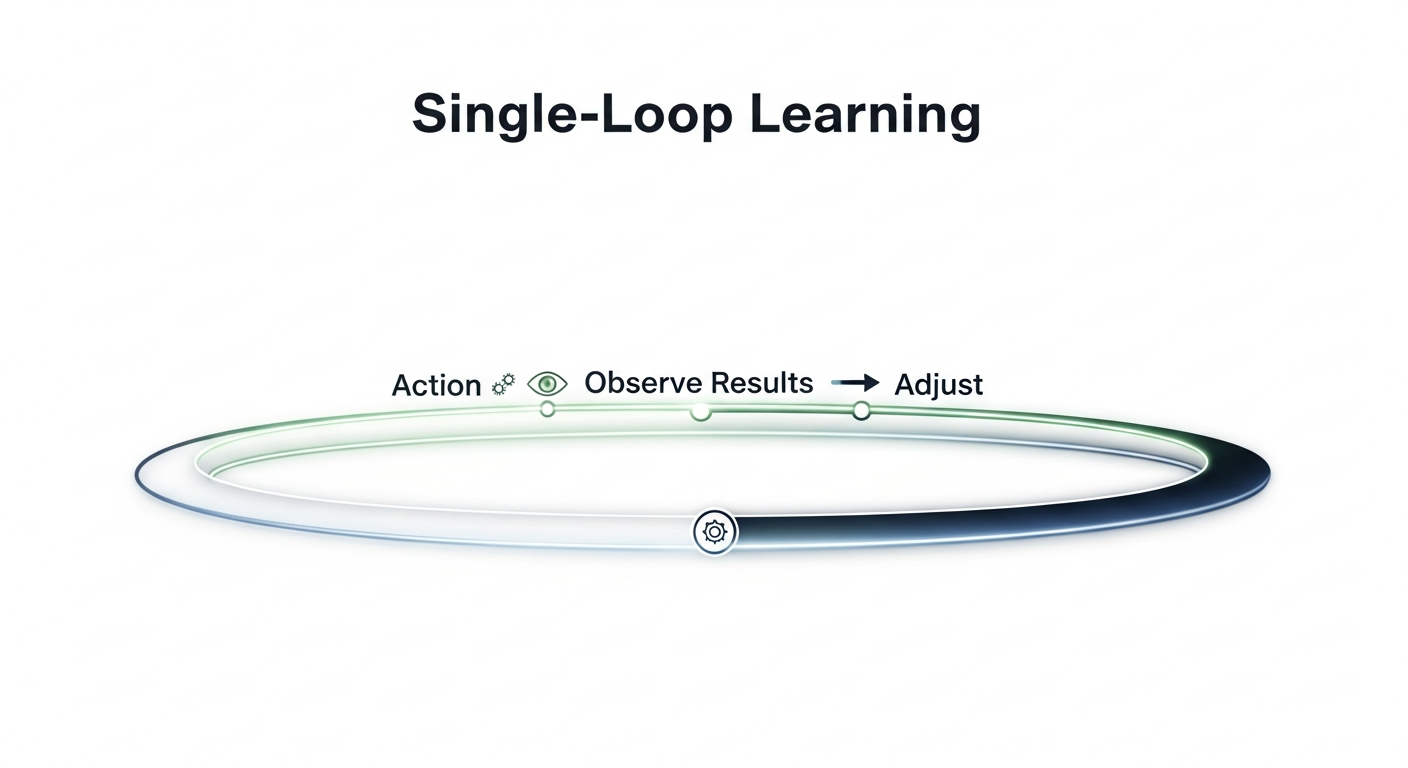
At its core, Single Loop Learning is a corrective process where individuals or organizations detect an error and correct it without questioning the underlying assumptions, values, or policies that led to the error in the first place. Think of a thermostat: it detects when the room temperature deviates from a set point and adjusts the heating or cooling to return to that point. It doesn't question *why* the temperature changed or *if* the set point is still appropriate for the current conditions.
The L&D Application
- Compliance Training: An employee fails a compliance test. The Single Loop approach is to retrain them on the specific policy they failed, perhaps with more examples or a different presentation of the same material. It doesn't question if the policy itself is outdated, if the training methodology is flawed, or if the organizational culture discourages compliance.
- Sales Performance: A sales team misses its quarterly targets. Single Loop Learning dictates additional training on existing sales techniques, more practice role-playing, or a refresh on product features. It often overlooks the possibility that market conditions have shifted, competitor strategies have evolved, or the company's sales model is no longer effective.
- Technical Skills Training: A team struggles with a new software feature. The immediate response is often a tutorial or workshop focused solely on how to use that feature, rather than exploring if the software integration process was poor, if the initial training was insufficient, or if the team's underlying technical literacy needs a broader uplift.
In industries like banking, finance, and insurance, where regulations are constantly evolving, Single Loop Learning can lead to a perpetual cycle of reacting to non-compliance without proactively preventing it. Similarly, in retail, hospitality, and pharma, merely addressing immediate operational errors can obscure deeper systemic issues in customer service, patient care, or supply chain management.
The L&D Challenge: When Single Loop Learning Falls Short
While effective for routine tasks and immediate error correction, Single Loop Learning is fundamentally reactive. It’s about "doing things right" rather than "doing the right things." For L&D leaders grappling with complex, interconnected challenges, this approach presents significant limitations:
- Superficial Solutions: It treats symptoms, not root causes. The same problems tend to resurface because the underlying assumptions remain unchallenged.
- Stifles Innovation: By adhering strictly to existing norms, it discourages creative problem-solving and the development of novel approaches.
- Limits Adaptability: In rapidly changing environments, organizations need to question their fundamental operating principles. Single Loop Learning prevents this deeper reflection, leaving them vulnerable to market shifts and disruptive technologies.
- Inefficient Resource Allocation: Constantly re-training on the same issues, or tweaking minor elements, can be a significant drain on L&D budgets and time without yielding substantial, lasting improvements. This is particularly true in industries like oil & gas and mining, where safety protocols demand constant, yet deeply reflective, updates.
Addressing Modern L&D Demands: Questions for Enhanced Learning Outcomes
To move beyond the limitations of reactive training, L&D leaders must embrace a more inquisitive and proactive mindset. Consider these questions, designed to foster deeper insights and more sustainable learning strategies:
How can L&D leverage advanced analytical insights to refine existing training processes for maximum impact?
By scrutinizing learning data beyond completion rates – looking at performance metrics, engagement patterns, and skill application – L&D can pinpoint not just *what* isn't working, but *why*. This data-driven approach allows for fundamental shifts in curriculum design, delivery methods, and even the foundational assumptions about learner needs, moving past superficial adjustments.
What strategies can organizations employ to ensure learning initiatives scale effectively across diverse global teams while maintaining consistency?
Achieving consistent, high-quality learning across geographically dispersed teams requires more than simply replicating existing courses. It demands an examination of cultural contexts, local regulatory nuances, technological infrastructure, and varying learning styles. Solutions must be flexible, modular, and accessible, designed from the ground up to accommodate global variance without diluting core messages.
In what ways can dynamic learning systems anticipate and address emerging skill gaps before they become critical organizational challenges?
Proactive skill development requires systems that can analyze trends in industry, technology, and internal performance to forecast future needs. Instead of waiting for a skill deficit to impact productivity, L&D can utilize predictive models and continuous feedback loops to identify and mitigate potential gaps, ensuring the workforce is always prepared for what's next.
Moving Beyond the Obvious: Modern L&D Strategies
To cultivate a truly learning organization, L&D must embrace methodologies and technologies that facilitate deeper inquiry and systemic change. This means shifting from merely fixing problems to questioning the frameworks within which problems occur.
- Embrace Microlearning: Instead of monolithic courses that get minor tweaks, break down learning into bite-sized, digestible modules. This allows for quicker iteration and more focused feedback. For L&D leaders aiming for rapid, relevant content delivery, exploring a MaxLearn Microlearning Platform can be a game-changer.
- Leverage Adaptive Learning: Move away from one-size-fits-all training. Systems that adapt to individual learner progress and preferences inherently challenge the assumption that all learners need the same content in the same way. To truly personalize learning journeys and cater to individual needs, the principles of Adaptive Learning are invaluable.
- Integrate Gamification: Enhancing engagement and retention becomes seamless with a Gamified LMS. This approach can make the process of exploring new ideas and challenging norms less daunting, encouraging a more experimental learning culture.
- Utilize Advanced Authoring Tools: Rapidly prototyping and deploying new learning experiences, which is crucial for testing new assumptions, is supported by modern tools. Developing targeted, high-impact content quickly is facilitated by an AI Powered Authoring Tool.
- Focus on Risk-focused Training: Beyond standard compliance, proactive L&D examines potential vulnerabilities and designs training to build resilience and foresight. This goes beyond fixing a past error to preventing future, unknown ones. Furthermore, addressing critical vulnerabilities requires Risk-focused Training that goes beyond surface-level fixes.
Transforming Your L&D Landscape
The transition from Single Loop Learning to a more comprehensive, insightful learning approach requires a shift in mindset and a strategic investment in the right tools and methodologies. For L&D VPs, Directors, and Managers across finance, healthcare, retail, and heavy industry, this means:
- Fostering a Culture of Inquiry: Encourage learners and trainers alike to ask "why" – why a particular process exists, why a certain outcome occurred, and what fundamental assumptions are at play.
- Adopting Data-Driven Decisions: Use analytics not just to report on training, but to inform strategic changes to learning design and organizational processes.
- Investing in Flexible Technology: Choose platforms that allow for rapid content creation, personalized learning paths, and robust data collection to support continuous improvement and adaptation.
Conclusion
In today's complex business environment, merely correcting errors isn't enough. L&D leaders must equip their organizations to continuously question, innovate, and adapt at a fundamental level. By consciously moving beyond the reactive confines of Single Loop Learning and embracing advanced methodologies and platforms, L&D can evolve from a cost center to a strategic driver of organizational excellence, ensuring their workforce is not just competent, but truly capable of navigating and shaping the future.
.jpg)