

Beyond the Checklist: Mastering Single-Loop and Double-Loop Learning for L&D Leaders
In today's rapidly evolving corporate landscape, the efficacy of an organization's learning and development (L&D) strategy is paramount. For Vice Presidents, Directors, and Senior Managers of L&D, the challenge isn't just about delivering training; it's about fostering genuine, impactful change that drives strategic objectives. This distinction often boils down to understanding and implementing two fundamental learning paradigms: Single-Loop Learning and Double-Loop Learning.
While Single-Loop Learning offers crucial quick fixes and maintains operational efficiency, it’s Double-Loop Learning that propels organizations toward true innovation, resilience, and sustainable growth. Let's delve into these concepts and explore how embracing both, with a strategic emphasis on the latter, can revolutionize your L&D initiatives across diverse sectors like Compliance, Sales, Banking, Finance, Insurance, Retail, Pharma, Healthcare, Hospitality, Oil and Gas, and Mining.
Understanding Single-Loop Learning: The Adaptive Fix
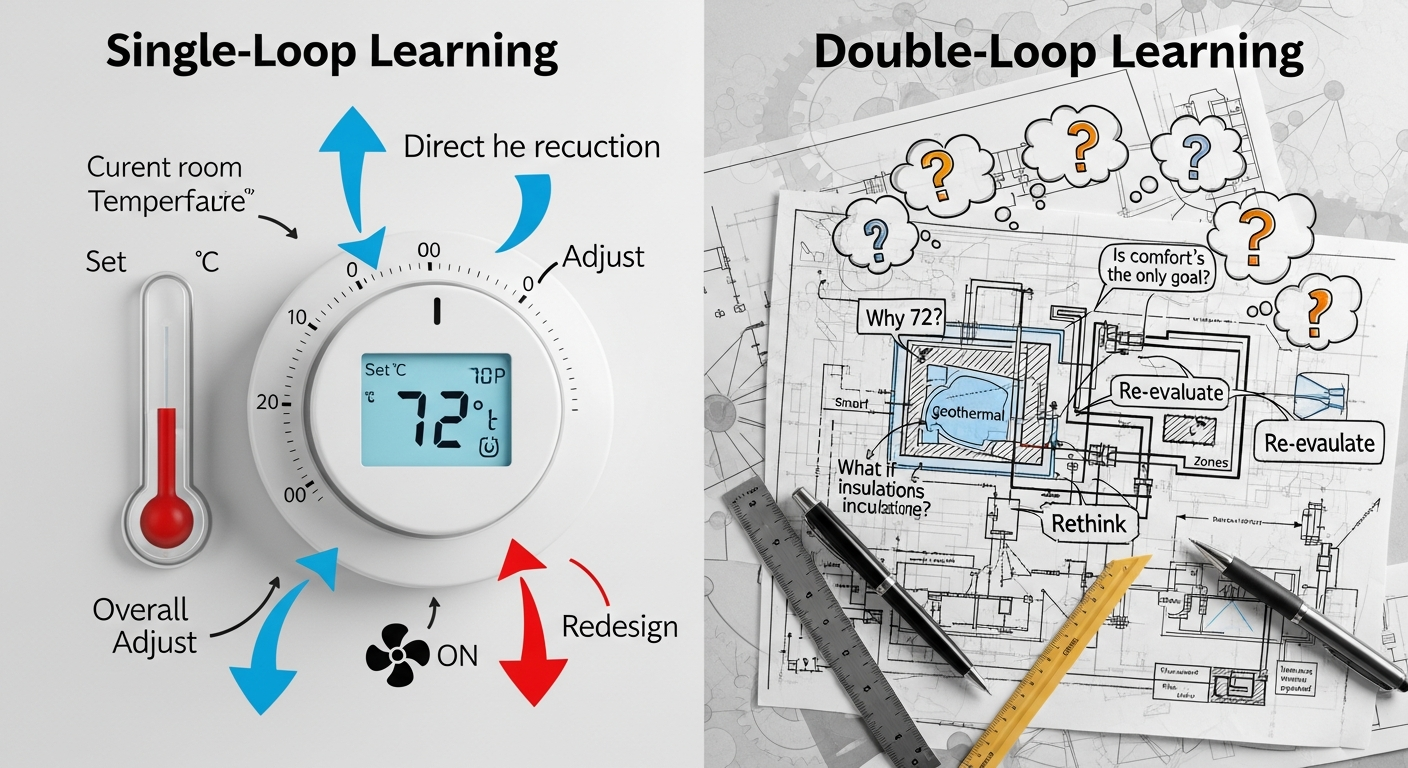
Single-Loop Learning is akin to a thermostat. When the room gets too cold, the thermostat registers the deviation from the desired temperature and turns on the heater. The system adjusts its actions based on feedback, but it doesn't question its fundamental programming or the ideal temperature setting. In an organizational context, Single-Loop Learning involves detecting and correcting errors within a given set of operating norms, policies, or goals.
For L&D, this often manifests as:
- Updating a compliance training module to reflect new regulations.
- Adding a new product feature to sales training after market feedback.
- Refining an onboarding process based on new hire survey results.
- Providing remedial training when a specific skill gap is identified.
This type of learning is essential for day-to-day operations and incremental improvements. It ensures that existing systems run smoothly and efficiently. However, its limitation lies in its inability to challenge the underlying assumptions, values, and policies that govern the organization's actions. It corrects symptoms, not necessarily the root causes of systemic issues.
Embracing Double-Loop Learning: The Transformative Shift
If Single-Loop Learning is a thermostat, Double-Loop Learning is the homeowner who not only adjusts the thermostat but also questions whether the house is properly insulated, if the heating system is optimal, or if the desired temperature itself is appropriate for energy efficiency. This deeper form of learning involves questioning and potentially modifying the underlying norms, assumptions, policies, and goals themselves. It's about "learning how to learn" and "learning how to unlearn."
For L&D, Double-Loop Learning signifies a profound shift:
- Instead of merely updating a compliance module, L&D might investigate why employees consistently struggle with certain regulatory concepts and redesign the entire approach to Risk-focused Training, perhaps by integrating real-world scenarios and critical thinking exercises.
- Beyond adding a new feature to sales training, L&D might analyze why current sales methodologies are failing against new market entrants and overhaul the entire sales training philosophy, potentially leveraging a Gamified LMS for experiential learning.
- Rather than refining an onboarding process, L&D might challenge the entire cultural integration strategy, questioning core values and leadership's role in new employee success.
- Moving beyond remedial training, L&D might ask why skill gaps persist despite repeated interventions, leading to a re-evaluation of job roles, hiring practices, or the fundamental design of learning pathways, possibly through an MaxLearn Microlearning Platform.
Double-Loop Learning drives genuine innovation, strategic agility, and sustainable competitive advantage by fostering a culture of critical inquiry and continuous re-evaluation.
The Imperative for Double-Loop Learning in Modern L&D
In fast-paced sectors like Banking and Finance, where regulatory landscapes are constantly shifting, or in Pharma and Healthcare, where scientific advancements redefine practices overnight, Double-Loop Learning is not just beneficial—it's critical for survival. For L&D leaders in these industries, merely reacting to changes (Single-Loop) is insufficient. Proactively questioning the effectiveness of existing learning strategies and their alignment with future business needs is essential.
Consider the retail sector facing rapid digital transformation, or the Oil and Gas and Mining industries grappling with sustainability and technological shifts. L&D must empower workforces not just to adapt to new tools, but to think critically about how their roles, processes, and even business models might need to evolve. This demands a learning framework that encourages deep reflection and systemic change.
Integrating Advanced Technologies for Deeper Learning Insights
Modern technology, particularly advanced analytics and intelligent systems, plays a crucial role in enabling both Single-Loop and Double-Loop Learning. It provides the data and insights necessary to identify problems and, more importantly, to question underlying assumptions.
How can L&D leaders identify root causes of persistent performance gaps across diverse departments?
Intelligent analytics can pinpoint specific skill deficits, content weaknesses, or environmental factors by analyzing learner interactions, performance data, and business outcomes. These systems move beyond simply showing who completed a course to revealing patterns in engagement, comprehension, and real-world application, offering a comprehensive view of performance bottlenecks.
What strategies can elevate our compliance training from mere checkbox completion to genuine behavioral change?
Utilizing smart systems for personalized learning paths and scenario-based simulations can move training beyond basic recall. These tools foster critical thinking and application in real-world scenarios, thereby driving deeper behavioral shifts. Imagine simulated banking fraud scenarios or pharmaceutical regulatory dilemmas where learners must apply knowledge, not just repeat it.
How can our organization proactively adapt its learning strategies to anticipate future industry disruptions and skill demands?
Intelligent predictive analytics can forecast emerging skill gaps and industry trends, allowing L&D to design forward-thinking programs. This involves integrating Adaptive Learning paths that personalize content based on individual learning styles and career trajectories. An AI Powered Authoring Tool can then enable rapid development of new content, ensuring the workforce remains future-ready and adaptable to unseen challenges in sectors like Hospitality or Sales.
Practical Steps to Foster Double-Loop Learning in Your Organization
Transitioning to a Double-Loop Learning culture requires deliberate effort and strategic investment. Here are actionable steps for L&D leaders:
- Cultivate a Culture of Inquiry: Encourage employees at all levels to ask "why" and "what if" questions, not just "how." Create safe spaces for challenging existing paradigms.
- Implement Robust Feedback Mechanisms: Go beyond traditional surveys. Utilize continuous feedback loops, peer reviews, and 360-degree assessments that encourage critical self-reflection and organizational critique.
- Leverage Data Analytics: Use learning analytics and performance data not just to measure outcomes, but to question the assumptions behind your learning interventions. Is the training effective, or are there deeper systemic issues?
- Promote Experimentation and Psychological Safety: Create an environment where experimentation with new approaches is encouraged, and failure is seen as a learning opportunity rather than a punitive event.
- Invest in Critical Thinking and Systems Thinking Training: Equip employees with the cognitive tools to analyze complex problems and understand interconnectedness, moving beyond siloed solutions.
- Regularly Review Learning Strategy: Schedule periodic, structured reviews of the entire L&D strategy, questioning its fundamental alignment with evolving business goals and future market demands.
The Role of Technology in Empowering Learning Loops
Modern learning platforms are indispensable tools for fostering both types of learning. A MaxLearn Microlearning Platform provides digestible, on-demand content that allows for quick error correction (Single-Loop) while also serving as a rich data source for analyzing broader learning patterns. A Gamified LMS can motivate learners to engage more deeply with content, encouraging repeated practice and application that reveal not just what to do, but why it works (or doesn't).
Conclusion
For L&D Vice Presidents, Directors, and Senior Managers, the journey from Single-Loop to Double-Loop Learning is a strategic imperative. While Single-Loop Learning is vital for maintaining operational excellence, it is Double-Loop Learning that unlocks an organization’s potential for true innovation, resilience, and adaptability in the face of constant change. By fostering a culture of deep inquiry, leveraging advanced learning technologies, and empowering your workforce to question and redefine foundational assumptions, you can position your organization not just to react to the future, but to actively shape it.
.jpg)


