

The Strategic Advantage: Why L&D Leaders Must Master Single-Loop and Double-Loop Learning
In today's dynamic business landscape, marked by relentless change and increasing complexity, organizations face an urgent need to adapt, innovate, and continuously improve. For Vice Presidents, Directors, and Senior Managers in Learning & Development, this isn't just about rolling out new training programs; it's about fundamentally reshaping how an organization learns and evolves. At the heart of this transformation lies the powerful framework of Single-Loop and Double-Loop Learning, concepts that offer a profound lens through which to examine organizational effectiveness, strategy, and resilience. Understanding and implementing both loops is not merely an academic exercise; it's a strategic imperative for fostering sustained growth, navigating compliance challenges, optimizing sales performance, and driving innovation across sectors from banking to healthcare, retail to oil and gas.
Understanding Single-Loop Learning: The "Fix-It" Approach
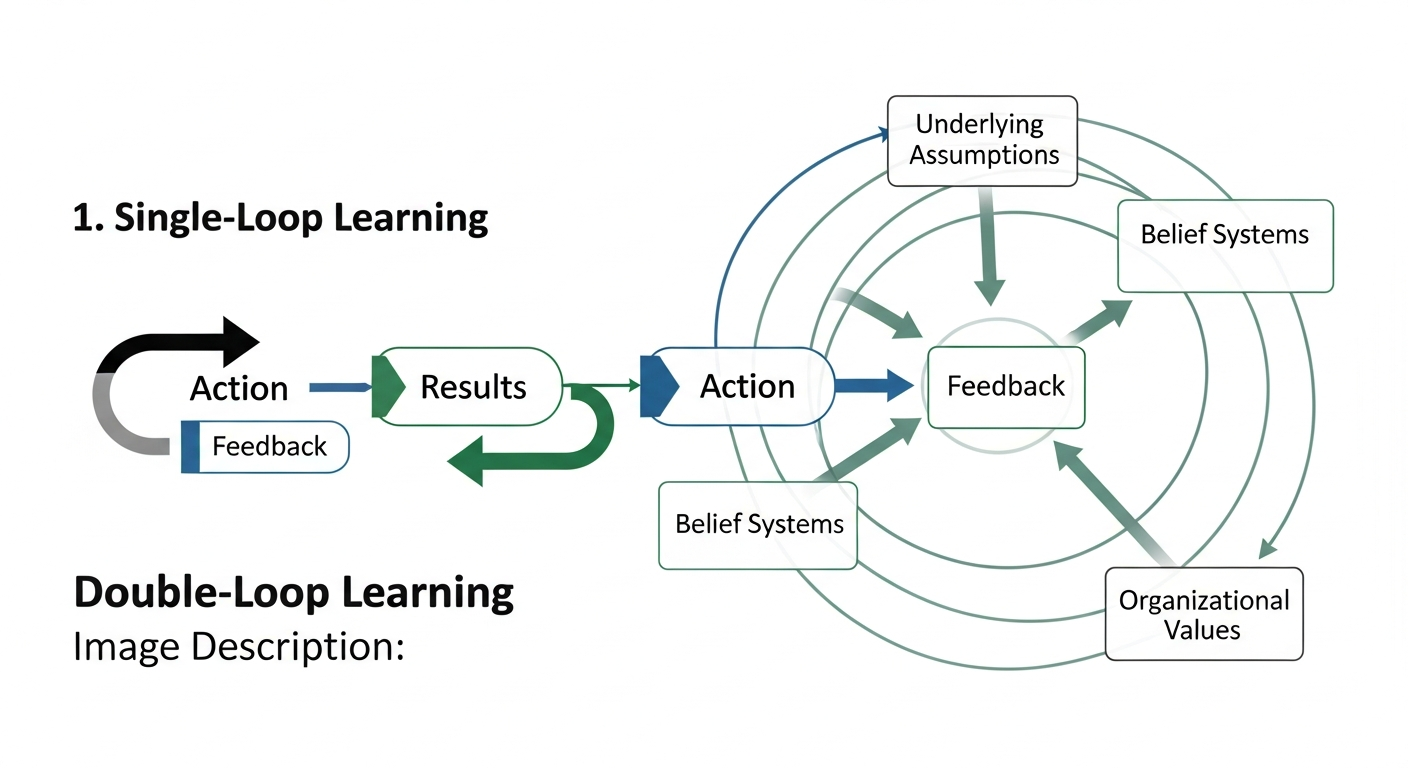
Single-Loop Learning, often referred to as "error correction," involves adjusting actions to achieve a given goal or maintain existing norms without questioning the underlying assumptions or strategies. Think of it as a thermostat: when the room gets too cold, the thermostat turns on the heater to bring the temperature back to the set point. The goal (desired temperature) and the method (heating) remain unquestioned.
In an L&D context, Single-Loop Learning manifests when:
- A sales team isn't meeting quotas, so L&D provides refresher training on product features or sales scripts. The objective is to fix the immediate performance gap.
- A compliance audit reveals a procedural error, leading to a new module explaining the correct procedure. The goal is to rectify the specific deviation.
- New software is introduced, and L&D creates tutorials on how to use it.
While essential for operational efficiency and adherence to established protocols, Single-Loop Learning has its limitations. It excels at improving existing systems but often fails to challenge or transform them. It's about "doing things right," but not necessarily "doing the right things."
Embracing Double-Loop Learning: The Path to Transformative Growth
Double-Loop Learning, in contrast, involves questioning the governing variables themselves—the underlying assumptions, values, policies, and goals that drive actions. It's about asking "why" rather than just "how." If Single-Loop Learning is adjusting the thermostat, Double-Loop Learning is asking whether the room even needs to be heated, or if there's a more fundamental reason for discomfort, perhaps even questioning the purpose of the thermostat itself.
For L&D professionals, embracing Double-Loop Learning means:
- Instead of just training a sales team on product features, exploring why sales are low. Are the products truly meeting customer needs? Is the sales strategy outdated? Are market conditions fundamentally shifting?
- Beyond correcting a compliance error, investigating why the error occurred. Is the policy unclear? Is the organizational culture inadvertently encouraging shortcuts? Are the risk assessment frameworks adequate for emerging threats? This leads to Risk-focused Training that addresses root causes.
- Questioning if the chosen software is the most effective tool for the organizational objective, rather than just training on its usage.
Double-Loop Learning fosters genuine innovation, enhances adaptability, and builds resilience by equipping individuals and teams to fundamentally rethink their mental models and strategic frameworks. It’s crucial for industries like banking and finance, which face evolving regulations and market pressures, or healthcare, where patient outcomes demand constant re-evaluation of practices.
The L&D Imperative: Cultivating a Culture of Deep Inquiry
For L&D leaders, the mandate is clear: move beyond merely facilitating Single-Loop improvements to actively championing Double-Loop inquiry. This means designing learning experiences that not only impart knowledge but also encourage critical thinking, challenge assumptions, and promote continuous reflection on organizational purpose and effectiveness. It transforms L&D from a reactive support function to a proactive strategic partner.
Consider the diverse needs across industries:
- Compliance: Moving beyond rote memorization of regulations to understanding the spirit of the law and proactively identifying systemic risks.
- Sales: Evolving from product knowledge dissemination to strategic market analysis and customer empathy, leveraging insights from AI Powered Authoring Tool for tailored content.
- Banking & Finance: Adapting to fintech disruptions by questioning traditional service models and operational norms.
- Pharma & Healthcare: Innovating patient care pathways and drug development processes, not just optimizing existing ones.
- Retail: Rethinking customer engagement strategies in the face of e-commerce dominance.
Leveraging Technology for Transformative Learning
Modern eLearning platforms are invaluable tools for supporting both learning loops. They offer the infrastructure to deliver targeted, efficient Single-Loop training while also providing the dynamic environments needed for Double-Loop exploration.
Understanding Learner Needs Through Advanced Analytics
Consider a scenario where an L&D team is observing a dip in employee engagement with critical ethical training modules in a financial institution. A common approach might be to simply remind employees to complete the modules (Single-Loop). However, a deeper inquiry would ask: What if the current training format isn't resonant with today's diverse workforce, spread across various roles and experience levels? Or, are the underlying cultural messages about ethics being effectively communicated and reinforced?
Question: How can sophisticated analytical tools within a learning platform help us uncover the deeper, often unarticulated, needs and motivations of our learners, enabling us to design interventions that go beyond surface-level fixes?
By tracking engagement patterns, completion rates, assessment scores, and even learner feedback through integrated surveys, an L&D platform can reveal trends that might suggest a need for a fundamental shift in instructional design or content strategy. This moves us from merely tracking completion to understanding why certain content resonates or fails, prompting deeper questions about learning objectives and organizational goals.
Tailoring Content for Global and Regional Impact
In a large multinational corporation operating in the oil and gas sector, safety protocols are paramount. If a particular region consistently reports more safety incidents despite regular training (Single-Loop), simply repeating the same training might not be enough. The Double-Loop approach would question if the safety protocols themselves are culturally appropriate, practically feasible in that specific environment, or if local leadership interpretations differ significantly.
Question: How can a flexible learning system enable us to rapidly adapt and localize learning content not just for different languages, but for distinct cultural nuances, regulatory environments, and operational realities across various global sites, thereby ensuring deep organizational intelligence and compliance?
A robust learning platform allows for the creation of Adaptive Learning pathways that can be dynamically adjusted based on geography, role, or even individual performance data. This ensures that learning isn't a one-size-fits-all solution but rather a contextually relevant experience that challenges local assumptions and fosters deeper understanding of principles, not just rules.
Driving Overall Organizational Intelligence and Performance
In the retail sector, a new customer service strategy is rolled out, accompanied by extensive training (Single-Loop). Initial results are mixed. A Double-Loop approach would then ask: Is our customer service strategy genuinely innovative? Does it align with evolving consumer expectations? Are our employees truly empowered to implement it, or are systemic barriers (e.g., rigid policies, lack of autonomy) hindering its effectiveness?
Question: Beyond immediate training efficacy, how can a comprehensive learning ecosystem contribute to a broader, more profound shift in organizational thinking and operational excellence, fostering a continuous cycle of strategic questioning and improvement?
This is where platforms like MaxLearn Microlearning Platform become critical. They not only deliver bite-sized, engaging content but also facilitate continuous feedback loops, peer-to-peer learning, and knowledge sharing. A Gamified LMS can motivate learners to explore complex scenarios and collaborate on solutions, pushing them beyond mere compliance to genuine engagement with strategic challenges. These systems allow L&D to track not just what's learned, but how that learning translates into behavioral change and, ultimately, strategic organizational outcomes.
Practical Strategies for Implementation
To cultivate a Double-Loop Learning culture, L&D leaders should:
- Design for Reflection: Integrate prompts for critical thinking, scenario analysis, and debate into all learning modules. Encourage learners to question "why" procedures exist and "what if" alternatives were considered.
- Foster Psychological Safety: Create environments where challenging norms and admitting errors are seen as opportunities for growth, not failure. This is essential for honest self-assessment.
- Leverage Data Beyond Completion: Use analytics from your Gamified LMS or MaxLearn Microlearning Platform to identify areas where performance gaps might indicate deeper systemic issues, not just individual skill deficits. Look at trends in common errors or areas of low engagement.
- Promote Cross-Functional Dialogue: Encourage teams from different departments (e.g., Sales and Product Development, Operations and Legal) to collaboratively analyze challenges and co-create solutions. This broadens perspectives and challenges siloed thinking.
- Champion Experimentation: Support pilots and small-scale experiments, viewing them as learning opportunities regardless of immediate success. Use the insights gained to iterate on processes and strategies.
- Enable Peer-to-Peer Learning: Facilitate platforms for employees to share best practices, discuss challenges, and collectively problem-solve, often leading to emergent insights that challenge existing frameworks.
Measuring Impact and Fostering Continuous Improvement
Measuring the impact of Single-Loop Learning is relatively straightforward: did performance improve, did compliance errors decrease? Measuring Double-Loop Learning, however, requires a broader perspective. It involves assessing:
- The frequency and quality of critical discussions.
- The generation of innovative solutions or strategic shifts.
- The agility with which the organization adapts to unforeseen challenges.
- Improvements in employee engagement and ownership of organizational goals.
Ultimately, both Single-Loop and Double-Loop Learning are vital. Single-Loop provides the necessary precision and efficiency within existing frameworks, while Double-Loop provides the vision and agility to adapt those frameworks when circumstances demand. L&D professionals who master the art of integrating both will not only drive individual competence but also build truly intelligent, resilient, and forward-thinking organizations ready to thrive in any future.
.jpg)


