

Beyond the Surface: Driving Transformative L&D with Single and Double-Loop Learning
In today's dynamic business landscape, organizational learning isn't just a buzzword; it's the bedrock of sustained competitive advantage. For Vice Presidents, Directors, and Senior Managers of Learning & Development (L&D), understanding how organizations learn—and critically, how they can learn better—is paramount. This article delves into the powerful frameworks of Single-Loop and Double-Loop Learning, exploring their nuances, benefits, and how L&D leaders across industries from Banking to Healthcare, and Retail to Oil and Gas, can harness them to foster true organizational growth and resilience.
The distinction between merely correcting errors and fundamentally questioning the assumptions that led to those errors is crucial. It differentiates an organization that adapts incrementally from one that innovates and thrives through profound change.
Understanding Single-Loop Learning: The "Doing Things Better" Approach
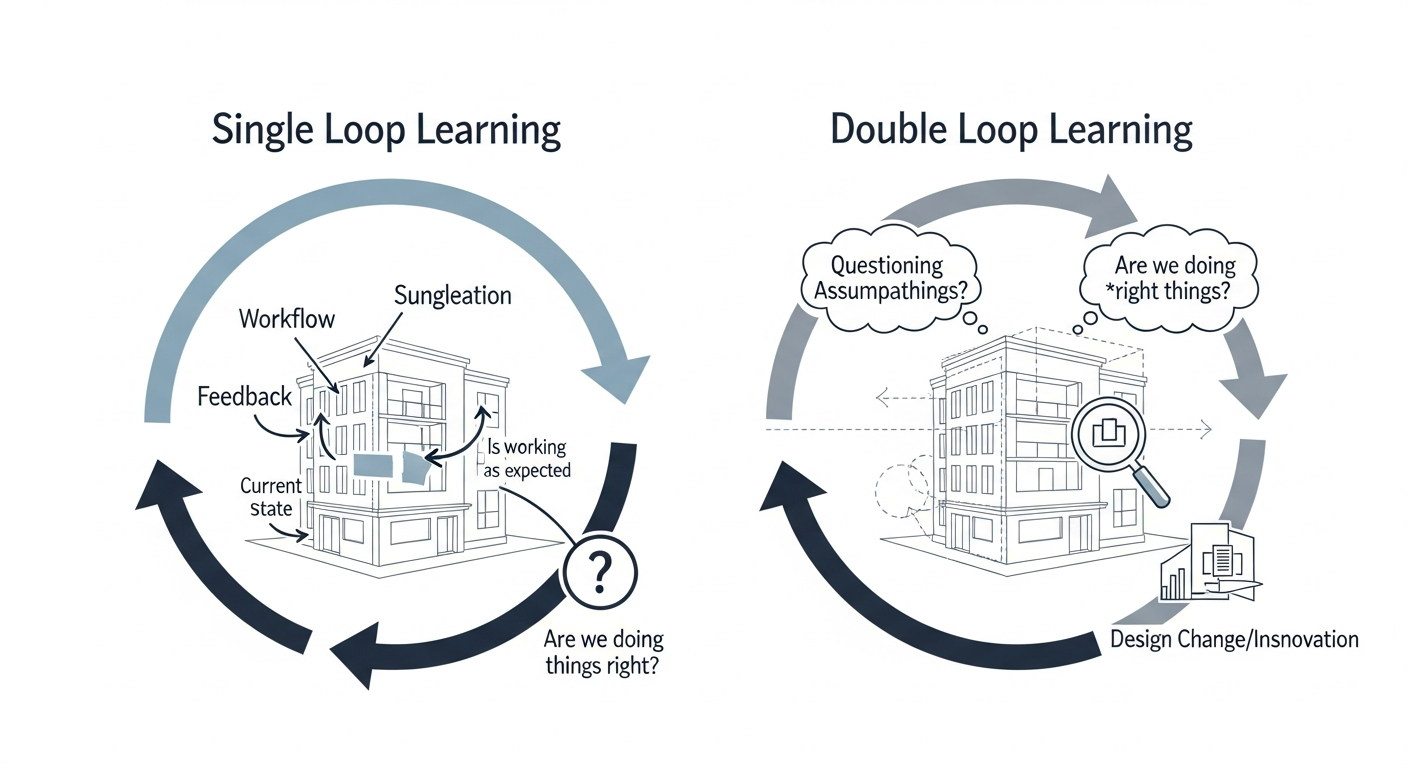
Single-Loop Learning is the most common form of organizational learning. It's about problem-solving within existing frameworks and rules. Think of it as a thermostat: when the temperature deviates from the set point, it automatically adjusts to bring it back in line. The thermostat doesn't question why the set point is what it is, or whether a different set point might be more appropriate; it simply corrects the deviation.
Characteristics and Examples:
- Focus: Identifying and correcting errors, improving efficiency, and achieving existing goals.
- Mechanism: Feedback loops that inform adjustments to actions without challenging underlying policies, assumptions, or values.
- Benefits: Quick fixes, operational efficiency, compliance with established standards, immediate problem resolution.
- Limitations: Can reinforce flawed assumptions, leads to incremental rather than transformative change, can hinder innovation by not questioning the status quo.
In L&D contexts, single-loop learning looks like:
- Updating a sales training module based on feedback that a particular product feature wasn't clearly explained. The goal is to improve the existing module, not to reconsider the entire sales methodology.
- Refining a compliance course after an audit reveals a specific knowledge gap, ensuring future training covers that gap more effectively. The underlying compliance policies themselves are not questioned.
- Adjusting the difficulty of a Gamified LMS challenge after post-training surveys indicate it was too easy or too hard, aiming to optimize engagement within the existing game structure.
- Improving the delivery mechanism of a customer service training program to reduce completion times, without re-evaluating the core principles of customer interaction being taught.
While essential for day-to-day operations and continuous improvement, an over-reliance on single-loop learning can lead to organizations becoming highly efficient at doing the wrong things, or at best, failing to adapt to significant environmental shifts.
Embracing Double-Loop Learning: The "Doing Better Things" Approach
Double-Loop Learning takes organizational inquiry a step further. It challenges the fundamental assumptions, values, policies, and goals that frame current actions. Instead of just fixing the thermostat, double-loop learning asks: "Why is the set point what it is? Is this the optimal temperature? What if we needed to adapt to a completely new climate?"
Characteristics and Examples:
- Focus: Questioning and altering underlying values, assumptions, policies, and strategic objectives.
- Mechanism: Critical reflection, open dialogue, challenging the status quo, and an willingness to unlearn and relearn.
- Benefits: Innovation, strategic repositioning, fundamental problem resolution, adaptability, long-term organizational resilience, and cultural transformation.
- Challenges: Can be uncomfortable, requires psychological safety, may challenge power structures, and can be slower to implement due to deep systemic changes.
In L&D contexts, double-loop learning prompts:
- A pharmaceutical company questioning whether its traditional product training model is truly effective in a rapidly evolving market, leading to a complete redesign of how new drug information is disseminated and understood, perhaps embracing an Adaptive Learning approach for nuanced roles.
- A banking institution re-evaluating the foundational principles of its fraud prevention training, not just updating detection methods, but challenging the cultural norms that might inadvertently contribute to vulnerabilities. This could involve exploring new Risk-focused Training strategies that delve into ethical frameworks.
- A retail chain critically assessing its entire sales training philosophy, moving beyond product knowledge to question customer engagement models, sales psychology, and the very definition of "success" in a multi-channel environment, potentially leveraging an AI Powered Authoring Tool to prototype new, radically different learning paths.
- A healthcare provider examining the root causes of recurring patient safety incidents, not just implementing new protocols (single-loop), but questioning the organizational culture, communication structures, and decision-making processes that allowed the issues to persist.
Why Both Learning Loops Are Indispensable for L&D Leaders
Effective L&D strategies require a symbiotic relationship between single and double-loop learning. Single-loop ensures your training programs are robust, efficient, and address immediate skill gaps. Double-loop ensures your L&D strategy itself remains relevant, innovative, and aligned with the organization's evolving strategic imperatives. Without single-loop, improvements might never materialize; without double-loop, your organization risks becoming incredibly efficient at tasks that no longer serve its purpose.
L&D leaders are uniquely positioned to champion both. By fostering environments where employees feel safe to question norms, and providing the tools to rapidly iterate and improve, you create a truly learning organization.
Implementing Single and Double-Loop Learning in Your Organization
Fostering Single-Loop Learning:
- Robust Feedback Mechanisms: Implement continuous feedback channels within your learning modules, post-training surveys, and performance reviews to quickly identify and address specific deficiencies.
- Data-Driven Iteration: Utilize analytics from your MaxLearn Microlearning Platform to track learner progress, engagement, and mastery, allowing for rapid content updates and optimization.
- Clear KPIs: Establish specific, measurable learning objectives and key performance indicators to assess the effectiveness of current training and guide incremental improvements.
Cultivating Double-Loop Learning:
- Psychological Safety: Create a culture where challenging assumptions, admitting mistakes, and proposing radical new ideas are encouraged, not punished. This is foundational for deep inquiry.
- Strategic Reflection Sessions: Regularly schedule workshops and forums where L&D teams, business leaders, and employees can critically examine existing learning strategies, business models, and underlying assumptions. Ask "why" repeatedly.
- Experimental Mindset: Encourage pilot programs and innovative approaches. Utilize an AI Powered Authoring Tool to quickly prototype and test entirely new learning methodologies based on emerging needs, rather than just refining old ones.
- Cross-Functional Collaboration: Bring diverse perspectives together to challenge departmental silos and their inherent assumptions about how things "should" be done.
Leveraging AI for Enhanced Organizational Learning
Artificial Intelligence is rapidly transforming how organizations learn, offering powerful capabilities to support both single and double-loop processes. For L&D leaders looking to optimize their strategies, AI presents exciting opportunities.
Common Questions from L&D Leaders:
How can advanced computational systems help our L&D team pinpoint specific learning deficiencies across our workforce more efficiently?
AI-powered analytics can process vast amounts of learner data, performance metrics, and assessment results to identify precise skill gaps and emerging knowledge needs. Instead of manual review, AI can instantly highlight where individuals or teams are struggling, allowing L&D to deploy targeted, responsive single-loop interventions, ensuring content updates are always relevant and timely. This accelerates the feedback-correction cycle significantly.
Is it possible for AI to customize learning content effectively for teams operating in different regions, each with unique regulatory and cultural requirements?
Absolutely. Generative AI and machine learning algorithms can analyze local regulations, cultural nuances, and industry-specific compliance requirements to dynamically adapt training materials. This means a single core curriculum can be intelligently modified to suit a sales team in Tokyo, a healthcare provider in Berlin, or an oil rig crew in the North Sea, ensuring localized relevance and maximizing the impact of training for critical double-loop considerations like risk mitigation and ethical conduct.
What practical steps should L&D leaders consider to integrate intelligent technologies into their learning programs to gain deeper strategic insights?
To move beyond mere automation, L&D leaders should start with clear objectives, identifying specific pain points AI can address. Begin with pilot projects, focusing on areas like personalized learning paths, intelligent content curation, or predictive analytics for skill obsolescence. Invest in training L&D professionals to work alongside AI tools, interpreting insights and designing human-centric interventions. Foster a culture of experimentation and continuous learning, where AI acts as a co-pilot, surfacing patterns that challenge existing assumptions and inspire double-loop strategic shifts in your overall L&D approach.
Conclusion
The journey towards a truly adaptive and innovative organization is paved by both single and double-loop learning. As L&D leaders, your role extends beyond delivering training; it’s about architecting a learning ecosystem that not only refines current practices but also boldly questions the very foundations upon which those practices rest. By consciously applying these two powerful frameworks, supported by strategic integration of tools like a MaxLearn Microlearning Platform and an AI Powered Authoring Tool, you can ensure your organization doesn't just survive change, but actively shapes its future. Equip your teams to not only do things better but to consistently discover what the "better things" truly are, driving unparalleled growth and resilience across every segment and industry.
.jpg)


