

Mastering Organizational Agility: The Power of Single and Double-Loop Learning in L&D
In today's dynamic business landscape, characterized by rapid technological advancements, evolving market demands, and complex regulatory frameworks, the ability of an organization to learn and adapt is paramount. For Vice Presidents, Directors, and Senior Managers of Learning & Development across industries like Compliance, Sales, Banking, Finance, Insurance, Retail, Pharma, Health Care, Hospitality, Oil and Gas, and Mining, fostering a culture of continuous improvement isn't just beneficial—it's essential for survival and growth. At the heart of this continuous improvement lie two powerful frameworks: Single-Loop and Double-Loop Learning. Understanding and strategically implementing these concepts can transform your L&D function from a reactive support system to a proactive driver of organizational excellence.
Understanding Single-Loop Learning: The 'Fix It' Approach
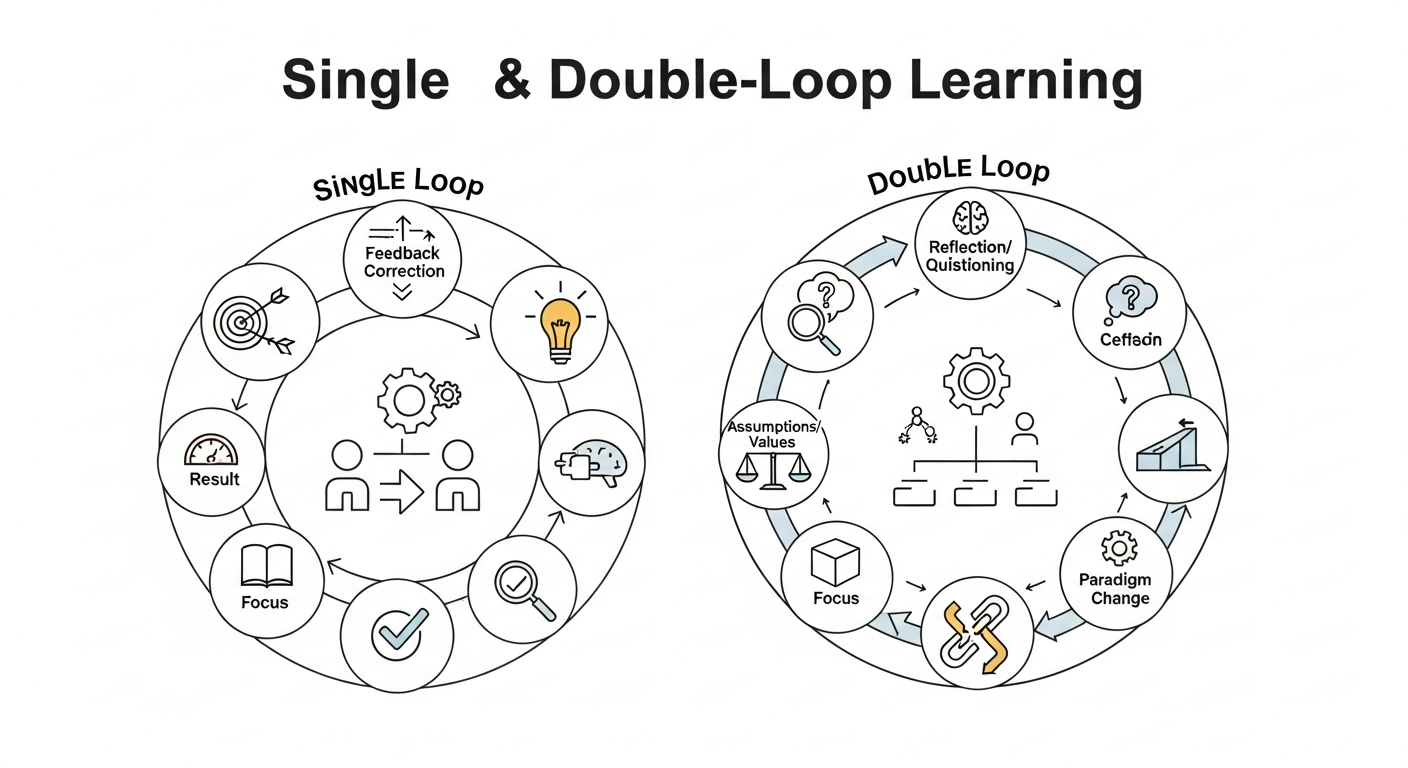
Single-Loop Learning is the most common form of learning within organizations. It involves detecting and correcting errors without questioning the underlying assumptions, policies, or goals. Think of it as adjusting the thermostat: if the room is too cold, you turn up the heat. You're addressing the immediate problem within the existing set of operating rules and goals.
In the context of L&D, Single-Loop Learning manifests when:
- A compliance training module is updated to reflect a new regulatory requirement, ensuring employees adhere to the latest rules without questioning the efficacy or necessity of the regulation itself.
- A sales team's closing rates drop, prompting L&D to introduce a new module on objection handling or a refreshed product knowledge course. The objective is to improve performance within the established sales methodology.
- A new software patch is rolled out in a banking or finance institution, leading to L&D quickly creating a guide or short training session on how to use the updated features.
- In a health care setting, a new protocol for patient intake is introduced, and training is provided to ensure staff follow the steps correctly.
While crucial for day-to-day operational efficiency and immediate problem-solving, Single-Loop Learning primarily focuses on "doing things right." It's efficient for maintaining standards and making incremental improvements, but it doesn't challenge the fundamental 'why' behind existing practices. Without this deeper inquiry, organizations risk repeatedly solving surface-level problems while the root causes of inefficiency or ineffectiveness persist.
Embracing Double-Loop Learning: The 'Re-Think It' Approach
Double-Loop Learning goes beyond merely correcting errors; it involves questioning the governing variables themselves—the underlying assumptions, values, strategies, and policies that frame organizational actions. It's like asking: "Why is the room too cold in the first place? Is the insulation adequate? Is the thermostat faulty? Are we even in the right building?" This level of inquiry leads to profound shifts in understanding and action.
For L&D professionals, Double-Loop Learning is about enabling a paradigm shift:
- Instead of merely updating compliance training, L&D partners with legal and operational teams to understand *why* certain regulations consistently lead to non-compliance issues, perhaps discovering flawed internal processes or an organizational culture that inadvertently encourages shortcuts. Training then shifts to address these systemic issues, not just the rules.
- If sales figures continue to stagnate despite new objection-handling training, Double-Loop Learning would prompt L&D to collaborate with sales leadership to critically examine the entire sales strategy, customer profiling, product market fit, or even the organizational reward system. This could lead to a complete overhaul of the sales approach, not just a tweak.
- In retail, persistent issues with customer service might not just be addressed by more customer service training (Single-Loop). Double-Loop Learning would question the hiring criteria, employee empowerment policies, or even the store layout that impacts service delivery.
- For an oil and gas company experiencing safety incidents, beyond specific safety procedure training, Double-Loop Learning would investigate the organizational safety culture, leadership commitment, and communication channels to fundamentally redesign how safety is perceived and integrated.
Double-Loop Learning is about "doing the right things" by challenging the status quo, fostering innovation, and driving truly transformative change. It requires a willingness to be vulnerable, question deeply held beliefs, and engage in reflective dialogue, often leading to more sustainable and impactful outcomes.
The Imperative for Double-Loop Learning in Modern Organizations
In an era of unprecedented change, organizations that only engage in Single-Loop Learning will find themselves constantly playing catch-up. Industries from Pharma to Banking face continuous disruption, whether from new technologies, changing consumer behaviors, or stricter global regulations. For L&D to be a strategic partner, it must cultivate Double-Loop Learning capabilities within the workforce and within its own function.
This means moving beyond just delivering content to becoming facilitators of critical thinking, experimentation, and organizational reflection. It's about designing learning experiences that not only impart knowledge and skills but also encourage employees to question, innovate, and contribute to systemic improvements. For instance, Risk-focused Training becomes much more powerful when it prompts learners to challenge existing risk mitigation strategies rather than just follow them blindly.
Integrating Learning Loops with Advanced eLearning Solutions
Modern eLearning technologies are powerful tools for facilitating both Single and Double-Loop Learning. A robust MaxLearn Microlearning Platform can efficiently deliver targeted content updates for Single-Loop adjustments. When a new compliance rule emerges or a product feature is added, microlearning can quickly disseminate the necessary information.
However, the real power emerges when these platforms are used to gather data and insights that can trigger Double-Loop reflection. A Gamified LMS, for example, can track learner performance and engagement, revealing patterns that go beyond individual knowledge gaps. Persistent struggles with certain concepts across a broad employee base might indicate a fundamental flaw in an operational process or a strategic assumption, rather than just a need for more training.
Adaptive Learning paths, guided by sophisticated algorithms, can not only personalize content (Single-Loop) but also identify where learners repeatedly deviate or struggle. These deviations can be crucial indicators that the core instructional design, or even the underlying organizational policy, needs a Double-Loop re-evaluation. Similarly, an AI Powered Authoring Tool can analyze learning data to suggest content improvements, which can be simple Single-Loop fixes or flag areas requiring deeper strategic questioning.
Intelligent Technologies and Enhanced Organizational Learning
Question: How can intelligent technologies enhance organizational learning effectiveness and efficiency?
Answer: Advanced algorithms and data processing capabilities can significantly boost learning. They personalize content delivery, ensuring each learner receives the most relevant information at the optimal time. These systems can quickly identify knowledge gaps across a workforce, automate feedback cycles, and dynamically adjust training modules based on performance data. This enables faster, more precise adjustments to learning programs, making the entire process more efficient and impactful for immediate skill acquisition and problem-solving.
Smart Systems for Diverse Workforces and Global Reach
Question: What role do smart systems play in tailoring learning experiences across diverse workforces and various geographic locations?
Answer: Sophisticated platforms powered by advanced computing are instrumental in addressing the complexities of global and diverse workforces. They can adapt learning content for cultural nuances, translate and localize materials into multiple languages, and ensure compliance with regional regulations. By analyzing demographic and performance data, these systems ensure that learning is relevant and effective for every employee, no matter their location or background, fostering consistent development across an entire international enterprise.
Analytical Engines for Deeper Insights and Strategic Shifts
Question: How do analytical engines reveal deeper insights into learning effectiveness and challenge existing organizational strategies?
Answer: Data analytics and pattern recognition engines move beyond surface-level metrics to uncover the root causes of performance issues and learning challenges. By analyzing vast datasets, they can identify correlations between training outcomes, operational inefficiencies, and strategic objectives. This capability allows L&D professionals to question the efficacy of current methodologies, challenge long-held assumptions about how work is done, and suggest fundamental shifts in organizational strategy, leading to more profound and sustainable improvements.
Driving Transformative Learning in Your Organization
For L&D leaders, the journey involves consciously deciding when to apply Single-Loop Learning for efficient problem-solving and when to trigger Double-Loop Learning for fundamental transformation. It requires building organizational capabilities for reflection, open dialogue, and a willingness to challenge deeply ingrained assumptions. By embracing both learning loops, L&D can empower employees to not only adapt to change but to actively drive innovation and shape the future of their respective industries.
Conclusion
Single-Loop and Double-Loop Learning are not mutually exclusive; they are complementary forces in the pursuit of organizational agility. While Single-Loop Learning provides the necessary incremental adjustments for operational excellence, Double-Loop Learning is the engine for strategic innovation and sustainable growth. As L&D leaders, your role is to cultivate environments where both thrive, leveraging advanced eLearning solutions to create a workforce that is not just responsive but truly transformative. Embrace these powerful frameworks, and position your organization at the forefront of continuous learning and adaptation.
.jpg)