

Mastering Corporate Memory: Applying the Ebbinghaus Learning Curve in the AI Era
For L&D leaders navigating the complexities of corporate training across diverse industries—from Compliance and Banking to Pharma and Oil & Gas—the challenge of ensuring lasting knowledge retention is paramount. We invest heavily in training programs, yet often, the information dissipates faster than it's absorbed. This persistent issue brings us back to foundational psychological principles, particularly the pioneering work of Hermann Ebbinghaus and his seminal "Forgetting Curve" and "Learning Curve." Understanding these principles, especially in conjunction with today's advanced technological capabilities, is not just academic; it's a strategic imperative for any organization aiming for sustainable growth and operational excellence.
Ebbinghaus's experiments over a century ago revealed that the vast majority of newly acquired information is forgotten rapidly, often within days, unless actively reinforced. Conversely, he demonstrated that repeated, spaced intervals of learning significantly improve recall and retention. For today's Vice Presidents, Directors, and Senior Managers of L&D, this isn't merely historical data; it's a blueprint for designing more effective, impactful, and intelligent learning ecosystems that counteract the natural decline of memory.
The Enduring Legacy of Ebbinghaus: Forgetting and Learning
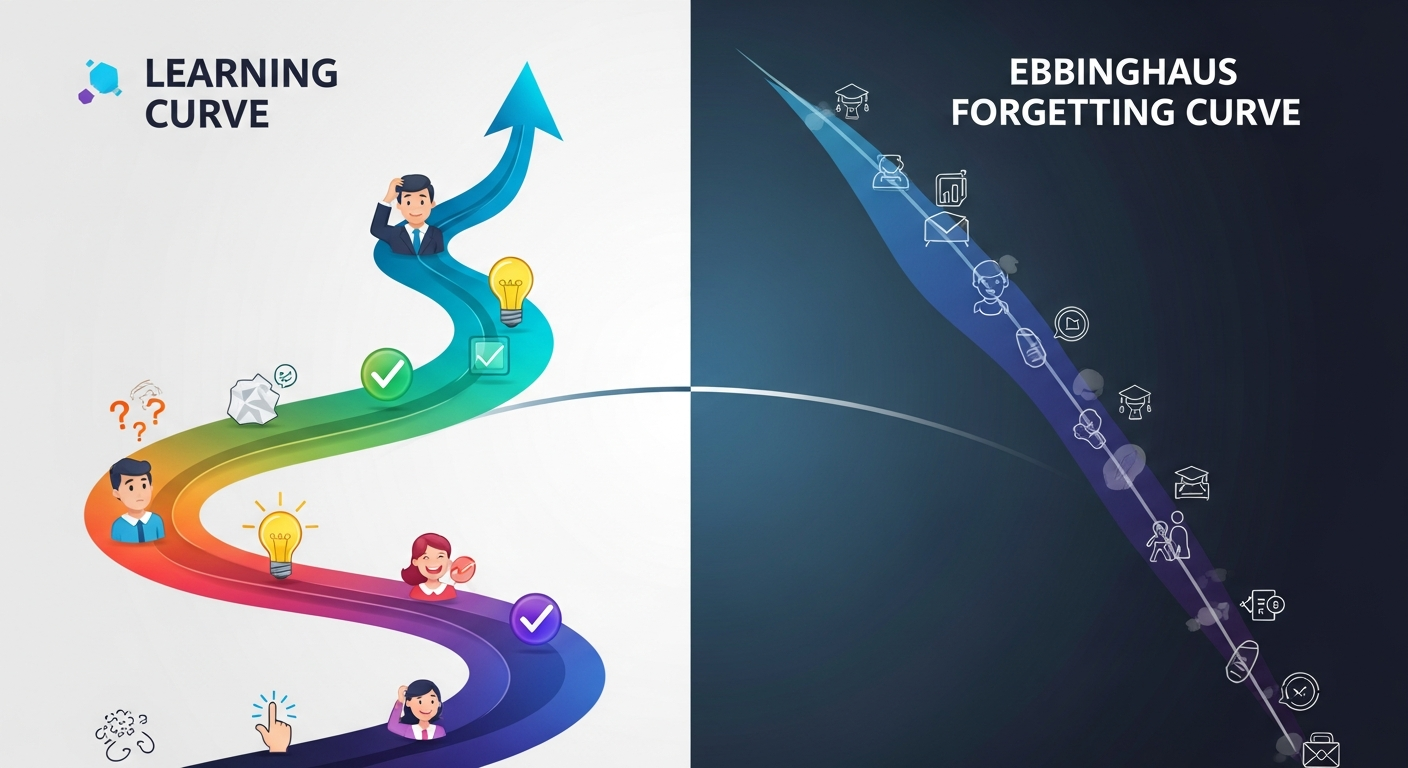
Hermann Ebbinghaus, a German psychologist, conducted groundbreaking research on memory in the late 19th century. His findings, particularly the "Forgetting Curve," illustrate how memory retention decreases over time without conscious effort to retain it. Crucially, he also established the "Learning Curve," demonstrating that each subsequent review or re-exposure to information not only slows the rate of forgetting but also reduces the effort required to recall it.
For L&D professionals, these curves illuminate a critical flaw in many traditional training approaches: the one-off workshop or intensive multi-day seminar often fails to account for the natural decay of memory. Learners are exposed to a deluge of information, and without strategic reinforcement, much of it is lost, rendering the initial investment inefficient. This is particularly critical in high-stakes environments like financial compliance, healthcare protocols, or oil and gas safety procedures, where knowledge gaps can lead to significant financial, reputational, or even safety risks.
Addressing the Retention Challenge Across Industries
The implications of the Ebbinghaus curves resonate deeply across all segments. In Compliance, regulatory updates require constant reinforcement. Sales teams need to internalize product knowledge and objection handling. Banking and Finance professionals must master complex financial instruments. Healthcare staff rely on precise procedural recall, and retail employees need to retain product features and customer service guidelines. In Pharma and Manufacturing, understanding intricate processes is non-negotiable. Even in Hospitality and Mining, the consistent application of best practices is vital for service quality and safety.
Traditional training often struggles to provide the necessary spaced repetition and personalized reinforcement. This is where modern eLearning platforms, informed by Ebbinghaus's insights and powered by intelligent technologies, become indispensable. They offer a pathway to transform sporadic learning events into continuous, impactful knowledge retention strategies.
Modern Solutions: Leveraging Technology for Lasting Knowledge
To truly combat the forgetting curve and optimize the learning curve, L&D strategies must embrace dynamic, technology-driven solutions. One of the most effective modern applications is microlearning, which breaks down complex information into digestible, bite-sized modules that are easier to absorb and recall. A robust MaxLearn Microlearning Platform can deliver these modules at optimal intervals, aligning directly with Ebbinghaus’s principles of spaced repetition.
Engagement is another critical factor. A Gamified LMS can transform monotonous training into an interactive and enjoyable experience. By incorporating elements like points, badges, leaderboards, and challenges, gamification motivates learners to revisit content, complete modules, and engage in repeated practice, thereby naturally applying the Ebbinghaus learning curve without it feeling like a chore.
Furthermore, personalization is key. Not all learners forget at the same rate, nor do they all respond to the same reinforcement strategies. Adaptive Learning systems can analyze individual learner performance and behavior, then dynamically adjust the learning path, content difficulty, and review schedules. This ensures that each learner receives the right information at the right time, precisely when they need it most to counteract forgetting.
AI's Transformative Role in Overcoming the Forgetting Curve
The advent of artificial intelligence (AI) has opened up unprecedented opportunities to not only understand but actively manipulate the Ebbinghaus curves to our advantage. AI-driven systems can analyze vast amounts of learner data to predict when an individual is most likely to forget specific information and intervene with targeted reinforcement.
How can intelligent algorithms enhance knowledge retention in corporate training?
Intelligent algorithms can significantly enhance knowledge retention by creating highly personalized and proactive learning experiences. Through machine learning, these algorithms analyze a learner's performance, past interactions, and unique learning patterns to predict points of potential forgetting. They can then automatically trigger reminders, provide targeted review quizzes, or re-present relevant microlearning modules precisely when the learner is most susceptible to forgetting specific content. This predictive capacity allows for dynamic, "just-in-time" interventions that are far more effective than static, one-size-fits-all training schedules, optimizing the recall process in accordance with Ebbinghaus's principles.
In what ways do advanced analytics tailor learning experiences to individual needs across diverse teams?
Advanced analytics, powered by AI, excels at tailoring learning experiences by creating truly individualized pathways for diverse teams within an organization. For example, in a global sales team, AI can discern that a salesperson in one region might struggle with product features related to local regulations, while another might need more practice on negotiation tactics for specific client segments. The system then recommends specific microlearning modules, practice scenarios, or even peer-to-peer learning opportunities based on identified strengths, weaknesses, role requirements, and cultural context. This level of granular personalization ensures that every team member receives the most relevant and impactful training, addressing their unique learning curve and accelerating their development.
What unique advantages do machine learning insights offer for standardizing compliance training globally, while still addressing regional nuances?
Machine learning insights offer a powerful advantage for global compliance training by enabling standardization without sacrificing regional relevance. AI can analyze vast datasets of compliance regulations, regional legal frameworks, and local operational procedures to identify universal requirements that apply across all geographies, creating a consistent core curriculum. Simultaneously, it can detect unique regional nuances or specific regulatory changes that require localized training modules. An AI-powered system can then automatically serve the standardized core training supplemented by specific, localized content relevant to an employee's geographic location or role. This ensures that every employee receives up-to-date, relevant compliance training, maintaining consistency across the organization while effectively navigating the complexities of diverse legal and operational landscapes.
An AI Powered Authoring Tool further empowers L&D teams to create content that is inherently optimized for retention. These tools can suggest optimal pacing, content structure, and question types based on learning science principles and predicted learner behavior. This ensures that the training content itself is designed to counteract the forgetting curve from its inception.
Moreover, for critical areas like financial risk or healthcare safety, Risk-focused Training can be significantly enhanced by AI. AI can identify areas of highest risk exposure within an organization and tailor training to address those specific vulnerabilities, ensuring that employees are continually updated on critical safety protocols, compliance mandates, and operational procedures where knowledge retention is paramount to mitigating organizational risk.
Implementing a Future-Proof Learning Strategy
For L&D Vice Presidents, Directors, and Senior Managers, the message is clear: the principles of Ebbinghaus remain profoundly relevant. However, their true potential is unlocked only when combined with the analytical power and personalization capabilities of modern AI and advanced learning platforms. By embracing microlearning, gamification, adaptive learning, and AI-powered content creation, organizations can:
- Significantly improve knowledge retention and application across all employee levels.
- Reduce the time and cost associated with remedial training.
- Ensure compliance and reduce risk by reinforcing critical information.
- Boost employee engagement and satisfaction with more relevant and effective training experiences.
- Drive tangible business outcomes through a more skilled and knowledgeable workforce.
Conclusion
The Ebbinghaus Learning Curve provides timeless insights into how humans learn and forget. In an era of rapid technological advancement and unprecedented information density, merely understanding these curves is not enough. Proactive L&D leaders must leverage the transformative power of AI and sophisticated eLearning platforms to build resilient learning ecosystems. By doing so, they can move beyond simply delivering training to truly fostering a culture of continuous learning and lasting knowledge retention, driving innovation, compliance, and competitive advantage across every industry segment they serve.
.jpg)


