

Conquering the Forgetting Curve: Why Your "Study Schedule PDF" Isn't Enough for L&D Success
In the high-stakes world of corporate learning and development, the enemy isn't always a lack of budget or resources. Often, it's something far more insidious: the forgetting curve. This natural human tendency to lose information over time silently erodes the efficacy of even the most well-designed training programs, impacting everything from critical compliance protocols in banking to sales methodologies in retail, and safety procedures in oil and gas. For Vice Presidents, Directors, and Senior Managers of L&D, understanding and actively combating the forgetting curve isn't just about knowledge retention; it's about safeguarding investment, enhancing performance, and mitigating risk across the enterprise.
For decades, L&D professionals have grappled with this challenge, often resorting to traditional methods like lengthy training manuals, one-off seminars, and, yes, even the ubiquitous "study schedule PDF" – a static document intended to guide learners through self-paced review. While these tools had their place, today's dynamic business environment demands more. The pace of change in industries like Pharma, Healthcare, and Finance means that what was learned yesterday might need immediate reinforcement or updating today. Relying solely on a passive PDF schedule to reinforce complex concepts like new regulations or advanced product features is akin to bringing a knife to a gunfight.
The Silent Drain: Why the Forgetting Curve Undermines Your L&D Investment
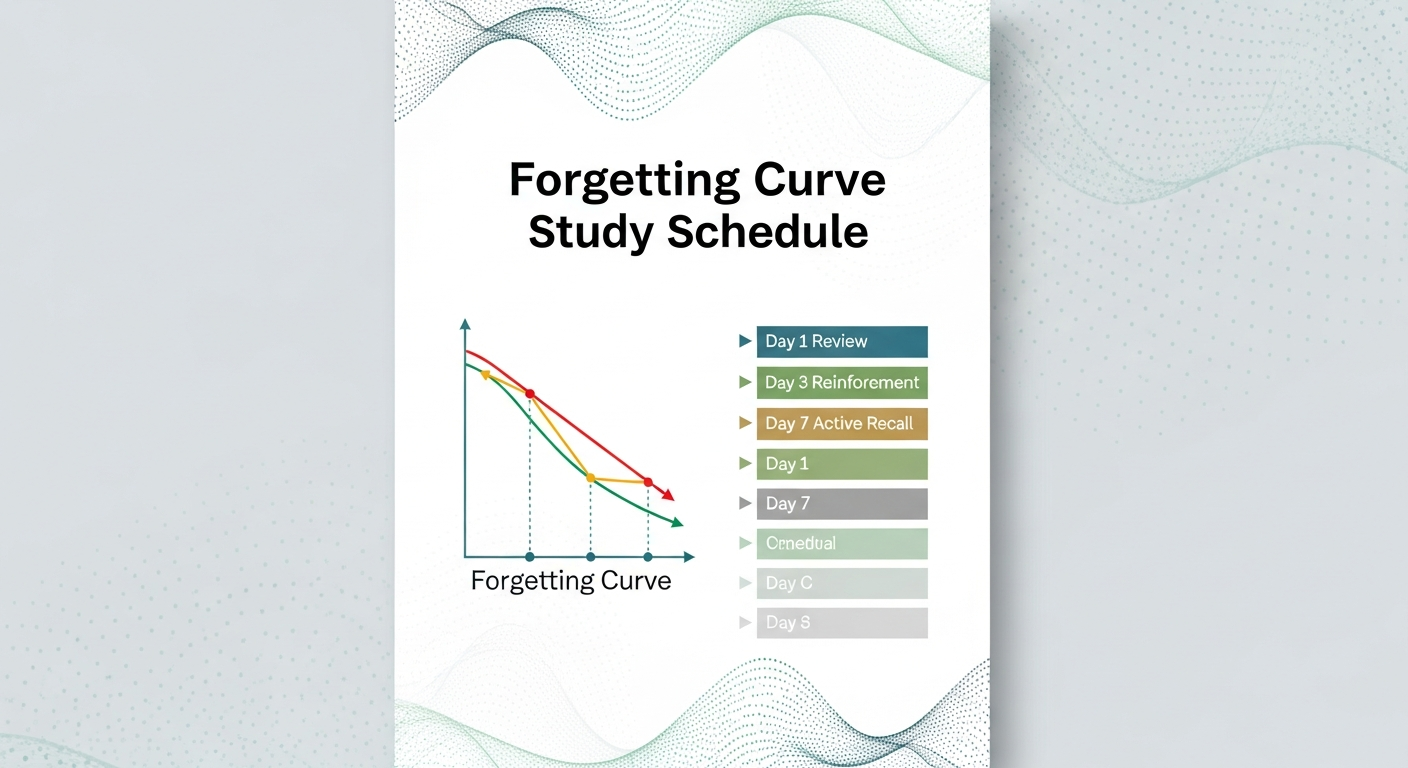
Hermann Ebbinghaus’s research on the forgetting curve revealed that within just an hour, people forget about 50% of new information, and within a day, about 70%. By a week, nearly 90% can be lost. Imagine the implications for your organization:
- Compliance: In Banking, Insurance, and Healthcare, regulatory updates are constant. If employees forget critical compliance details, the organization faces significant penalties and reputational damage.
- Sales Performance: Forgetting product knowledge, sales techniques, or customer relationship management best practices directly impacts revenue generation in Retail and other sales-driven sectors.
- Operational Efficiency: In industries like Oil and Gas or Mining, forgetting safety protocols or equipment operation procedures can lead to accidents, downtime, and massive financial losses.
- Skill Obsolescence: Rapid technological advancements mean skills learned today can quickly become outdated. Without continuous reinforcement, teams fall behind, impacting innovation and competitiveness.
The traditional "study schedule PDF" attempts to address this by providing a blueprint for review. However, it places the onus entirely on the learner, often lacking the engagement, adaptability, and timely triggers necessary for genuine, long-term retention.
Beyond the PDF: Embracing Dynamic Solutions for Knowledge Retention
To truly conquer the forgetting curve, L&D leaders must move beyond static documents and embrace intelligent, dynamic learning solutions. The goal is to move from passive learning consumption to active, personalized engagement that adapts to individual learner needs and the evolving demands of the business.
This is where modern eLearning platforms, especially those leveraging microlearning and artificial intelligence, come into play. They don't just provide content; they orchestrate a continuous learning journey designed to embed knowledge deeply and durably.
A prime example of a platform designed to combat the forgetting curve is the MaxLearn Microlearning Platform. By delivering learning in bite-sized, focused chunks, it makes information easier to digest and retain. This approach is inherently more compatible with the brain's natural learning and forgetting patterns, allowing for strategic repetition.
The Power of Spaced Repetition and Adaptive Learning
The most effective antidote to the forgetting curve is spaced repetition – strategically revisiting information at increasing intervals. Modern learning systems automate this process, ensuring learners encounter key concepts just as they're about to forget them. This is further enhanced by Adaptive Learning, which tailors the learning path based on a learner's performance and knowledge gaps.
Imagine a sales professional in the Retail sector needing to master a new product line. Instead of re-reading a lengthy manual, an adaptive system identifies which specific product features they struggled with in a quiz and delivers a quick, focused microlearning module to reinforce those exact points, days or weeks later. This targeted approach is significantly more efficient and effective than a generic "study schedule PDF."
Leveraging AI for Personalized and Engaging Learning Journeys
Artificial intelligence is revolutionizing how organizations tackle the forgetting curve, transforming the static "study schedule PDF" into a living, intelligent learning companion. AI capabilities allow platforms to:
- Predict Forgetting Points: By analyzing learner performance and engagement data, AI can predict when an individual is most likely to forget specific information, triggering timely refreshers.
- Personalize Content Delivery: AI identifies individual learning styles, prior knowledge, and performance trends to deliver the most relevant content in the most effective format.
- Automate Content Creation and Curation: With an AI Powered Authoring Tool, L&D teams can rapidly create and update engaging microlearning content, ensuring that training materials remain current and impactful, especially for fast-evolving industries like Hospitality or Pharma.
Let's consider some crucial questions regarding AI's role in L&D:
How can artificial intelligence optimize learning content for maximum knowledge retention and application?
AI can analyze vast amounts of data to identify content patterns that lead to higher retention rates. It can recommend optimal presentation formats (e.g., video, interactive quiz, simulation), segment content into digestible microlearning units, and even suggest the best time for content delivery based on individual learner schedules and engagement patterns. For a Compliance training module in Finance, AI might break down complex regulations into interactive scenarios, ensuring active participation and better understanding.
In what ways can artificial intelligence help deliver localized and relevant training experiences across diverse geographical teams?
AI-driven platforms can automatically translate and localize content, adapting not just language but also cultural nuances, examples, and regulatory specificities. For a global organization in the Oil and Gas sector, AI can ensure that safety training delivered to a team in the Middle East is contextually relevant, compliant with local regulations, and presented in a familiar way, vastly improving engagement and comprehension compared to a one-size-fits-all approach.
What insights can artificial intelligence provide into learner engagement and effectiveness, allowing for continuous optimization of training programs?
AI provides deep analytics on how learners interact with content, where they struggle, and what content drives the most significant performance improvements. It can pinpoint bottlenecks, identify areas where content needs improvement, and even predict future training needs. This intelligence allows L&D leaders to make data-driven decisions, continuously refining their strategy to achieve measurable outcomes, such as reduced compliance violations or increased sales conversions.
Transforming L&D: From Reactive to Proactive
Implementing an effective anti-forgetting strategy moves L&D from a reactive function (responding to skill gaps after they appear) to a proactive driver of organizational performance. By integrating solutions like a Gamified LMS, organizations can further boost engagement and motivation, turning the often-dreaded task of review into an enjoyable and rewarding experience.
For industries like Banking and Insurance, which require meticulous attention to detail and adherence to strict guidelines, gamification can make otherwise dry compliance training more palatable and effective. Similarly, for Sales teams, a gamified approach can foster healthy competition and continuous learning around product updates or selling techniques.
Furthermore, a focus on Risk-focused Training, particularly in sectors like Healthcare, Pharma, or Oil and Gas, can be dramatically improved. By using microlearning and spaced repetition, critical safety procedures, hazard identification, and emergency protocols can be reinforced regularly, reducing the likelihood of human error and associated risks.
Conclusion: Future-Proofing Your L&D Strategy
The "Forgetting Curve Study Schedule Pdf" represents an artifact of a bygone era in L&D. While its intention was noble, its execution falls short in today's fast-paced, complex business environment. For L&D Vice Presidents, Directors, and Senior Managers, the imperative is clear: embrace intelligent, dynamic learning solutions that actively combat the forgetting curve.
By investing in platforms that leverage microlearning, spaced repetition, adaptive learning, and artificial intelligence, organizations can ensure that knowledge isn't just acquired, but truly retained and applied. This strategic shift will not only maximize your L&D investment but also empower your workforce to perform at their peak, drive growth, and navigate the challenges of their respective industries with confidence and competence. The future of learning is not about providing information; it's about guaranteeing retention and fostering continuous growth.
.jpg)


