

Is The Forgetting Curve Real? Unraveling Its Impact on Modern L&D
For decades, the concept of the "Forgetting Curve" has loomed large over the learning and development landscape. As L&D Vice Presidents, Directors, and Managers, you invest significant resources into training initiatives, from critical compliance modules to advanced sales techniques and essential product knowledge. But how much of that meticulously crafted content truly sticks? Is the rapid decay of learned information a myth, or a quantifiable challenge that demands a strategic response?
The stark reality is that the forgetting curve is not just a theoretical construct; it’s a powerful, persistent phenomenon that actively erodes the effectiveness and ROI of even the best training programs. In today's dynamic corporate environment, where information overload is the norm and continuous learning is paramount, understanding and actively combating this curve is more crucial than ever before. This article delves into the evidence, implications, and modern strategies to ensure your employees retain the knowledge they need to excel.
Understanding the Forgetting Curve: A Historical Perspective
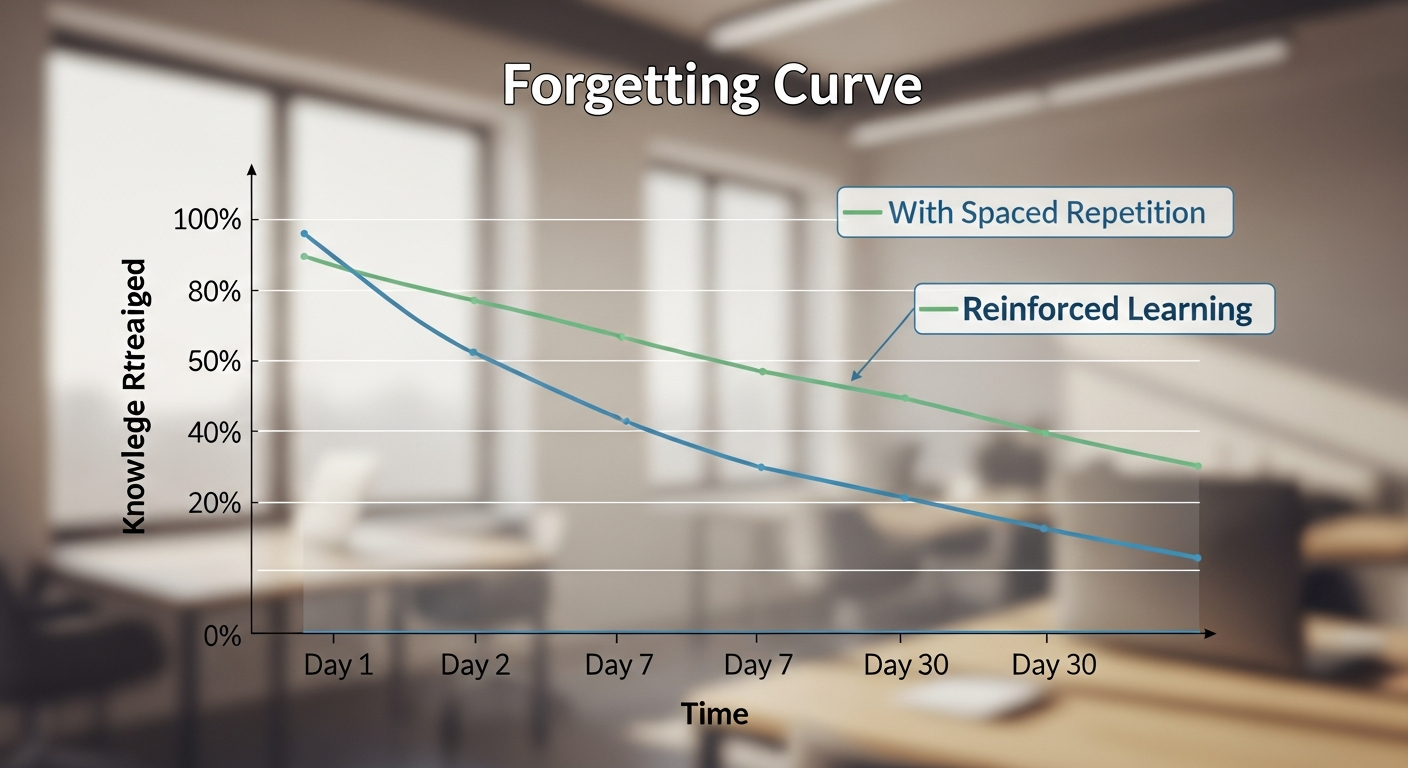
The idea of the forgetting curve originated with German psychologist Hermann Ebbinghaus in the late 19th century. Through his groundbreaking self-experiments, Ebbinghaus discovered that the vast majority of newly acquired information is forgotten within a short period, often within hours or days, unless it's actively reinforced. His research revealed a predictable pattern: a sharp initial drop in retention, followed by a slower, gradual decline.
Imagine your employees attending an intensive workshop on new financial regulations or a critical healthcare protocol. Without immediate and consistent reinforcement, a significant portion of that knowledge can vanish within a week. For industries like compliance, banking, finance, insurance, retail, pharma, healthcare, hospitality, oil and gas, and mining, where knowledge retention directly impacts risk, safety, and profitability, this rapid decay presents a formidable obstacle.
The Modern Workplace: A Catalyst for Forgetting
The challenges identified by Ebbinghaus are amplified in the 21st-century workplace. Employees are bombarded with information daily, often switching between tasks and absorbing new data at a relentless pace. This constant influx, combined with the pressure to perform, makes deep encoding and long-term recall difficult. Traditional, one-off training sessions, even when well-designed, often fall victim to this accelerated forgetting.
Consider the scenario: a sales team learns a new product line, a customer service agent masters updated software, or an oil and gas employee undergoes safety refresher training. Without ongoing engagement and opportunities to apply and recall the information, the knowledge fades, leading to reduced performance, increased errors, and potentially significant business risks.
Evidence and Relevance in Today's L&D
Contemporary studies consistently validate Ebbinghaus's findings, highlighting the critical need for proactive retention strategies. Organizations routinely observe the impact of the forgetting curve through:
- Declining performance metrics post-training.
- Increased errors or non-compliance after initial training.
- The need for frequent retraining on core concepts.
- A noticeable gap between initial learning and long-term application.
The economic implications are substantial. Millions are spent annually on training, but if the learned content doesn't translate into sustained knowledge and improved performance, much of that investment is lost. The forgetting curve is real, and it directly impacts your training ROI and the competence of your workforce.
Combating the Forgetting Curve: Strategies for Retention
The good news is that while the forgetting curve is a powerful force, it’s not insurmountable. Modern L&D leverages innovative approaches and technology to flatten the curve and dramatically improve knowledge retention:
Microlearning
Breaking down complex information into small, digestible chunks of content is incredibly effective. MaxLearn Microlearning Platform delivers targeted, bite-sized lessons that fit seamlessly into an employee's workflow, making learning less overwhelming and more sticky.
Spaced Repetition
This technique involves revisiting information at increasingly longer intervals. Instead of cramming, spaced repetition reinforces learning over time, moving knowledge from short-term to long-term memory. Advanced systems can automate this process, prompting learners for recall at optimal times.
Active Recall
Instead of passively rereading notes, active recall involves retrieving information from memory through quizzes, flashcards, or self-testing. This effortful retrieval strengthens neural pathways and significantly boosts retention.
Gamification
Turning learning into an engaging, game-like experience increases motivation and participation. Leaderboards, badges, points, and challenges within a Gamified LMS make the reinforcement process enjoyable and encourage repeated interaction with the content.
Adaptive Learning
Personalized learning paths that adjust to an individual's pace and knowledge gaps are highly effective. Adaptive Learning technologies analyze performance data to deliver tailored content and challenges, ensuring learners focus on what they need most.
AI-Powered Tools
Artificial intelligence is revolutionizing how we create, deliver, and manage learning. An AI Powered Authoring Tool can streamline content creation, suggest optimal learning paths, and provide actionable insights into learner behavior and retention.
Intelligent Solutions for Modern L&D Queries
As L&D leaders navigate the complexities of knowledge retention, several questions frequently arise:
How can advanced algorithms personalize learning paths to improve knowledge retention?
Intelligent systems analyze individual learner data, identifying strengths and weaknesses. They then dynamically adjust the learning content, pace, and sequence, ensuring each employee receives precisely what they need, when they need it. This highly personalized approach counters the generic nature of traditional training, making learning more relevant and thus more memorable.
What impact does intelligent automation have on designing engaging training content that counters memory decay?
Intelligent automation can revolutionize content design. It can suggest interactive elements, generate varied practice questions, and even create scenario-based modules based on learner performance data. This ensures content remains fresh and challenging, actively engaging learners and compelling them to recall information rather than passively receive it, thereby mitigating the rapid decline associated with memory decay.
Where can my organization find solutions to implement effective knowledge reinforcement strategies across a distributed workforce?
For organizations with employees spread across different locations and time zones, digital learning platforms are essential. These platforms offer centralized access to microlearning modules, gamified quizzes, and adaptive pathways accessible from any device. Robust learning management systems are designed to deliver consistent, measurable reinforcement strategies to every corner of your global operations.
When is the optimal time to deliver refresher training modules to maximize long-term recall?
Determining the precise timing for refreshers is crucial. Leveraging data analytics and predictive models, modern learning platforms can identify when an individual is likely to start forgetting specific information. They can then automatically trigger targeted microlearning refreshers or quick quizzes, aligning reinforcement with the predicted forgetting curve to optimally strengthen long-term memory.
Addressing Specific Industry Needs
The impact of the forgetting curve varies across industries, but its presence is universal:
- Compliance: Forgetting regulations can lead to severe penalties. Continuous, Risk-focused Training with spaced repetition is vital.
- Sales: Forgetting product features or sales techniques means lost revenue. Regular, scenario-based microlearning keeps knowledge sharp.
- Banking & Finance: Constant regulatory updates and complex products demand persistent recall. Adaptive learning ensures critical knowledge is retained.
- Healthcare: Patient safety hinges on accurate, current knowledge. Frequent, short modules on protocols and new treatments are non-negotiable.
- Retail & Hospitality: Service standards and product knowledge are perishable. Gamified reinforcement keeps teams performing at their best.
- Pharma: Understanding drug interactions and regulations is critical. Targeted learning paths minimize risk.
- Oil and Gas & Mining: Safety procedures and operational protocols must be ingrained. High-stakes environments require maximum retention through continuous, engaging reinforcement.
Conclusion
The forgetting curve is unequivocally real, a constant force working against effective learning. However, by embracing modern L&D strategies and leveraging cutting-edge technology, organizations can not only counteract its effects but transform how employees acquire and retain essential knowledge.
As L&D leaders, your role is to move beyond simply delivering content to actively engineering retention. By implementing microlearning, spaced repetition, active recall, gamification, adaptive learning, and AI-powered tools, you can build a resilient, knowledgeable workforce. It's time to flatten the forgetting curve and unlock the full potential of your training investments, ensuring that learning truly lasts.
.jpg)


