

Mastering Memory: How the Graph of the Forgetting Curve Shapes Modern Learning Strategies
In the dynamic landscape of corporate learning and development, the goal isn't just to deliver information, but to ensure it sticks. For Vice Presidents, Directors, and Senior Managers in L&D, the challenge of knowledge retention is perennial, impacting everything from compliance adherence in banking and pharma to sales performance in retail, and safety protocols in oil and gas. At the heart of this challenge lies a concept first elucidated by German psychologist Hermann Ebbinghaus over a century ago: the Graph of the Forgetting Curve.
Understanding this curve is more crucial than ever in an era where information overload is rampant and continuous learning is a business imperative. It provides a powerful framework for designing effective training programs across all industries, ensuring that the substantial investments made in eLearning translate into tangible, lasting knowledge and improved performance.
The Science Behind Knowledge Decay: Understanding the Forgetting Curve
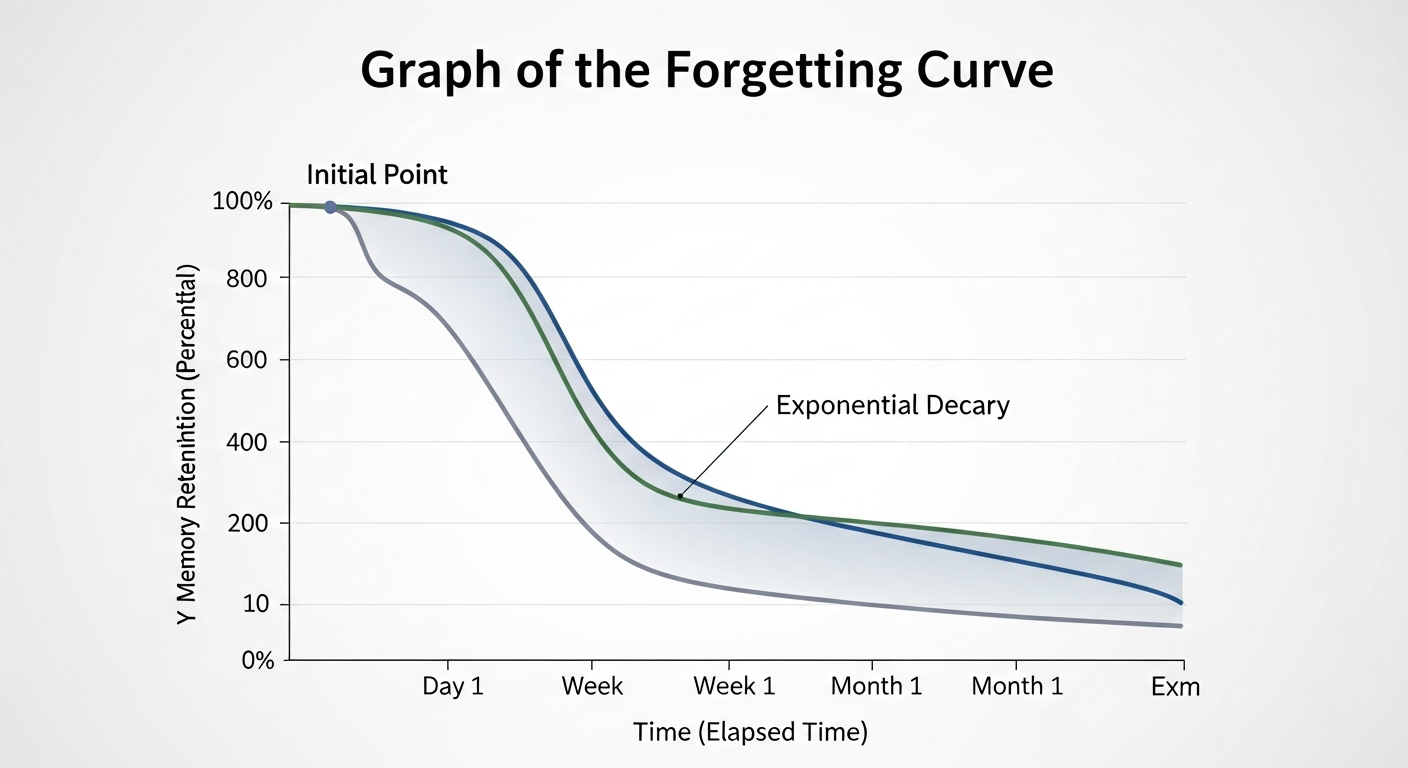
Hermann Ebbinghaus conducted groundbreaking experiments on memory, revealing a predictable pattern of how we forget. His research showed that shortly after learning new information, our retention drops off sharply, then gradually levels out over time. This rapid initial decline, followed by a slower rate of forgetting, is what we visualize as the "Forgetting Curve."
Key Insights from Ebbinghaus's Research:
- Rapid Initial Loss: A significant portion of newly acquired information is forgotten within hours or days if not reinforced.
- Time-Dependent Decline: The longer the interval since learning, the more information is forgotten, though the rate of forgetting slows down over time.
- Impact of Meaningfulness: While Ebbinghaus primarily studied nonsense syllables, later research confirmed that even meaningful information is susceptible to this decay, albeit potentially at a slower rate.
- Implications for Learning: Without active recall and reinforcement, knowledge acquired during training sessions or eLearning modules will inevitably fade.
For L&D professionals, this isn't just an academic curiosity; it's a critical operational challenge. Whether it's complex financial regulations in banking, new drug protocols in healthcare, intricate sales methodologies, or critical safety procedures in mining and heavy industries, knowledge retention directly correlates with operational efficiency, risk mitigation, and overall business success.
The Cost of Forgetting: Impact on Corporate Learning ROI
Ignoring the Forgetting Curve can have significant financial and operational consequences for organizations. Every dollar spent on training where knowledge isn't retained represents a diminished return on investment. Consider these industry-specific implications:
- Compliance & Finance: Forgetting critical regulatory updates can lead to costly fines, legal repercussions, and reputational damage.
- Sales & Retail: Inconsistent product knowledge or forgotten sales techniques directly impact revenue generation and customer satisfaction.
- Healthcare & Pharma: Lapses in understanding new treatments, patient safety protocols, or drug interactions can have life-threatening consequences.
- Hospitality: Poorly retained service standards can severely damage brand perception and customer loyalty.
- Oil and Gas & Mining: Forgetting safety procedures can result in serious accidents, injuries, and environmental hazards.
The traditional "once-and-done" training model is inherently at odds with how the human brain retains information. To truly embed knowledge, L&D strategies must actively counteract the natural tendency to forget.
Flattening the Curve: Modern Strategies for Sustained Retention
Fortunately, the insights from the Forgetting Curve also reveal powerful strategies to combat knowledge decay. Modern eLearning technologies, especially those incorporating intelligent design and advanced analytics, are proving incredibly effective in reinforcing learning and ensuring long-term retention. Here are key approaches:
1. Microlearning for Spaced Repetition
Breaking down complex topics into bite-sized, digestible modules allows for easier consumption and recall. When combined with spaced repetition—introducing information, reinforcing it after a short interval, and then revisiting it at increasing intervals—microlearning directly targets the rapid initial drop-off of the Forgetting Curve. Platforms like a MaxLearn Microlearning Platform are designed specifically to facilitate this approach, ensuring continuous engagement and reinforcement.
2. Gamification for Engagement and Recall
Engaging employees through game-like elements can significantly enhance motivation, participation, and ultimately, retention. Leaderboards, badges, points, and challenges create a fun, competitive environment that encourages repeated interaction with learning content. A Gamified LMS transforms routine training into an exciting experience, making learners more likely to revisit modules and commit information to long-term memory.
3. Adaptive Learning Paths
Not all learners are the same, and neither are their knowledge gaps. Adaptive Learning systems leverage data to personalize the learning journey, delivering content precisely when and where it's most needed. By identifying areas of weakness and providing targeted reinforcement, adaptive platforms ensure that time and effort are spent efficiently, directly addressing individual forgetting patterns.
4. Intelligent Content Creation and Updates
Keeping learning content fresh, relevant, and engaging is a constant challenge. An AI Powered Authoring Tool can significantly streamline the creation and updating of learning materials. This ensures that L&D teams can quickly respond to changes in regulations, products, or best practices, providing employees with the most current information and preventing the "forgetting" of outdated procedures.
5. Risk-Focused Reinforcement
In industries like compliance, healthcare, and manufacturing, certain knowledge areas carry higher risks if forgotten. Implementing Risk-focused Training strategies ensures that critical information receives amplified reinforcement. By prioritizing and frequently reinforcing high-risk topics, organizations can significantly reduce exposure to errors, accidents, and non-compliance, even in the face of the Forgetting Curve.
Leveraging Intelligence for Enhanced Learning Outcomes
In our increasingly data-driven world, the fusion of cognitive science and advanced technology offers unprecedented opportunities to supercharge learning retention. As L&D leaders consider future-proofing their training initiatives, questions naturally arise about how sophisticated systems can optimize every aspect of the learning journey.
Consider these forward-thinking inquiries:
- When employees need just-in-time information to solve a problem, how can our learning system ensure they access the precise answers instantly, effectively flattening the immediate decline of the forgetting curve for critical facts?
Intelligent search algorithms and personalized content recommendations, powered by sophisticated analytics, can pinpoint exactly what a learner needs, delivering it at the moment of need. This proactive recall assistance drastically reduces the window for forgetting critical operational details. - For multinational corporations, how can we guarantee that essential compliance training, for instance, is not only understood but also retained by employees operating in vastly different regulatory and cultural environments?
Advanced platforms can leverage contextual awareness to localize learning content, provide culture-specific examples, and even adapt learning paths based on regional performance data. This ensures that training resonates deeply, making information more memorable and enduring across global teams. - How can we move beyond fragmented training modules to a truly integrated learning ecosystem that continuously assesses, adapts, and reinforces knowledge across an employee's entire career journey?
By connecting performance data, skill assessments, learning consumption patterns, and career progression goals, sophisticated systems can create dynamic, personalized development paths. This holistic approach ensures continuous skill growth, proactive remediation of knowledge gaps, and sustained expertise that evolves with the employee and the organization.
Conclusion
The Graph of the Forgetting Curve is a fundamental truth of human cognition, but it doesn't have to be a barrier to effective corporate learning. By embracing modern, intelligently designed eLearning strategies—such as microlearning, gamification, adaptive paths, and intelligent content tools—L&D leaders can actively counteract memory decay. This proactive approach ensures that training investments yield maximum returns, fostering a culture of continuous learning, reducing risks, and driving sustained performance across all segments and industries. The future of L&D lies in not just delivering knowledge, but in mastering its retention.
.jpg)


