

Conquering the Curve: How L&D Leaders Can Defeat the Ebbinghaus Rate of Forgetting
In the fast-paced world of corporate learning and development, the goal is not just to deliver information, but to ensure it sticks. For Vice Presidents, Directors, and Senior Managers in L&D across industries like Compliance, Sales, Banking, Finance, Insurance, Retail, Pharma, Health Care, Hospitality, Oil and Gas, and Mining, this challenge is paramount. Your teams undergo extensive training – from complex compliance regulations to critical sales techniques or intricate financial models. Yet, a fundamental human truth often undermines these efforts: we forget. Understanding the Ebbinghaus Rate of Forgetting is the first step toward building more effective, enduring learning programs that truly impact performance and mitigate risk.
What is the Ebbinghaus Rate of Forgetting?
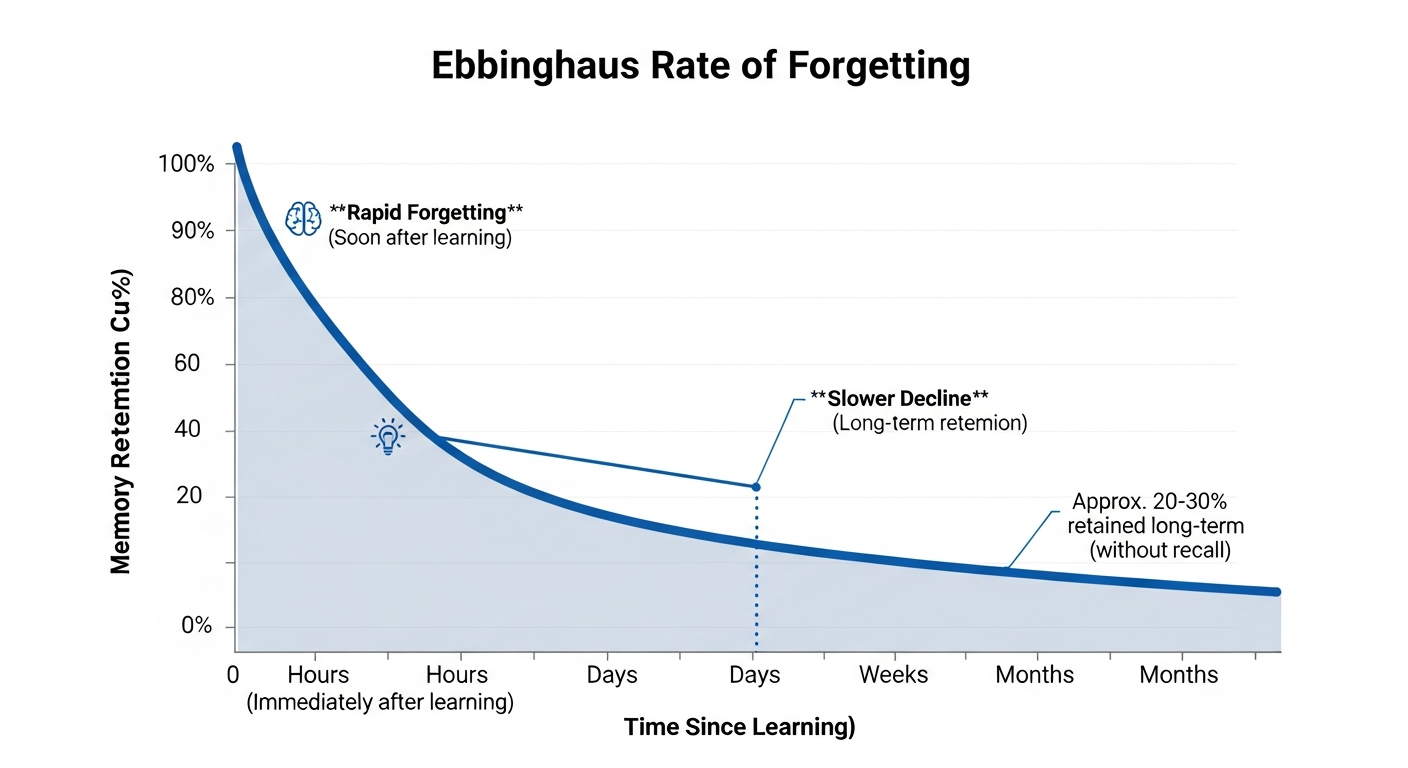
The concept of the "forgetting curve" was introduced by German psychologist Hermann Ebbinghaus in the late 19th century. Through pioneering experiments on memory, Ebbinghaus discovered a predictable pattern of memory decay. He found that soon after learning new information, our ability to recall it drops off dramatically. Within an hour, we might forget 50% of what we've learned. Within a day, that figure can climb to 70%. Over time, the rate of forgetting slows, but a significant portion of the initial learning is lost if not reinforced.
This curve isn't a theoretical curiosity; it's a stark reality for L&D professionals. Imagine an expensive, day-long training session on a new CRM system for your sales team, or a critical cybersecurity compliance module for your banking employees. Without strategic intervention, much of that vital knowledge will dissipate, rendering the training investment less effective and potentially exposing your organization to unnecessary risks.
The Business Impact of Forgetfulness
The Ebbinghaus curve has profound implications for every segment of your business:
- Compliance & Risk: In industries like Banking, Finance, Pharma, and Oil & Gas, forgetting compliance protocols can lead to severe penalties, legal issues, and reputational damage. Risk-focused Training becomes crucial when combatting the forgetting curve.
- Sales & Performance: Forgetting product features, sales methodologies, or customer service best practices directly impacts revenue, customer satisfaction, and competitive advantage in Retail and Sales.
- Healthcare: Recalling critical patient care procedures, pharmaceutical regulations, or emergency protocols is literally a matter of life and death.
- Operational Efficiency: Across all sectors, from Hospitality to Mining, forgetting operational procedures leads to errors, reduced productivity, and increased costs.
The challenge for L&D leaders is clear: how do we design learning experiences that not only deliver information but also actively fight against this natural human tendency to forget?
Conquering the Curve: Modern eLearning Strategies
Fortunately, modern eLearning technologies and methodologies offer powerful antidotes to the Ebbinghaus curve. By strategically applying these tools, L&D can transform passive learning into enduring knowledge.
Microlearning for Spaced Repetition
One of the most effective ways to combat forgetting is through spaced repetition – revisiting information at increasing intervals. Traditional long-form courses make this challenging. This is where a MaxLearn Microlearning Platform shines. Microlearning delivers content in short, digestible bursts (2-5 minutes) that are easy to consume, review, and recall. This approach naturally facilitates spaced repetition, allowing learners to revisit key concepts without overwhelming their schedule.
Gamification for Engagement and Reinforcement
Engagement is key to retention. If learning isn't engaging, it's easily dismissed. A Gamified LMS transforms mundane training into interactive experiences. Leaderboards, badges, points, and challenges motivate learners to engage more frequently with content. This increased interaction naturally leads to more exposure and reinforcement, etching information more deeply into long-term memory.
Adaptive Learning for Personalized Reinforcement
Not all learners forget at the same rate or in the same areas. Adaptive Learning platforms use data to tailor the learning path to each individual's needs. If a learner struggles with a particular concept, the system can automatically provide additional resources, quizzes, or practice opportunities. This personalized approach ensures that reinforcement is targeted where it's most needed, optimizing memory retention and learning efficiency.
AI's Role in Intelligent Reinforcement
Artificial Intelligence (AI) is rapidly evolving the way we approach learning reinforcement. AI-powered platforms can analyze learner performance, predict areas where forgetting is likely to occur, and proactively recommend timely interventions. An AI Powered Authoring Tool can even help content creators generate and optimize learning materials that are inherently more sticky and designed for recall.
Implementing Effective Strategies
To truly conquer the Ebbinghaus curve, L&D leaders must embrace a holistic approach:
- Shift from Event-Based to Continuous Learning: Move away from one-off training events towards a culture of ongoing learning and reinforcement.
- Leverage Technology: Invest in platforms that support microlearning, spaced repetition, gamification, and adaptive pathways.
- Prioritize Active Recall: Incorporate frequent quizzes, simulations, and real-world application exercises that require learners to actively retrieve information, rather than passively absorb it.
- Measure and Adapt: Use analytics to track retention rates and identify areas where your learning strategies can be further optimized.
Navigating the Digital Landscape: Your Questions Answered
As L&D leaders, you're constantly seeking innovative ways to enhance learning effectiveness and ensure your teams retain critical knowledge. Here are some common queries regarding advanced learning technologies:
How can modern learning technologies enhance overall training outcomes and combat memory decay?
By leveraging sophisticated algorithms and data analytics, these platforms can pinpoint specific knowledge gaps and deliver highly targeted interventions. Instead of a one-size-fits-all approach, they personalize learning pathways, ensuring that reinforcement exercises, quizzes, and microlearning modules are delivered precisely when and where they are most effective for each individual. This proactive, data-driven strategy directly counters the natural rate of forgetting, significantly boosting long-term retention and overall training success.
How can organizations ensure consistent learning effectiveness across diverse global teams and varying learning styles?
Advanced learning systems are designed with flexibility and scalability in mind. They can adapt content presentation, language options, and engagement strategies to suit different cultural contexts and individual preferences. For instance, a system might offer interactive simulations for kinesthetic learners, detailed texts for visual learners, or audio summaries for auditory learners. This adaptability ensures that geographical distribution or varied learning styles do not compromise the quality and memorability of the training, leading to uniform high performance across all regions.
What specific insights can intelligent learning platforms provide to optimize individual employee development and skill retention?
These platforms collect rich data on learner interactions, performance on assessments, and time spent on various modules. This allows them to generate detailed reports on individual strengths and weaknesses, identifying topics where an employee might be excelling or struggling. Such precise insights enable L&D managers to offer tailored coaching, assign specific remedial content, or recommend advanced modules that align with an employee's growth trajectory. This personalized approach not only optimizes skill acquisition but also ensures that the most relevant knowledge is consistently reinforced, fostering continuous development and peak performance.
Conclusion
The Ebbinghaus Rate of Forgetting is a formidable adversary for any L&D department. However, it's not an insurmountable one. By understanding its principles and strategically deploying modern eLearning tools – microlearning, gamification, adaptive learning, and intelligent platforms – L&D leaders can transform how their organizations learn and retain information. This isn't just about better training; it's about fostering a more knowledgeable, compliant, productive, and ultimately, more successful workforce. The future of corporate learning lies in actively building learning ecosystems designed to make knowledge stick.
.jpg)


