

Conquering the Forgetting Curve: Why Spaced Repetition is Your L&D's Secret Weapon
As leaders in Learning & Development, you understand the critical investment in training your workforce. Whether it's mastering new sales techniques, navigating complex compliance regulations, or adopting innovative healthcare protocols, the goal is always clear: equip your teams with knowledge that sticks. Yet, a persistent challenge looms over even the most meticulously designed programs – the insidious "forgetting curve." This isn't just an abstract concept; it represents lost productivity, increased risk, and a significant dent in your training ROI.
Imagine if your meticulously crafted training content could defy the natural decay of memory. What if your employees could consistently recall vital information precisely when it's needed most? This is not wishful thinking; it's the proven power of spaced repetition, a scientifically validated technique poised to revolutionize how organizations approach learning and retention.
Understanding the Forgetting Curve: A Relentless Foe
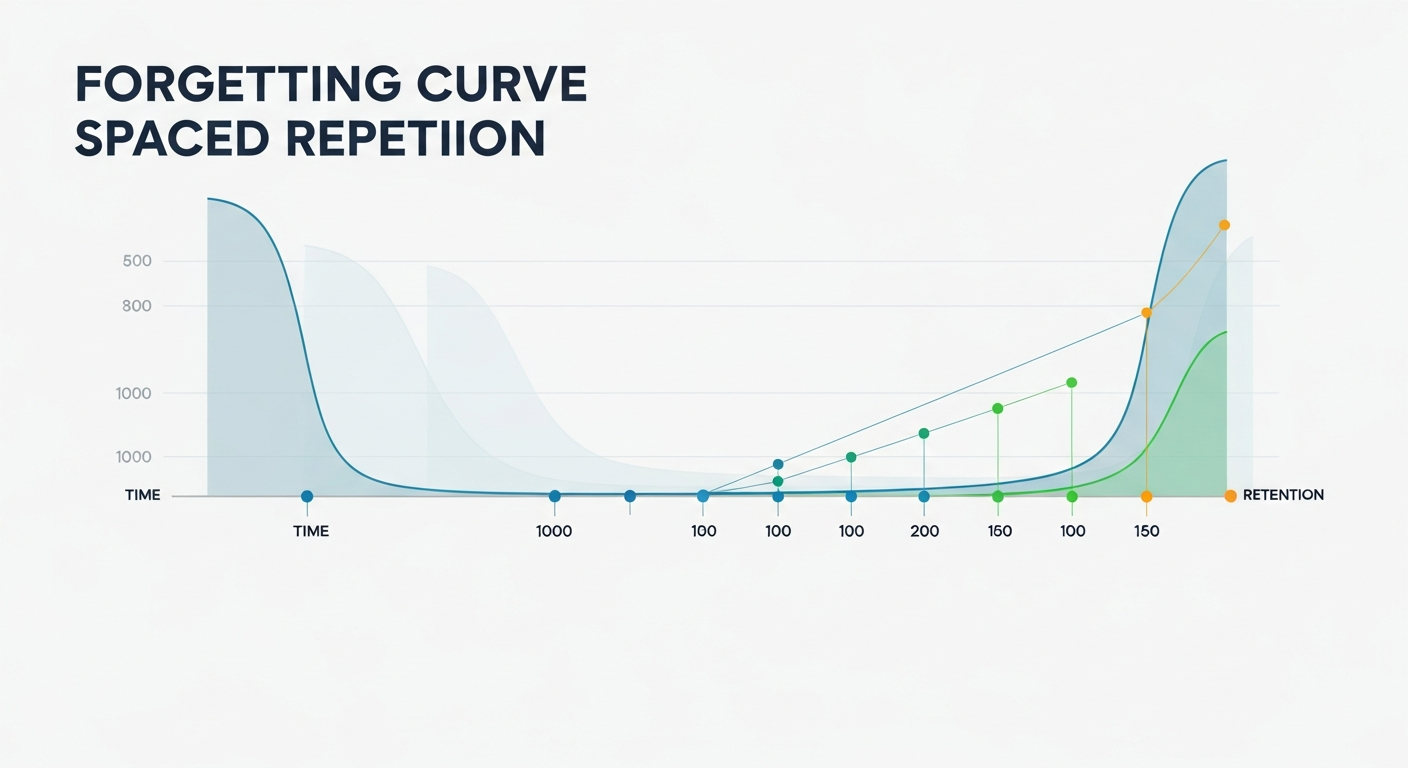
In the late 19th century, psychologist Hermann Ebbinghaus conducted groundbreaking research that revealed a sobering truth about human memory: we rapidly forget new information if it's not reinforced. His "forgetting curve" illustrates that within days, sometimes even hours, a significant portion of what we learn vanishes from our minds. For L&D professionals, this isn't merely academic; it has profound implications:
- Compliance Training: Critical policies and procedures can fade, leading to errors, fines, or safety hazards.
- Sales Enablement: Product features, competitive advantages, and sales methodologies are forgotten, impacting quota attainment.
- Banking & Finance: Regulatory updates and complex financial products are misremembered, increasing risk and customer dissatisfaction.
- Healthcare: Patient protocols and drug interactions are forgotten, potentially compromising care quality.
The traditional "one-and-done" training model, where knowledge is delivered intensely over a short period, is fundamentally at odds with how our brains retain information. Without strategic reinforcement, much of that valuable learning simply evaporates, rendering your significant training investments less effective.
The Power of Spaced Repetition: A Strategic Antidote
Spaced repetition is the direct counter-strategy to the forgetting curve. It’s an evidence-based learning technique that involves reviewing information at progressively longer intervals. Instead of cramming, it leverages the brain's natural memory consolidation process. Here's how it works:
- Initial learning introduces the new concept.
- A short time later (e.g., 1 day), the learner reviews the material.
- If recalled successfully, the next review interval is extended (e.g., 3 days).
- This interval continues to expand (e.g., 7 days, 14 days, 30 days) as long as the information is successfully recalled.
- If the learner struggles, the interval shortens, providing more immediate reinforcement.
This intelligent scheduling ensures that material is revisited just as it's about to be forgotten, solidifying it into long-term memory with minimal effort. The result? Superior retention, deeper understanding, and a more efficient learning process.
How Spaced Repetition Transforms Corporate Training Across Industries
Implementing spaced repetition isn't just about better memory; it's about driving tangible business outcomes across diverse sectors:
For Compliance, Banking, Finance, and Insurance:
- Ensures critical regulatory knowledge remains fresh, reducing audit risks and costly errors.
- Facilitates seamless adoption of new policies and procedures, maintaining operational integrity.
- Empowers employees with unwavering confidence in their understanding of complex financial products and legal frameworks.
For Sales and Retail:
- Keeps product knowledge, pricing updates, and sales scripts at the forefront of sales professionals' minds.
- Strengthens objection handling skills and boosts confidence in customer interactions, leading to higher conversion rates.
- Rapidly onboards new hires, getting them revenue-ready faster.
For Pharma and Healthcare:
- Guarantees up-to-date knowledge of drug protocols, patient care guidelines, and new treatment methodologies.
- Minimizes medical errors and improves patient safety through consistent recall of essential information.
- Supports continuous professional development in a rapidly evolving scientific landscape.
For Hospitality, Oil & Gas, and Mining:
- Reinforces safety procedures, equipment operation, and service standards critical for operational excellence and risk mitigation.
- Ensures consistent quality of service and adherence to best practices, enhancing brand reputation.
- Reduces incidents and improves efficiency by embedding core competencies deeply.
Integrating Spaced Repetition with Modern Learning Technologies
The true power of spaced repetition is unleashed when integrated with advanced learning technologies. This synergy allows for automated, personalized, and scalable retention strategies:
- Microlearning Reinforcement: Spaced repetition is perfectly suited for reinforcing bite-sized content. Leveraging a platform like MaxLearn Microlearning Platform ensures that these short, focused bursts of information are delivered precisely when needed for optimal recall.
- Engaging Experiences: Combine spaced repetition with interactive elements. A Gamified LMS can transform routine reviews into challenging and enjoyable activities, significantly boosting learner engagement and adherence to review schedules.
- Personalized Pathways: Not all learners forget at the same rate. Adaptive Learning systems leverage data on individual performance to tailor review intervals and content, ensuring each learner receives the most effective reinforcement schedule.
- Streamlined Content Creation: Developing effective spaced repetition content requires precision. An AI Powered Authoring Tool can assist in breaking down complex topics into digestible chunks and even suggest optimal review questions, speeding up content development.
- Targeted Training Focus: For critical areas like compliance or safety, focused, repeated exposure is paramount. Implement Risk-focused Training strategies that utilize spaced repetition to embed essential knowledge, thereby mitigating organizational vulnerabilities.
Intelligent Systems and the Future of Knowledge Retention
The evolution of learning science, combined with advanced computing, is paving the way for unprecedented control over knowledge retention.
"How can intelligent systems provide personalized guidance to individual learners, ensuring optimal recall at the right moment?"
Intelligent systems continually analyze individual learning patterns, performance data, and even emotional responses to content. By creating sophisticated profiles for each learner, these systems can dynamically adjust the frequency, format, and content of review sessions. They predict when a learner is most likely to forget a piece of information and then deliver a timely, targeted nudge or challenge, effectively creating a bespoke learning coach for every employee.
"What insights can advanced analytics offer about organizational learning efficacy across diverse global teams and operational units?"
Advanced analytics, powered by intelligent algorithms, can aggregate vast amounts of learning data from across an enterprise. This provides leadership with a panoramic view of knowledge strengths and gaps, not just at an individual level, but across departments, regions, and job roles. L&D leaders can pinpoint areas where memory decay is most prevalent, identify content that consistently underperforms, and optimize training resources for maximum impact on a global scale, ensuring consistent competency standards everywhere.
"In what ways can automation streamline the creation and deployment of dynamic, adaptive learning content that effectively combats memory decay?"
Automation tools, infused with intelligent capabilities, significantly reduce the manual effort involved in designing and managing spaced repetition programs. These tools can automatically generate varied question formats from source material, segment content into micro-modules, and then autonomously schedule their delivery based on algorithmic predictions of memory decay. This empowers L&D teams to focus on strategic content development while the intelligent infrastructure handles the complex logistics of personalized, adaptive content deployment, ensuring continuous reinforcement with minimal human intervention.
Key Benefits for L&D Leaders
- Maximized ROI: Ensure training investments translate into lasting knowledge and skill application.
- Enhanced Performance: Empower employees with instant recall, leading to fewer errors and increased productivity.
- Reduced Risk: Fortify critical knowledge in compliance, safety, and operational protocols.
- Engaged Workforce: Foster a culture of continuous learning with effective, less burdensome review methods.
- Data-Driven Insights: Leverage analytics to continuously optimize learning strategies.
The forgetting curve is a natural phenomenon, but it doesn't have to be a barrier to effective corporate learning. By embracing the scientific principles of spaced repetition and integrating them with cutting-edge learning technologies, L&D leaders can transform their organizations. Move beyond simply delivering information to truly embedding knowledge, empowering your workforce to remember, apply, and excel.
.jpg)


