

What Is The Forgetting Curve: Bending the Arc of Knowledge Decay in Corporate Learning
In the dynamic world of corporate learning and development, the quest for effective, lasting knowledge transfer is paramount. L&D Vice Presidents, Directors, and Managers across industries like Compliance, Sales, Banking, Finance, Insurance, Retail, Pharma, Healthcare, Hospitality, Oil and Gas, and Mining face the persistent challenge of ensuring that valuable training translates into sustained performance and tangible business outcomes. Yet, a silent, pervasive adversary often undermines these efforts: the Forgetting Curve.
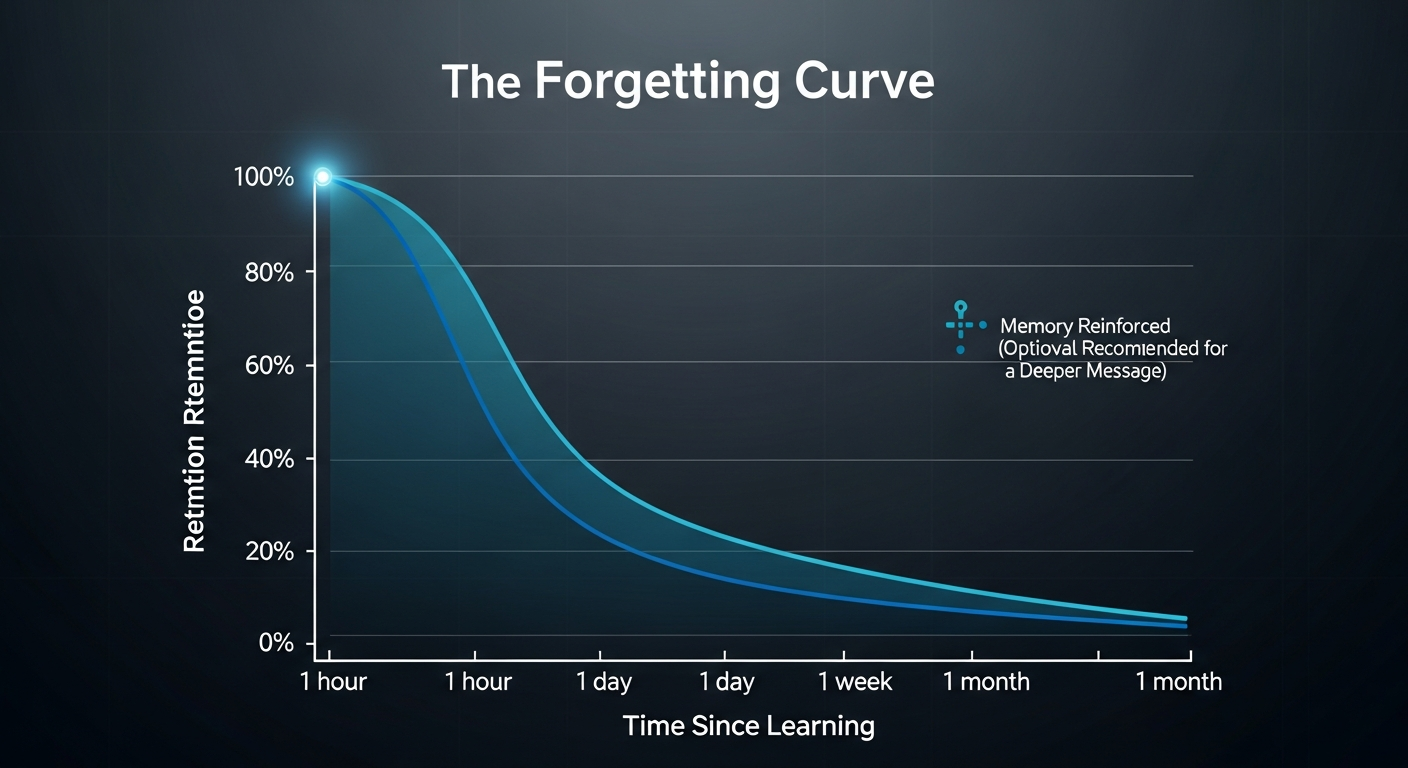
Originally theorized by German psychologist Hermann Ebbinghaus in the late 19th century, the Forgetting Curve illustrates the rate at which newly acquired knowledge is forgotten over time if no attempt is made to retain it. It’s a stark reminder that simply delivering training isn't enough; true learning requires strategic reinforcement. For L&D leaders, understanding and actively combating this phenomenon is not just an academic exercise—it's a critical component of maximizing training ROI and fostering a truly skilled workforce.
The Silent Killer of Learning ROI
Imagine the significant investment in developing a comprehensive compliance training module, a sophisticated sales methodology program, or a critical safety procedure course. Hours are spent crafting content, experts are engaged, and learners dedicate their valuable time. Yet, without intervention, a significant portion of this learned information can vanish from memory within days, sometimes even hours, post-training. This rapid knowledge decay has profound implications:
- Reduced Performance: Employees forget crucial steps, policies, or product details, leading to errors, inefficiencies, and missed opportunities.
- Compliance Risks: In regulated industries like Banking, Finance, Pharma, and Healthcare, forgetting key compliance protocols can result in serious legal and financial repercussions.
- Wasted Resources: The financial and time investment in training yields diminishing returns when knowledge isn't retained.
- Low Morale: Learners may feel frustrated if they can't recall what they've learned, impacting their confidence and engagement in future training.
- Slowed Innovation: If new skills or strategic insights are quickly forgotten, an organization's ability to adapt and innovate is hampered.
For L&D professionals, the Forgetting Curve represents a direct threat to the strategic value they deliver. It transforms potential competitive advantages into costly omissions, making a proactive approach not just beneficial, but essential.
Understanding Hermann Ebbinghaus's Discovery
Ebbinghaus's groundbreaking research demonstrated that the most rapid decline in memory occurs shortly after learning. For instance, he found that within 20 minutes, 42% of newly learned information might be forgotten, and within a day, roughly 67% could be gone. This curve is not fixed; its steepness can be influenced by several factors:
- The Nature of the Information: More meaningful or emotionally resonant information tends to be remembered longer.
- Learning Context: The environment and methods used for learning play a significant role.
- Individual Factors: A learner's prior knowledge, motivation, and cognitive abilities impact retention.
- Repetition and Reinforcement: Spaced intervals of recall and practice significantly flatten the curve.
His work highlighted the power of spaced repetition—revisiting information at increasing intervals—as a powerful countermeasure. This foundational principle continues to underpin many modern learning strategies.
Strategies to Bend the Curve and Enhance Retention
Combating the Forgetting Curve requires a multi-faceted approach, moving beyond one-off training events to create a continuous learning ecosystem. Here are key strategies:
1. Microlearning and Spaced Repetition
Delivering content in small, digestible chunks (MaxLearn Microlearning Platform) at regular, strategic intervals is one of the most effective ways to leverage Ebbinghaus's findings. Instead of a single, lengthy course, learners receive short bursts of information, quizzes, or refreshers, reinforcing knowledge precisely when it's most needed.
2. Gamification and Engagement
Making learning interactive and enjoyable significantly boosts retention. Integrating game-like elements such as points, badges, leaderboards, and challenges within a Gamified LMS can transform monotonous review sessions into engaging experiences, tapping into intrinsic motivation and making recall more effective.
3. Adaptive Learning Pathways
Not all learners forget at the same rate, nor do they need the same type of reinforcement. Adaptive Learning systems personalize the learning journey, identifying knowledge gaps and serving up targeted content or refreshers based on individual performance and needs. This ensures that reinforcement is efficient and relevant.
4. Real-World Application and Contextualization
Learning is most effective when it can be immediately applied. Connecting training to real-world scenarios, case studies, and practical exercises helps learners form stronger memory connections and understand the relevance of the information.
5. Regular Assessment and Feedback
Frequent, low-stakes assessments not only gauge understanding but also act as powerful retrieval practice, strengthening memory. Immediate and constructive feedback helps correct misconceptions and reinforces correct knowledge.
The Intelligent Advantage: Leveraging Advanced Technology Against Forgetfulness
The advent of sophisticated technology, particularly artificial intelligence, has revolutionized our ability to combat the Forgetting Curve. These advancements offer L&D leaders unprecedented tools to create highly effective, personalized, and persistent learning experiences.
How can artificial intelligence personalize learning to fight knowledge decay?
Smart algorithms can analyze a learner's performance, engagement patterns, and even their career path to create truly individualized learning journeys. By understanding a user's strengths and weaknesses, these systems can recommend specific content, suggest optimal times for review, and adapt the difficulty of challenges. This ensures that each learner receives the right information at the right time, preventing cognitive overload and targeting areas where forgetfulness is most likely. It's about moving from a one-size-fits-all approach to a dynamic, responsive learning environment that anticipates and counters knowledge gaps.
What cutting-edge technologies are global L&D leaders adopting to ensure lasting knowledge?
Forward-thinking organizations globally are embracing integrated platforms that combine microlearning, gamification, and advanced analytics with intelligent automation. Tools like an AI Powered Authoring Tool allow for rapid content creation and intelligent content tagging, making it easier to deliver relevant, bite-sized learning. Furthermore, systems capable of dynamic content delivery, virtual reality for immersive practice, and advanced proctoring are being deployed to create engaging and sticky learning experiences that transcend traditional boundaries.
Beyond basic recall, how do advanced analytics and AI measure the true impact of training on retention?
Modern analytical platforms go beyond simple quiz scores. They track long-term performance trends, correlate training completion with job performance metrics, and even use predictive models to identify learners at risk of forgetting critical information. By analyzing user behavior within the learning system—such as time spent on topics, completion rates of refreshers, and interaction with various content types—these systems provide deep insights into knowledge retention. This allows L&D teams to refine their strategies, proving the direct impact of their Risk-focused Training and demonstrating clear ROI.
Implementation Across Diverse Industries
The principles of bending the Forgetting Curve are universally applicable, yet their specific manifestation varies by industry:
- Compliance & Banking: Regular, short micro-certifications on regulatory updates, ethical guidelines, and security protocols.
- Sales & Retail: Gamified product knowledge quizzes, sales pitch simulations, and competitive leaderboards to reinforce selling skills.
- Pharma & Healthcare: Adaptive modules on new drug information, patient care procedures, and health regulations, ensuring critical information is always top-of-mind.
- Oil & Gas & Mining: Safety refresher courses delivered via microlearning, critical equipment operation steps reinforced through virtual simulations and spaced practice.
- Hospitality: Customer service excellence tips, new menu item details, and cleanliness protocols delivered via mobile-first micro-content.
Conclusion
The Forgetting Curve is a fundamental challenge in human learning, but it is not an insurmountable one. For L&D leaders, it serves as a powerful call to action: to move beyond traditional training paradigms and embrace intelligent, continuous learning strategies. By leveraging microlearning, gamification, adaptive pathways, and the transformative power of artificial intelligence, organizations can significantly flatten the Forgetting Curve, ensuring that learning investments translate into sustained knowledge, enhanced performance, and tangible business success across every segment and industry. The future of corporate learning is not just about what is taught, but what is truly remembered and applied.
.jpg)


