

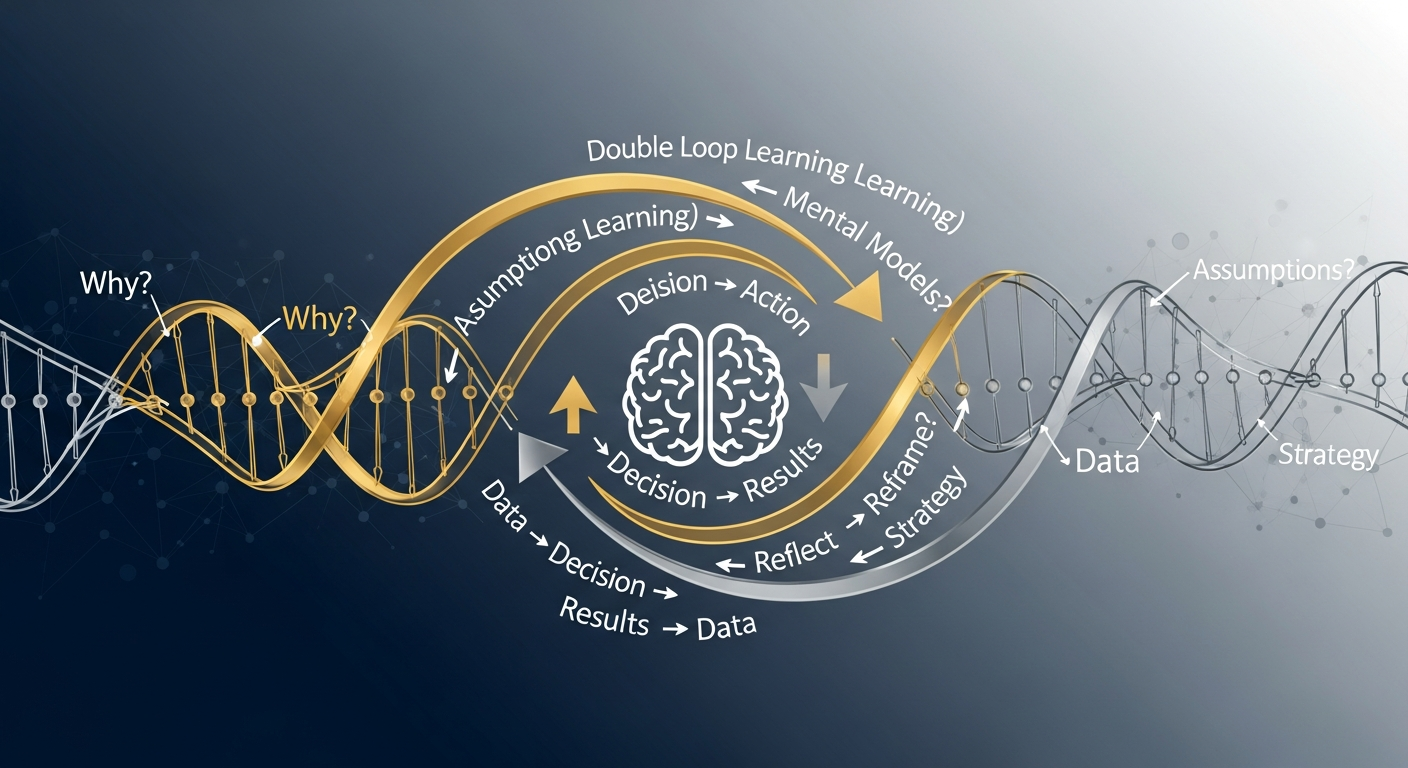
Double Loop Learning: The Strategic Imperative for L&D Leaders in the AI Era
In an epoch defined by rapid technological shifts, geopolitical uncertainties, and evolving market demands, the traditional approaches to organizational learning are proving increasingly insufficient. For Vice Presidents, Directors, and Senior Managers of Learning & Development, the mandate is clear: cultivate an organizational capacity that doesn't just adapt, but anticipates and proactively shapes its future. This is where Double Loop Learning emerges, not merely as a concept, but as a strategic imperative for sustained success.
Originating from the work of Chris Argyris and Donald Schön, Double Loop Learning offers a profound framework for organizations to move beyond mere problem-solving to a deeper, more transformative mode of learning. It challenges the very foundations of an organization's operations, its guiding principles, and its established norms. For L&D leaders across Compliance, Sales, Banking, Finance, Insurance, Retail, Pharma, Health Care, Hospitality, Oil and Gas, and Mining sectors, understanding and implementing this theory is crucial for navigating complexity and fostering true innovation.
Understanding the Two Loops of Learning
To grasp Double Loop Learning, it's essential to first differentiate it from its more common counterpart: Single Loop Learning.
Single Loop Learning: The Corrective Action
- Definition: This form of learning focuses on identifying and correcting errors within an existing framework of rules, norms, and objectives. It's about 'doing things better' without questioning the underlying assumptions.
- Analogy: Imagine a thermostat. When the room gets too cold, it turns on the heater. When it gets too hot, it turns it off. The thermostat successfully maintains the desired temperature within its pre-programmed settings. It doesn't question *why* 72 degrees is the ideal temperature or whether the heating system is the most energy-efficient method.
- Business Example: A sales team realizes its conversion rate is low. Single Loop Learning would involve training them on new closing techniques, refining their pitch, or optimizing lead qualification – all within the existing sales strategy.
Double Loop Learning: The Transformative Insight
- Definition: This level of learning goes beyond error correction to question the governing variables themselves. It involves scrutinizing the underlying assumptions, values, policies, and goals that led to the actions in the first place. It's about 'doing better things' or even 'redefining what better means'.
- Analogy: Extending the thermostat analogy, Double Loop Learning would involve questioning whether 72 degrees is truly the optimal temperature for comfort and energy efficiency, exploring alternative climate control systems (e.g., solar, geothermal), or even rethinking the entire building's insulation design.
- Business Example: The same sales team, applying Double Loop Learning, would ask: "Are our existing sales targets realistic given current market shifts?" "Are our product offerings truly aligned with customer needs?" "Is our fundamental approach to market segmentation still valid?" This might lead to a complete overhaul of the sales strategy, product development, or even the business model itself.
Why Double Loop Learning is Imperative for Modern L&D Leaders
In today’s hyper-competitive and rapidly evolving landscape, organizations cannot afford to merely tinker at the edges. Double Loop Learning offers several profound benefits:
- Enhanced Adaptability and Resilience: It equips organizations to not just react to change, but to proactively anticipate and shape their environment. This is critical for industries like Finance, Banking, and Insurance facing regulatory shifts and new digital competitors, or Pharma and Health Care grappling with evolving patient needs and technological advancements.
- Fostering True Innovation: By challenging ingrained assumptions, it unlocks new possibilities and drives genuine breakthroughs, essential for staying ahead in Retail, Hospitality, and Sales, where customer expectations are constantly shifting.
- Mitigating Systemic Risks: Especially vital in Compliance, Oil and Gas, and Mining, Double Loop Learning helps identify and address the root causes of systemic failures, rather than just patching symptoms. This can prevent costly and reputation-damaging incidents.
- Building a Genuine Learning Culture: It transforms employees from passive recipients of training into active participants in organizational evolution, fostering engagement and critical thinking.
- Strategic Competitive Advantage: Organizations that master Double Loop Learning are better positioned to outmaneuver competitors by continually refining their core strategies and operational models.
Implementing Double Loop Learning through L&D Initiatives
As L&D leaders, you are uniquely positioned to champion and facilitate Double Loop Learning within your organizations. This involves cultivating environments and designing programs that encourage critical self-reflection and questioning.
Key Strategies for L&D Leaders:
- Design Reflective Learning Experiences: Move beyond rote memorization. Create scenarios, simulations, and case studies that force learners to not just solve problems, but to interrogate the underlying assumptions that led to the problems.
- Cultivate Psychological Safety: Employees must feel safe to challenge norms, admit errors, and ask "why" without fear of reprisal. Leaders must model this behavior.
- Promote Systems Thinking: Encourage learners to see how different parts of the organization interact and how their actions impact the larger system. This is particularly relevant in complex environments like Pharma R&D or large-scale Oil and Gas operations.
- Leverage Technology for Deep Insights: Modern eLearning platforms can be powerful enablers. A MaxLearn Microlearning Platform can deliver targeted prompts for reflection at critical moments, fostering continuous self-assessment. A Gamified LMS can incentivize critical thinking and problem re-framing through engaging challenges.
- Empower Through Adaptive Pathways: Implement Adaptive Learning programs that dynamically adjust content based on a learner’s ability to question and challenge existing solutions, guiding them towards deeper understanding.
- Utilize Advanced Content Creation Tools: An AI Powered Authoring Tool can rapidly develop and iterate content that challenges prevailing wisdom, offering diverse perspectives and scenarios for learners to dissect.
- Integrate Risk-Focused Approaches: Beyond standard compliance, Risk-focused Training should encourage learners to scrutinize the assumptions behind current risk mitigation strategies, leading to more robust and foresightful frameworks in Banking, Finance, and Compliance.
AI and the Future of Profound Organizational Learning
The advent of artificial intelligence is fundamentally reshaping how organizations learn, process information, and make decisions. For L&D leaders, it presents both a challenge and an unparalleled opportunity to accelerate Double Loop Learning.
How can advanced computational systems enhance an organization's capacity for deep, transformative learning?
Intelligent systems excel at processing vast datasets, identifying subtle patterns, and correlating seemingly disparate pieces of information. This capability can reveal inconsistencies in organizational logic or expose hidden assumptions that human analysis might miss. For instance, in Health Care, AI could analyze patient outcomes against treatment protocols to suggest a fundamental re-evaluation of diagnostic criteria. In Retail, it could uncover shifts in consumer behavior that necessitate a complete re-think of store layouts or product lines. Furthermore, AI can power sophisticated simulations, allowing leaders to test the impact of challenging core strategies in a safe, virtual environment, accelerating the reflective cycle without real-world consequences.
Are there universal principles of profound organizational learning, or do approaches vary significantly across different global business environments?
While the core human psychological need for safety to challenge norms is universal, the *manifestation* and *acceptance* of profound organizational learning can indeed vary significantly across diverse cultural and geographic contexts. In some cultures, direct questioning of authority or long-standing practices might be perceived differently than in others. Therefore, L&D leaders operating on a global scale must adopt culturally sensitive approaches, perhaps using indirect questioning techniques, anonymized feedback mechanisms, or storytelling to initiate difficult conversations. However, the underlying goal of questioning assumptions and seeking deeper understanding remains a powerful lever for organizational improvement, irrespective of location, whether in a multinational banking firm or a globally distributed pharma research team.
What advanced strategies can L&D leaders employ to leverage technology for systemic organizational change?
L&D leaders can harness the power of sophisticated analytical tools to identify organizational "blind spots" and areas ripe for Double Loop Learning. Predictive analytics, for example, can forecast potential failures of current strategies, providing the impetus for deeper inquiry. Intelligent feedback systems, powered by machine learning, can offer personalized coaching that challenges individual biases and thought patterns. By integrating learning platforms with operational data, L&D can demonstrate the direct impact of re-evaluating core processes, linking learning directly to key performance indicators in industries like Mining (safety protocols) or Hospitality (customer experience models). These technologies enable a data-driven approach to cultural transformation, making the case for profound learning undeniable.
Conclusion
Double Loop Learning is no longer an academic curiosity; it is a critical skill for any organization aspiring to thrive in the 21st century. For L&D Vice Presidents, Directors, and Senior Managers, the opportunity is immense: to move beyond reactive training and to strategically position your function as the driving force behind organizational resilience, innovation, and sustainable growth. By championing a culture where questioning assumptions is not just tolerated but actively encouraged and supported by advanced learning technologies, you empower your organization to not only survive the disruptions of the AI era but to truly define its own future.
.jpg)


