

Embracing Double Loop Learning: Real-World Examples for L&D Leaders
As a leader in Learning & Development, you navigate a landscape of constant change. From evolving compliance regulations in banking to rapid product cycles in retail, the imperative to adapt and innovate has never been stronger. Traditional training approaches often fall short, addressing symptoms rather than root causes. This is where the profound concept of Double Loop Learning offers a transformative advantage, pushing L&D beyond mere knowledge transfer to true organizational evolution.
In this article, we’ll delve into practical examples of Double Loop Learning, illustrating how it empowers organizations across diverse industries to not just fix problems, but to fundamentally rethink their processes, policies, and underlying assumptions. Prepare to discover how this deeper mode of learning can reshape your strategic approach to talent development.
Understanding Double Loop Learning in the L&D Context
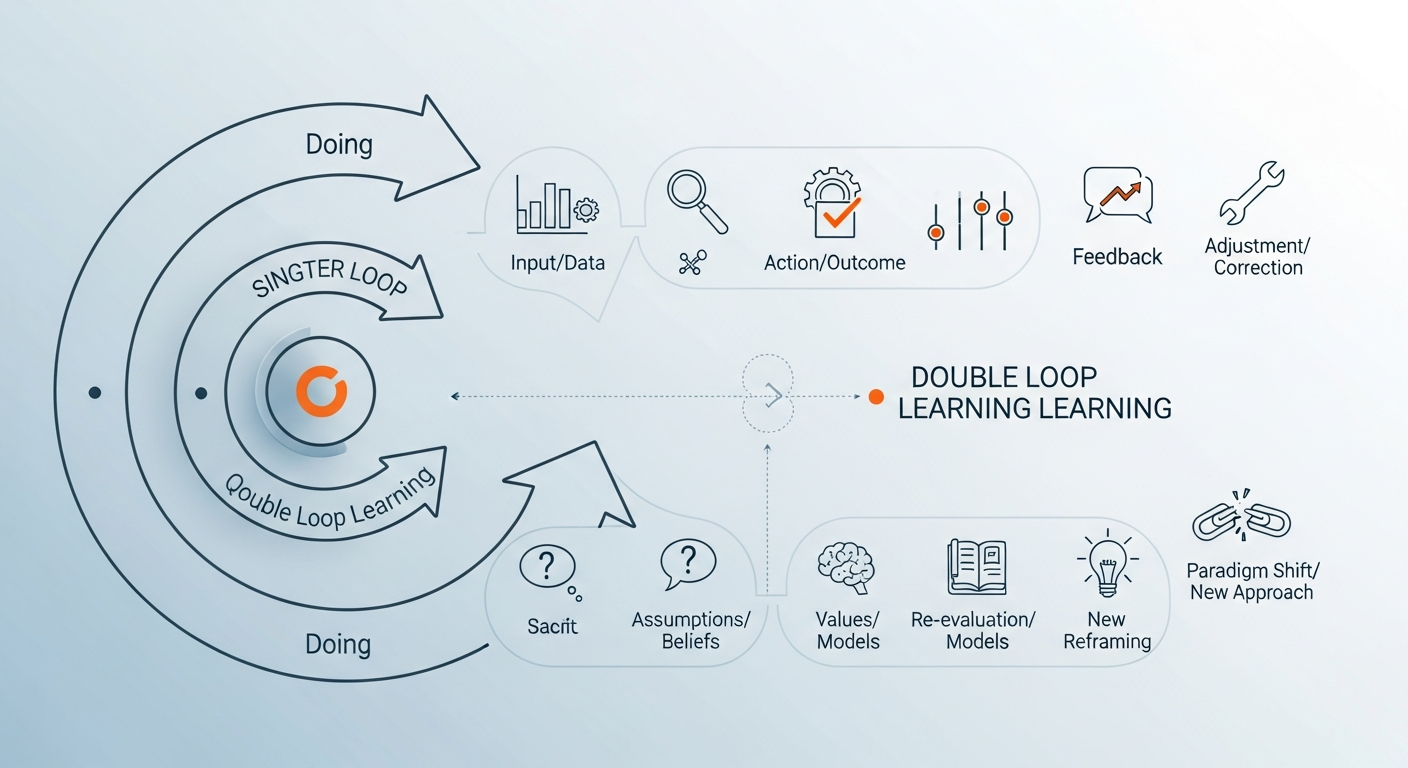
First conceptualized by Chris Argyris and Donald Schön, Double Loop Learning is a powerful framework that goes beyond simply correcting errors within existing frameworks (Single Loop Learning). While Single Loop Learning asks, "Are we doing things right?" and adjusts actions to achieve set goals, Double Loop Learning probes deeper, asking, "Are we doing the right things?" It involves questioning the fundamental assumptions, values, and policies that guide an organization's actions and decisions.
Consider a thermostat: Single Loop Learning adjusts the temperature to a predefined setting. Double Loop Learning, however, questions whether the thermostat should even be the primary control, or if there's a better system for climate management altogether. For L&D, this means moving beyond updating course content to interrogating why current training methodologies, organizational structures, or cultural norms might be hindering desired outcomes.
Why Double Loop Learning is Crucial for Modern L&D Leaders
In today's complex and volatile business environment, the ability to adapt and innovate isn't just an advantage—it's a necessity. L&D leaders must champion this deeper form of learning to:
- Foster Sustainable Change: Address the root causes of performance gaps, ensuring solutions are long-lasting rather than superficial.
- Drive Innovation: Encourage a culture of inquiry and experimentation, leading to breakthrough solutions and competitive advantage.
- Enhance Organizational Resilience: Equip the workforce to critically evaluate challenges and adapt foundational strategies in the face of unforeseen disruptions.
- Improve Decision-Making: Promote a more nuanced understanding of complex problems, leading to more informed and effective strategic choices.
Practical Double Loop Learning Examples Across Industries
Let's explore how Double Loop Learning manifests in various sectors, demonstrating its versatility and impact:
Compliance in Banking and Finance
- Single Loop: A bank experiences a regulatory breach related to anti-money laundering (AML) protocols. The L&D team responds by updating the existing AML training modules and ensuring all relevant employees complete the refreshed course.
- Double Loop: Despite the updated training, similar breaches recur. Instead of just retraining, the L&D and compliance leadership initiate an inquiry. They question not only the effectiveness of the training design but also the underlying assumptions about employee understanding, the complexity of the regulations, the communication channels, the software interfaces, or even the performance metrics tied to compliance. They might discover that the compliance policies themselves are too convoluted, or that the organizational culture inadvertently discourages reporting minor inconsistencies. A robust Risk-focused Training approach, delivered through microlearning, might then be developed, targeting specific high-risk behaviors identified through this deeper analysis.
Sales Performance in Retail and Pharma
- Single Loop: A retail chain launches a new product, and sales figures are below projections. L&D trains sales associates on the product's features, benefits, and sales scripts.
- Double Loop: Sales still lag. The L&D team, in collaboration with sales leadership, goes beyond training. They analyze customer feedback, sales conversion rates, and even competitor strategies. They might question the product's market fit, its pricing strategy, the target demographic assumptions, the incentive structure for sales staff, or the fundamental sales methodology being used. Perhaps the existing sales training, even when updated by an AI Powered Authoring Tool, is based on outdated assumptions about customer buying behavior. The goal is to uncover and challenge the underlying beliefs driving the sales approach.
Patient Care Protocols in Healthcare
- Single Loop: A hospital identifies an increase in medication errors. L&D conducts refresher training on medication administration protocols for nursing staff.
- Double Loop: Errors persist. The L&D and clinical leadership investigate further. They challenge the assumption that errors are solely due to individual negligence. They might examine staffing levels, nurse-to-patient ratios, the design of the electronic health record system, communication protocols during shift changes, the physical layout of medication rooms, or even the psychological safety within teams that might prevent staff from reporting near-misses. They might use a Gamified LMS to not only train but also gather data on common error patterns and systemic weaknesses.
Operational Efficiency in Oil and Gas / Manufacturing
- Single Loop: A manufacturing plant experiences frequent equipment downtime. L&D provides technical training on preventive maintenance and troubleshooting for technicians.
- Double Loop: Downtime continues to impact production. The L&D and operations teams dig deeper. They might question the maintenance schedule itself, the procurement process for spare parts, cross-departmental communication between production and maintenance, the autonomy given to technicians, or even the organizational culture's perception of "minor" issues. Implementing Adaptive Learning could then help identify specific knowledge gaps or procedural weaknesses that contribute to systemic issues, rather than just retraining.
Employee Experience in Hospitality
- Single Loop: A hotel chain notices declining customer satisfaction scores related to front desk service. L&D provides customer service excellence training.
- Double Loop: Customer satisfaction remains stagnant, and employee turnover at the front desk is high. L&D collaborates with HR and operations to examine the broader context. They might question current hiring practices, onboarding effectiveness, management styles, compensation structures, career progression opportunities, or the fundamental philosophy guiding employee empowerment. A comprehensive MaxLearn Microlearning Platform could then be deployed to support continuous employee development, addressing both skill gaps and broader cultural shifts identified through this deeper inquiry.
Integrating Double Loop Learning with Modern eLearning Solutions
Today's advanced eLearning tools are not just about content delivery; they are powerful enablers of Double Loop Learning. Data analytics from platforms can reveal patterns that spark deeper inquiry. For instance:
- A MaxLearn Microlearning Platform can track learner engagement, completion rates, and performance trends over time. When certain topics consistently show low mastery despite repeated training, it's a signal to question the instructional design, the prerequisite knowledge, or even the relevance of the topic itself in the organizational workflow.
- A Gamified LMS provides rich data on learner behavior, motivation, and problem-solving approaches. This data, when analyzed with a Double Loop lens, can prompt L&D to re-evaluate the underlying motivational theories, the perceived value of learning, or the organizational support for applying new skills.
- Adaptive Learning systems adjust content based on individual performance, but the aggregate data can expose systemic weaknesses. If many learners struggle with a concept, it suggests a flaw not just in individual understanding, but potentially in how that concept is integrated into operational processes or even the foundational design of the work itself.
- An AI Powered Authoring Tool can help create highly targeted content. But the process of identifying what to target, especially when addressing complex performance issues, requires a Double Loop mindset to ensure the content tackles core challenges, not just surface-level symptoms.
- When implementing Risk-focused Training, the deeper inquiry inherent in identifying and mitigating systemic risks is a quintessential Double Loop activity, questioning existing protocols and assumptions about risk tolerance.
Addressing Key Challenges through Deeper Insight
How can organizations truly understand the underlying reasons for consistent training failures?
To grasp the profound causes behind persistent learning challenges, organizations must move beyond immediate feedback. It involves rigorously analyzing patterns in performance data, conducting qualitative interviews with learners and their managers, and looking beyond immediate symptoms. The focus should be on questioning fundamental processes, the clarity of organizational objectives, and the underlying assumptions guiding current training design and delivery. This deeper scrutiny often reveals systemic issues that a superficial review would miss.
For a global enterprise, how can learning initiatives adapt to varying regional challenges and cultural norms effectively?
Adapting learning for diverse global contexts extends beyond simple localization. It requires evaluating whether core learning strategies, even when locally modified, adequately address unique local systemic issues, rather than merely translating content or making minor cultural adjustments. This means questioning if the fundamental principles of a global program resonate with regional operational realities and cultural values, and if the learning approach itself needs a radical rethink for specific geographies, acknowledging that a 'one-size-fits-all' core might inherently limit effectiveness.
What steps can L&D leaders take to ensure their learning programs don't just transfer knowledge, but genuinely transform organizational behavior and outcomes?
Ensuring learning translates into genuine organizational transformation necessitates a shift in focus. The path forward requires moving beyond measuring completion rates or knowledge recall, to assessing the direct impact on key business metrics and strategic objectives. This involves critically examining the assumptions behind current behavioral models, understanding the environmental factors that either enable or hinder new behaviors, and iteratively redesigning learning interventions for systemic change. It’s about creating a feedback loop that informs not just what to teach, but how the entire system needs to adapt to support new ways of working.
Implementing Double Loop Learning in Your Organization
For L&D leaders, fostering Double Loop Learning requires conscious effort:
- Foster Psychological Safety: Create an environment where questioning assumptions and challenging the status quo is encouraged, not penalized.
- Promote Critical Reflection: Implement processes for after-action reviews, lessons learned sessions, and strategic discussions that delve into 'why' rather than just 'what.'
- Embrace Data and Analytics: Use learning and performance data not just to report, but to identify anomalies and patterns that trigger deeper inquiry.
- Champion Experimentation: Encourage pilots and prototypes, viewing failures as opportunities to learn at a deeper level about underlying system flaws.
- Lead by Example: Demonstrate a willingness to question your own assumptions about learning effectiveness and L&D strategy.
Conclusion
Double Loop Learning is more than an academic concept; it's a strategic imperative for L&D leaders aiming for true organizational agility and resilience. By moving beyond surface-level fixes and daring to question foundational assumptions, you empower your organization to not only solve today's problems but to proactively design a more effective and innovative future. Embrace this powerful approach, and transform your L&D function into a true catalyst for systemic change and continuous improvement.
.jpg)


