

Unlocking Breakthrough Performance: The Power of the Double Learning Loop in Modern L&D
In today’s volatile, uncertain, complex, and ambiguous (VUCA) world, the traditional approach to learning and development is simply not enough. L&D leaders across industries – from banking and finance to healthcare and oil & gas – are constantly challenged to not just keep pace, but to proactively drive organizational growth and resilience. This demands a paradigm shift, moving beyond mere problem-solving to a deeper, more transformative mode of operation: the Double Learning Loop. For Vice Presidents, Directors, and Senior Managers of L&D, understanding and implementing this concept is not just an advantage, but a strategic imperative.
The Double Learning Loop, a concept popularized by Argyris and Schön, offers a powerful framework for continuous improvement that transcends superficial fixes. It pushes organizations to question deeply held assumptions and underlying mental models, leading to genuine, sustainable change. In the realm of eLearning, especially for critical areas like compliance, sales, and risk management, this approach can redefine effectiveness and impact.
Understanding Single-Loop Learning: The Foundational Step
Before diving into the transformative power of the double loop, it's essential to understand its counterpart: single-loop learning. This is the most common form of learning, akin to a thermostat. When the room temperature drops below a set point, the thermostat turns on the heater. It achieves its goal by detecting an error and correcting it within the existing set of operating rules or assumptions.
- What it is: Single-loop learning involves detecting and correcting errors without questioning the underlying goals, values, operating procedures, or mental models of the system. It's about 'doing things better' within the established framework.
- L&D Examples:
- Updating compliance training content to reflect new regulations.
- Adjusting a sales training module based on low quiz scores.
- Refining an onboarding program after receiving poor feedback on a specific session.
- Troubleshooting a technical issue with an MaxLearn Microlearning Platform.
- Limitations: While necessary, single-loop learning is reactive and often incremental. It fails to address root causes that stem from flawed assumptions or outdated strategies. It won't tell you if the temperature you've set for the room is actually optimal for productivity or comfort, only that it's maintaining that temperature.
Embracing the Double Learning Loop: The Path to Transformation
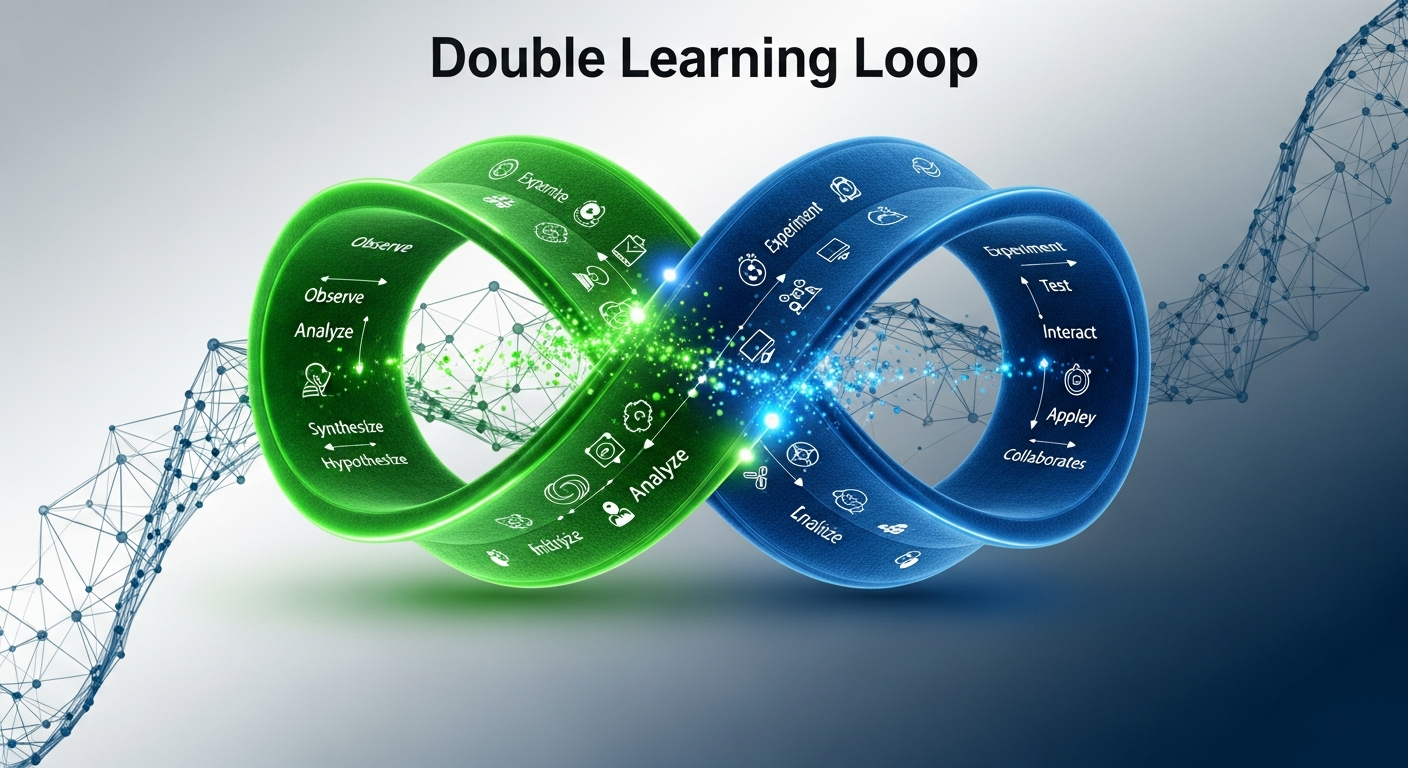
The Double Learning Loop goes a step further. It's not just about correcting errors, but about questioning the very framework that led to those errors. It's about 'doing better things' by examining and altering the governing variables themselves.
- What it is: Double-loop learning occurs when an organization, or an individual, questions the validity of the governing variables (norms, policies, assumptions, goals, values) that guide action. It involves reflecting on the 'why' behind our actions and redesigning the underlying system if necessary. This leads to fundamental shifts in understanding and behavior.
- Impact on L&D:
- Compliance: Instead of merely updating modules, a double-loop approach asks: "Are our existing compliance training methods truly fostering ethical decision-making, or just ticking boxes? How can we fundamentally shift our culture to embed compliance as a proactive value, perhaps through engaging Gamified LMS experiences?" This could lead to a complete overhaul of strategy, focusing on experiential learning and psychological safety over mere rule memorization. This also significantly enhances Risk-focused Training.
- Sales: Beyond just improving sales pitch training, double-loop learning queries: "Are our sales methodologies still relevant in a rapidly evolving market? Do our assumptions about customer needs hold true? How can we empower our sales teams to adapt dynamically, perhaps leveraging an Adaptive Learning approach that personalizes skill development based on real-time market feedback?"
- Employee Development: It means asking if current career pathing or leadership development programs truly align with future organizational needs and employee aspirations, or if they are based on outdated models of talent progression.
Why the Double Learning Loop is Critical for L&D Leaders Today
For L&D executives, embracing the double learning loop is paramount for several reasons:
- Navigating Rapid Change: Industries are constantly disrupted by technology, market shifts, and new regulations. A double-loop mindset allows L&D to anticipate, adapt, and even drive change, ensuring training strategies remain ahead of the curve.
- Strategic Impact: It elevates L&D from a support function to a strategic partner. By questioning foundational assumptions, L&D can align learning initiatives directly with core business objectives, driving innovation and competitive advantage.
- Fostering Agility and Resilience: Organizations that can learn and unlearn quickly are more resilient. The double learning loop cultivates an agile workforce capable of critical thinking and continuous adaptation, essential for industries from retail to pharma.
- Enhanced Employee Engagement and Retention: A culture that encourages questioning and transformation empowers employees, fostering a sense of ownership and psychological safety. This leads to higher engagement, better performance, and reduced turnover.
- Proactive Risk Mitigation: Especially crucial in highly regulated sectors like banking, insurance, and healthcare, double-loop learning enables L&D to proactively identify and address systemic risks, moving beyond reactive compliance to truly embed ethical practices through Risk-focused Training.
Implementing Double Learning Loop in Your L&D Strategy
Translating this theory into practice requires intentional effort and the right tools:
- Cultivate a Culture of Inquiry: Encourage L&D teams and learners to ask "why" – why do we do things this way? What assumptions are we operating under? This fosters critical thinking and curiosity.
- Leverage Data for Deeper Insights: Move beyond surface-level metrics. Use analytics from your MaxLearn Microlearning Platform to uncover patterns, correlations, and anomalies that point to systemic issues, not just individual performance gaps.
- Embrace Experimentation and Pilot Programs: Create safe spaces for testing new approaches. Be willing to "fail fast" and learn from those experiments, iterating on the underlying assumptions rather than just tweaking the execution.
- Integrate Reflective Practices: Build reflection into learning journeys. After a training module or a project, encourage teams to not just review outcomes but also the processes and assumptions that led to those outcomes.
- Utilize Transformative Technologies: Modern eLearning solutions are critical enablers:
- An MaxLearn Microlearning Platform can deliver targeted, bite-sized content that allows for rapid experimentation and feedback loops.
- Adaptive Learning pathways can dynamically adjust based on learner performance, challenging existing assumptions about linear progression.
- A Gamified LMS can provide a sandbox for learners to test new ideas and experience consequences in a low-stakes environment, encouraging behavioral shifts.
- An AI Powered Authoring Tool can help in quickly generating diverse content for A/B testing different approaches.
AI's Role in Catalyzing Double Learning Loops
Artificial Intelligence is not just a tool for efficiency; it's a powerful ally in fostering double-loop learning. By providing unprecedented data analysis and personalized experiences, AI can help L&D leaders challenge norms and reshape strategies.
How can artificial intelligence revolutionize content creation and delivery, ensuring optimal engagement and impact for our global workforce?
AI-powered tools can rapidly analyze learning needs, personalize content, and suggest improvements based on vast datasets. An AI Powered Authoring Tool can dramatically accelerate the creation of dynamic, relevant modules, allowing L&D teams to focus on strategic insights rather than manual content production. This enables quicker iteration and testing of new learning models, which is central to double-loop learning.
In what specific operational areas, particularly those involving multi-location teams or complex regulatory environments, can AI significantly enhance learning effectiveness and consistency?
For industries like compliance, banking, pharma, healthcare, or oil & gas, AI can identify regional knowledge gaps, localize content automatically, and ensure consistent application of standards across diverse geographical locations. By analyzing performance across different regions, AI can highlight whether a particular training methodology or a core assumption about learning transfer is failing in specific contexts, prompting a deeper review of the approach, thereby supporting Risk-focused Training effectively. A comprehensive MaxLearn Microlearning Platform often provides these capabilities.
What advanced analytical capabilities does AI offer to deeply understand learner behavior and optimize individual learning paths for sustained improvement?
AI can analyze vast amounts of learner data – completion rates, quiz scores, time spent, even sentiment and interaction patterns – to provide deep insights. This enables true Adaptive Learning, suggesting tailored resources and pathways, identifying root causes of performance issues (e.g., a systemic knowledge gap versus individual misunderstanding), and even predicting future training needs. Furthermore, a Gamified LMS, enhanced by AI, can further boost motivation and engagement by tailoring challenges and rewards based on individual progress and learning styles, constantly optimizing the learning environment based on deeper behavioural insights.
Conclusion
The Double Learning Loop is more than just a theoretical concept; it’s a vital strategy for L&D leaders committed to fostering innovation, resilience, and sustained performance. By moving beyond reactive problem-solving to critically examine and transform underlying assumptions, L&D can become a true strategic driver within the organization. Embracing this transformative approach, augmented by advanced eLearning platforms and AI capabilities, is how forward-thinking leaders will ensure their organizations not only survive but thrive in the face of continuous change, creating a workforce that is not just trained, but truly capable of continuous evolution.
.jpg)


