

Mastering Organizational Agility: Unleashing the Power of Argyris Double Loop Learning in L&D
In today's relentlessly evolving business landscape, the traditional approach to learning and development often falls short. Vice Presidents, Directors, and Senior Managers of L&D across industries like Banking, Pharma, Retail, and Oil and Gas are constantly seeking strategies that transcend mere skill acquisition. They need methodologies that drive profound organizational change, foster innovation, and cultivate true resilience. This is where Adaptive Learning shines, and where the profound insights of Chris Argyris's Double Loop Learning become indispensable.
Argyris's framework offers a powerful lens through which L&D leaders can evaluate and refine their learning strategies. It distinguishes between two fundamental types of organizational learning, one focused on corrective action within existing norms, and the other on challenging and transforming those norms themselves. Understanding and implementing Double Loop Learning is not just about improving processes; it's about reshaping the very DNA of how your organization learns, adapts, and thrives.
Understanding Single Loop Learning
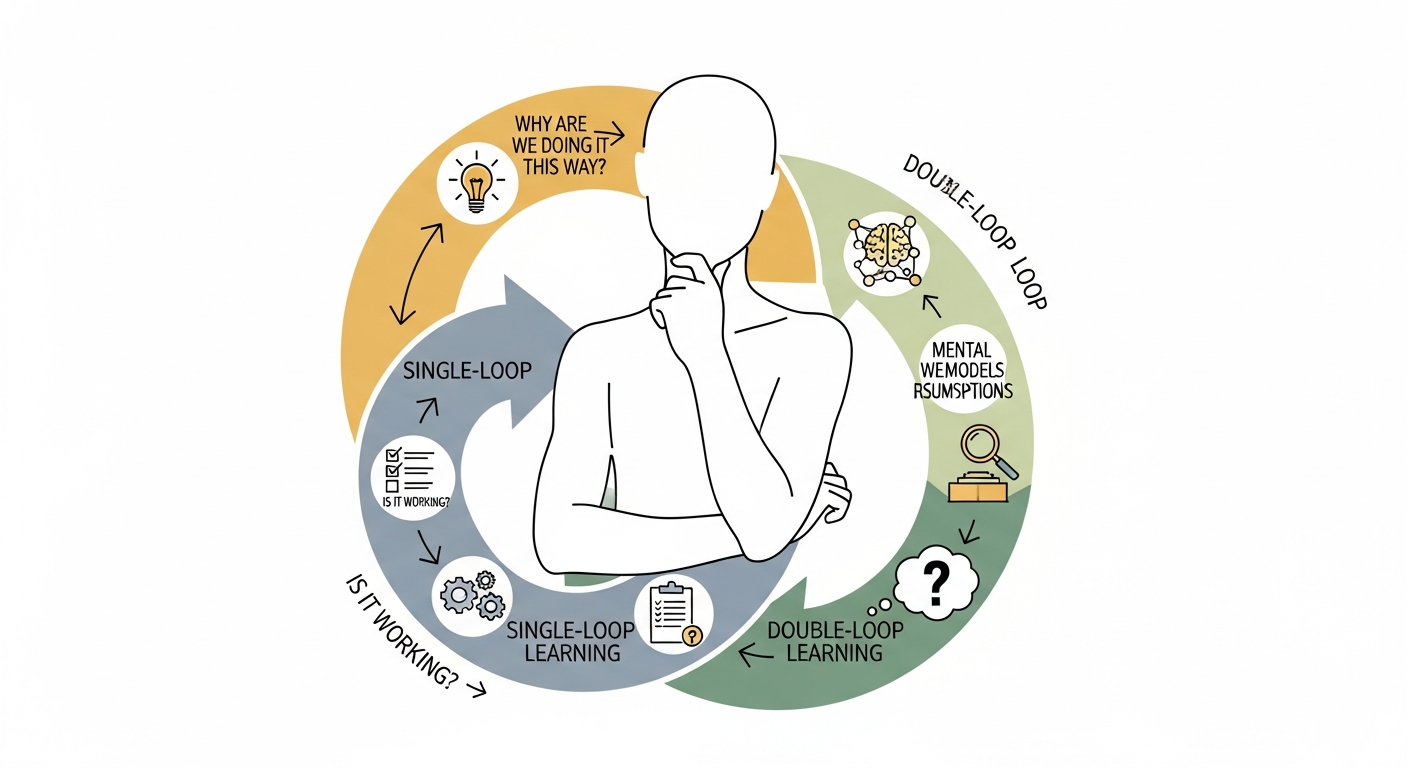
To fully grasp Double Loop Learning, it's essential to first understand its counterpart: Single Loop Learning. Imagine a thermostat. When the temperature drops below a set point, the thermostat activates the heater. When the temperature rises too high, it turns the heater off. This is Single Loop Learning in action. It involves detecting errors and correcting them without questioning the underlying goals, values, or assumptions that guide the actions.
In an organizational context, Single Loop Learning occurs when employees or teams identify a problem and fix it using existing strategies and rules. For example, if a sales team isn't meeting targets, Single Loop Learning might involve providing more product training, refining sales scripts, or increasing the number of calls. The goal (hitting targets) and the methods (current sales process) are taken as given. While efficient for routine problem-solving and maintaining stability, reliance solely on Single Loop Learning can lead to stagnation, preventing an organization from adapting to significant external shifts or internal challenges.
Embracing Double Loop Learning: A Paradigm Shift
Double Loop Learning, in contrast, goes a step further. It's about questioning the thermostat itself – not just adjusting the temperature, but asking why the temperature is set where it is, or even whether heating and cooling are the most appropriate solutions. It involves re-examining the underlying assumptions, values, policies, and goals that frame the problem and guide actions.
Applying this to our sales team example: Double Loop Learning would involve asking: "Are our sales targets realistic in the current market?" "Are our products still meeting customer needs effectively?" "Is our fundamental sales strategy outdated?" "Are our current metrics truly indicative of success, or are we measuring the wrong things?" This level of inquiry challenges the status quo, pushing individuals and organizations to reflect critically on their governing variables and mental models. It's about learning how to learn, and unlearning what no longer serves the organization.
Why Double Loop Learning is Crucial for Modern L&D
For L&D leaders, championing Double Loop Learning is paramount for several strategic reasons:
Fostering a Culture of Innovation
In industries demanding constant innovation, from Pharma to Technology, Double Loop Learning encourages employees to challenge entrenched beliefs and explore novel solutions. It shifts the focus from merely improving existing processes to inventing entirely new ones, leading to genuine breakthroughs.
Driving Strategic Organizational Change
Whether responding to market disruption in Retail or navigating regulatory changes in Banking and Finance, organizations need to adapt strategically. Double Loop Learning empowers L&D to facilitate profound behavioral and systemic changes, ensuring that training initiatives don't just patch over problems but address their root causes.
Improving Compliance and Risk Management
For high-stakes sectors like Health Care, Mining, and Oil and Gas, robust Risk-focused Training is non-negotiable. Double Loop Learning in compliance means not just training employees on rules, but also questioning why certain rules exist, whether they are still effective, and how the organization's underlying assumptions might inadvertently contribute to risk. This leads to more proactive and resilient risk mitigation strategies.
Enhancing Sales Performance and Adaptability
In Sales, the ability to adapt to changing customer behaviors and competitive landscapes is crucial. Double Loop Learning helps sales teams move beyond simply refining their pitch to fundamentally rethinking their approach, understanding customer psychology, and even influencing product development based on market feedback. An AI Powered Authoring Tool can help create scenarios that encourage this deeper reflection.
Implementing Double Loop Learning in Your Organization
Shifting from Single to Double Loop Learning requires intentional effort and a supportive organizational culture. Here’s how L&D can lead the charge:
Cultivating Psychological Safety
Employees must feel safe to challenge authority, question norms, and admit mistakes without fear of retribution. L&D can promote this by training managers in empathetic leadership and creating safe spaces for open dialogue and constructive dissent.
Leveraging Data and Feedback Mechanisms
Robust data analytics and feedback systems are crucial. Beyond tracking basic completion rates, L&D should implement surveys, focus groups, and performance reviews that encourage critical self-reflection and questioning of existing practices.
Empowering Learners Through Advanced Platforms
Utilize modern learning technologies that facilitate critical thinking. A Gamified LMS can create engaging scenarios that require learners to analyze situations, make decisions, and reflect on the outcomes, prompting deeper learning beyond rote memorization.
AI and Double Loop Learning: Unlocking Deeper Understanding
Artificial Intelligence is not just a tool for efficiency; it’s a powerful catalyst for enabling Double Loop Learning, especially in complex, data-rich environments. For L&D leaders, integrating AI means moving beyond traditional analytics to predictive insights that can highlight underlying systemic issues.
How can technology help us move beyond surface-level problem-solving to questioning our fundamental assumptions in training?
Modern learning platforms, augmented with AI, can analyze learning patterns, performance data, and even qualitative feedback to identify discrepancies between stated goals and actual outcomes. This goes beyond identifying a skills gap (Single Loop) to pinpointing whether the training objectives themselves, or the underlying organizational beliefs, are misaligned with business realities (Double Loop). AI can surface these inconsistencies, prompting L&D professionals to ask fundamental questions about their strategy.
What digital strategies enable organizations to consistently challenge their core learning paradigms?
AI-driven simulations and scenario-based training can expose learners to complex situations where existing rules or assumptions fail. By providing immediate, personalized feedback that not only corrects errors but also explains why an approach was ineffective, AI fosters a culture of critical reflection. Furthermore, AI can personalize learning pathways to introduce diverse perspectives and conflicting viewpoints, forcing learners to reconsider their established mental models and ultimately facilitating Double Loop Learning across global teams in industries from Hospitality to Finance.
How can advanced analytics transform our L&D approaches from reactive fixes to proactive, assumption-challenging strategies?
AI's predictive capabilities are a game-changer. Instead of reacting to performance issues, AI can analyze vast datasets to anticipate future skill requirements, identify potential blind spots in current training, and even predict where current organizational assumptions might lead to problems. This proactive intelligence allows L&D leaders to design interventions that don't just address symptoms but challenge the very frameworks guiding their organization’s actions, thereby embedding Double Loop Learning into the strategic planning cycle.
The MaxLearn Advantage: Enabling Double Loop Learning
Implementing Double Loop Learning requires robust and intelligent learning infrastructure. A platform like the MaxLearn Microlearning Platform is designed to facilitate this deeper level of engagement and critical thinking. Its microlearning approach encourages continuous, iterative learning cycles that are ideal for reflection and adjustment. Through its features, organizations can:
- Utilize its Gamified LMS to create interactive challenges that require learners to think critically and challenge assumptions, providing immediate feedback that prompts deeper reflection.
- Leverage Adaptive Learning paths that personalize content based on a learner's responses, presenting scenarios that specifically target their existing mental models and encourage them to re-evaluate their approaches.
- Employ an AI Powered Authoring Tool to quickly develop and iterate on training modules that simulate complex business problems, allowing L&D teams to design experiences that push learners beyond simple compliance to critical analysis, especially relevant for Risk-focused Training in sectors like Mining or Finance.
Conclusion
Argyris Double Loop Learning is more than a theoretical concept; it's a strategic imperative for L&D leaders aiming to build truly adaptive, resilient, and innovative organizations. By moving beyond reactive problem-solving to proactive questioning of fundamental assumptions, you can empower your workforce to not just navigate change, but to drive it. Embracing advanced technologies, especially AI-powered platforms, provides the essential infrastructure to cultivate this transformative learning capability, ensuring your organization remains ahead of the curve in any industry.
.jpg)


