

Mastering the Forgetting Curve: The Strategic Imperative for Modern L&D
In today’s rapidly evolving business landscape, knowledge is power – but only if it sticks. Every year, organizations invest colossal sums in employee training and development, aiming to upskill their workforce, ensure compliance, and drive innovation. Yet, a silent, pervasive enemy constantly threatens to undermine these efforts: the human tendency to forget. This challenge is meticulously explained by a psychological phenomenon known as The Forgetting Curve Theory, a concept that demands a strategic response from modern Learning & Development (L&D) departments across every sector.
Understanding and actively combating this natural decay of memory isn't just an academic exercise; it's a critical business imperative impacting productivity, safety, customer satisfaction, and ultimately, profitability in industries from Insurance to Oil and Gas.
Unveiling The Forgetting Curve Theory
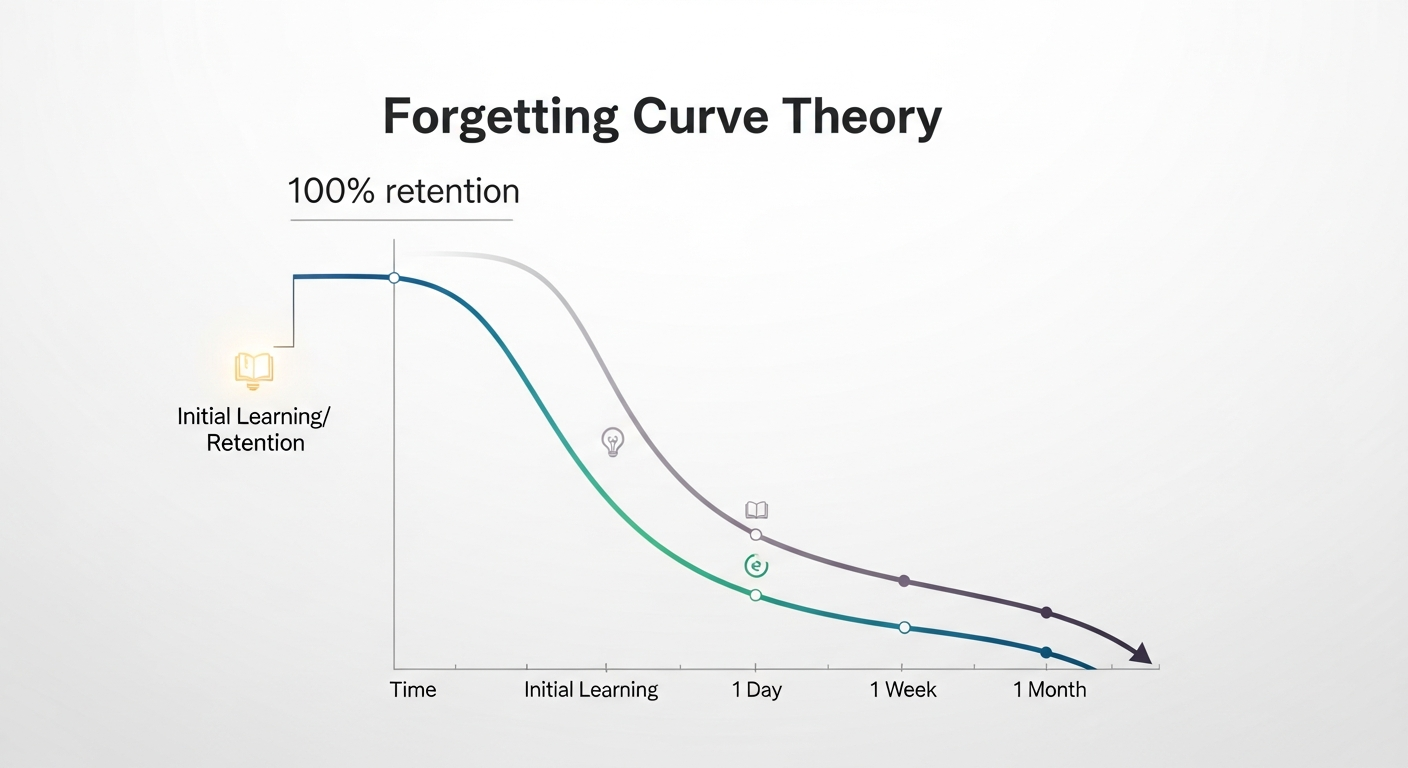
The Forgetting Curve, first conceptualized by German psychologist Hermann Ebbinghaus in the late 19th century, illustrates the rate at which newly acquired information is forgotten. His groundbreaking research revealed a startling truth: we forget most new information very quickly if it's not reinforced. Within hours, a significant portion of what was learned can vanish, with the decline continuing steadily over days and weeks.
Imagine your employees attending an intensive training session. Ebbinghaus’s work suggests that without intervention, they might retain only 50% of the material within a day, dropping to less than 30% after a week. This rapid decline poses a formidable obstacle to effective knowledge transfer and long-term skill development. For L&D professionals, this isn't just a fascinating theory; it's a call to action to design learning experiences that actively counteract this natural memory erosion.
The Business Impact of Knowledge Decay Across Industries
The implications of the Forgetting Curve are profound and far-reaching, translating into tangible costs and risks for businesses that fail to address it proactively.
Finance & Banking
- **Compliance Training:** In sectors like Finance and Banking, where regulatory landscapes constantly shift, forgetting new compliance mandates can lead to hefty fines, reputational damage, and operational risks. Employees need to consistently recall complex regulations, fraud detection protocols, and ethical guidelines.
- **Product Knowledge:** Sales teams need up-to-date knowledge of intricate financial products. If they forget key features or benefits, sales opportunities are missed, and customer trust can erode.
Insurance & Pharma
- **Regulatory Updates:** Both Insurance and Pharma operate under stringent, ever-changing regulations. Sales agents, claims processors, and drug developers must maintain current knowledge of policies, drug interactions, and safety protocols to ensure accuracy and avoid critical errors.
- **New Product Launches:** Keeping vast sales forces and medical representatives informed about new insurance products or pharmaceutical innovations requires robust retention strategies to ensure they can effectively communicate benefits and risks.
Retail & Healthcare
- **Customer Service Excellence:** Retail staff need to remember product details, company policies, and best practices for handling customer queries. In Healthcare, forgetting patient care protocols, medication dosages, or equipment operation can have severe, life-threatening consequences.
- **Procedural Recall:** From point-of-sale systems in retail to emergency procedures in healthcare, employees rely on precise memory of steps and workflows. Gaps in this recall can lead to inefficiencies, errors, and compromised safety.
Mining & Oil and Gas
- **Safety Protocols:** Perhaps nowhere is the cost of forgetting more critical than in high-risk environments like Mining and Oil and Gas. Forgetting safety procedures, equipment operation manuals, or emergency response plans can lead to accidents, fatalities, and environmental disasters.
- **Operational Efficiency:** Maintaining complex machinery and optimizing extraction processes requires consistent recall of maintenance schedules, diagnostic procedures, and efficient operational techniques. Knowledge decay directly impacts productivity and asset longevity.
Overcoming the Curve: Modern Learning Strategies for Lasting Retention
The good news is that Ebbinghaus also noted that the rate of forgetting can be slowed and even reversed through strategic repetition and engagement. Modern L&D leverages technology and pedagogical insights to create powerful interventions.
- **Microlearning:** Breaking down complex information into short, digestible modules significantly improves retention. Instead of an all-day seminar, delivering knowledge in 3-5 minute bursts makes it easier for the brain to process and store. A MaxLearn Microlearning Platform provides the ideal environment for this kind of focused, bite-sized learning.
- **Spaced Repetition:** This technique directly attacks the Forgetting Curve by scheduling review sessions at increasing intervals. Just as information is about to be forgotten, it's reintroduced, strengthening memory traces.
- **Gamification:** Turning learning into a game, with points, badges, leaderboards, and challenges, boosts engagement and motivation. When learning is enjoyable, employees are more likely to participate, leading to better retention. Explore how a Gamified LMS can transform your training outcomes.
- **Adaptive Learning:** One size does not fit all in learning. Adaptive learning systems personalize the learning path based on an individual's existing knowledge, learning style, and performance. This ensures learners focus on what they need most, making the learning process more efficient and effective. Discover the power of Adaptive Learning for powerful knowledge retention.
Intelligent Solutions for Enhanced Knowledge Retention
The advent of sophisticated technology is revolutionizing how organizations combat knowledge decay, offering unprecedented capabilities for personalized, engaging, and highly effective learning experiences. By harnessing advanced analytics and machine learning, learning platforms can move beyond simple content delivery to become intelligent partners in employee development.
Organizations are increasingly seeking answers to critical questions about leveraging technology for superior learning outcomes:
Question: How can smart learning systems combat the rapid decline in absorbed information?
Answer: Intelligent platforms leverage sophisticated algorithms to track individual learning progress, identify specific areas of weakness, and predict when knowledge is likely to fade. They then automatically deliver timely refreshers, personalized quizzes, or relevant micro-lessons precisely when an individual needs reinforcement, effectively creating a personalized spaced repetition system. This proactive approach ensures that crucial information is revisited before it's forgotten, solidifying long-term memory and maximizing training return on investment.
Question: What role do advanced algorithms play in making training more effective globally?
Answer: Advanced algorithms enable learning content to be dynamically localized, translated, and adapted not just for language, but also for cultural nuances and regional regulatory requirements. This ensures that training materials resonate deeply with diverse international teams, enhancing comprehension and engagement. Furthermore, these algorithms can analyze global performance data to identify best practices and common learning hurdles, allowing for continuous optimization of training programs across all geographical boundaries, thereby ensuring equitable and effective learning experiences worldwide.
Question: How do intelligent tools enhance the creation and delivery of training materials?
Answer: Advanced tools significantly streamline the development and deployment of learning content. They can automate repetitive authoring tasks, suggest improvements to content clarity and engagement based on past performance data, and even generate personalized learning paths. This allows L&D teams to rapidly create high-quality, relevant training, such as AI Powered Authoring Tool, that is optimized for learner consumption. Moreover, these tools analyze how learners interact with content, providing insights that lead to iterative improvements, making delivery more targeted and impactful, especially for vital areas like Risk-focused Training, where precision and retention are paramount.
The Future of Corporate Learning: A Continuous Journey
The Forgetting Curve is a natural human phenomenon, but its impact on business is anything but natural. By embracing modern L&D strategies powered by cutting-edge technology, organizations can transform their training programs from one-off events into continuous, engaging, and highly effective journeys of knowledge retention and skill development. Investing in platforms that intelligently combat forgetting is no longer optional; it’s a strategic imperative for businesses aiming to maintain a competitive edge, ensure operational excellence, and foster a truly knowledgeable and resilient workforce in every industry sector.
.jpg)


