

Conquering the Forgetting Curve: Maximizing Knowledge Retention in the Modern Enterprise
In today's fast-paced corporate world, continuous learning is not just an advantage; it's a necessity. From navigating complex financial regulations to mastering life-saving healthcare protocols, employees across every industry are constantly acquiring new knowledge and skills. Yet, there's a silent adversary threatening to undermine these vital learning efforts: the Forgetting Curve. Understanding this psychological phenomenon and implementing strategic interventions is paramount for any organization committed to effective learning and development (L&D).
Understanding the Forgetting Curve: A Foundation for Effective Learning
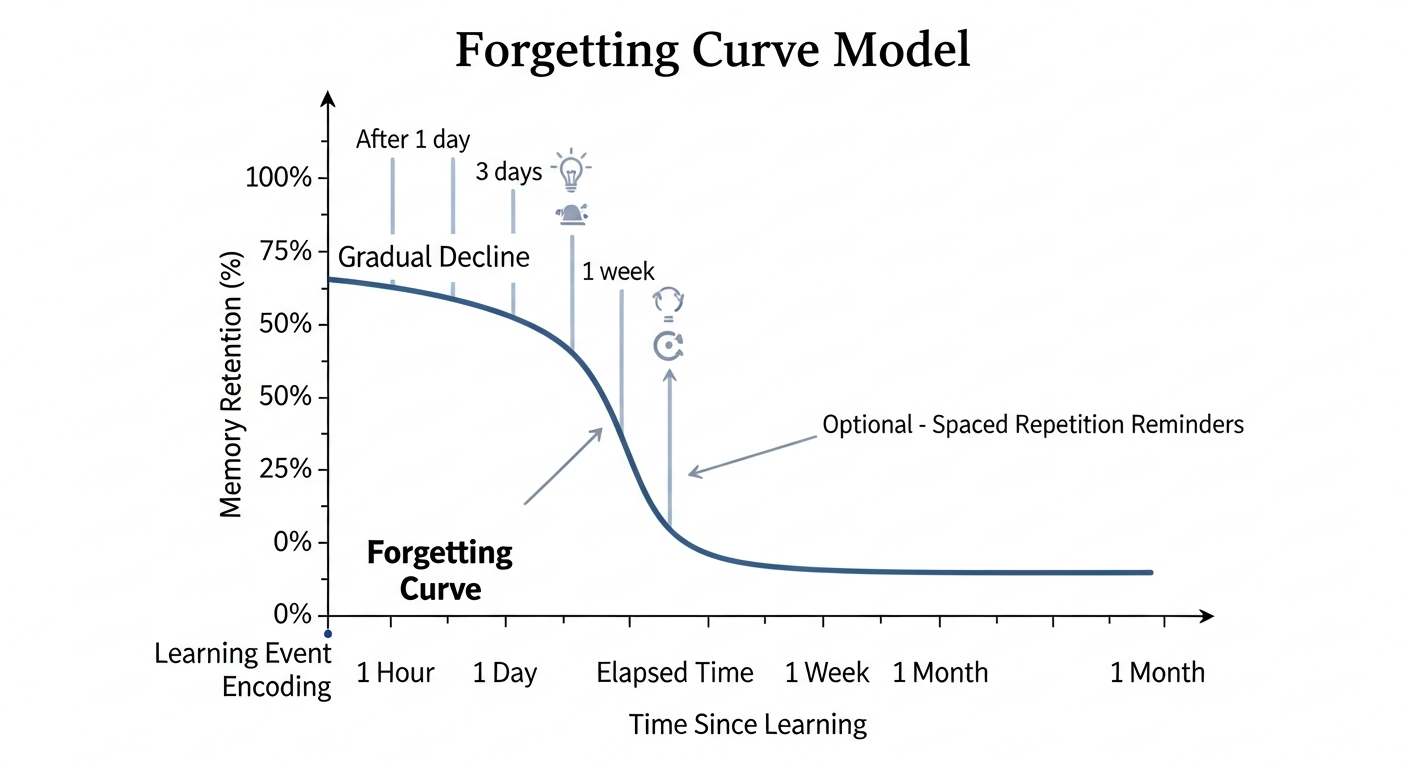
The concept of the Forgetting Curve was first introduced by German psychologist Hermann Ebbinghaus in 1885. Through his pioneering research, Ebbinghaus discovered that without reinforcement, information retention declines rapidly after initial learning, then levels off over time. His findings revealed that a significant portion of newly acquired knowledge can be lost within a day, and even more within a week, if not actively reinforced.
Imagine your team undergoes an intensive training session on a new compliance procedure or a critical safety protocol. According to Ebbinghaus's model, much of that detailed information could be gone within a matter of hours or days. This rapid decay poses a significant challenge for L&D professionals and business leaders who invest heavily in training programs, only to see the knowledge evaporate before it can be effectively applied.
Key Factors Influencing Retention:
- Meaningfulness: Information that is personally relevant or connected to existing knowledge is retained better.
- Repetition: Spaced intervals of review and practice significantly improve recall.
- Active Recall: Engaging the learner in retrieving information (e.g., through quizzes) strengthens memory traces.
- Emotional Engagement: Learning experiences that evoke emotion tend to be more memorable.
Why the Forgetting Curve Matters for Learning & Development
For L&D departments, the Forgetting Curve isn't merely an academic curiosity; it's a critical challenge that directly impacts business performance and return on investment (ROI) in training. When employees forget crucial information, the consequences can range from decreased productivity and inefficiency to significant compliance breaches, safety incidents, or loss of revenue.
Ignoring this natural human tendency to forget means that valuable resources—time, money, and effort—spent on training might not yield the desired long-term benefits. The goal of L&D is not just to deliver information, but to ensure that information is absorbed, retained, and applied effectively in the workplace.
Impact Across Industries: Where Knowledge Decay Hits Hardest
The implications of the Forgetting Curve are universal, but its impact is particularly acute in industries where precision, compliance, and up-to-date knowledge are non-negotiable.
-
Insurance & Finance:
In sectors governed by stringent regulations and complex product offerings, forgetting even minor details can lead to compliance violations, financial penalties, or incorrect customer advice. Training on new policies, regulatory updates, or fraud detection methods requires robust retention strategies.
-
Retail & Banking:
Customer service excellence, product knowledge, and transaction security are paramount. Forgetting how to handle specific customer queries, process new payment types, or recognize security threats can lead to poor customer experiences, errors, and security vulnerabilities.
-
Mining & Oil and Gas:
Safety protocols, operational procedures, and equipment maintenance are critical. A lapse in memory regarding a safety check or an emergency response procedure can have catastrophic human and environmental consequences. Continuous, reinforced training is vital for Risk-focused Training and operational integrity.
-
Healthcare & Pharma:
Forgetting medical procedures, drug interactions, patient care protocols, or clinical trial specifics can have life-threatening implications. Healthcare professionals must consistently retain vast amounts of critical, evolving information to ensure patient safety and effective treatment.
Strategies to Combat the Forgetting Curve
The good news is that organizations are not powerless against the Forgetting Curve. Modern L&D strategies, often powered by innovative technology, offer powerful ways to reinforce learning and ensure knowledge sticks.
- Spaced Repetition: Instead of one-off training, information is revisited at increasing intervals. This method leverages the brain's natural way of consolidating memories.
- Microlearning: Delivering content in short, digestible bursts makes learning less overwhelming and easier to integrate into busy schedules. This approach is highly effective for reinforcement and review. Platforms like MaxLearn Microlearning Platform are designed to facilitate this.
- Gamification: Incorporating game-like elements such as points, badges, and leaderboards into learning can significantly boost engagement and motivation, making repetition enjoyable and effective. A Gamified LMS transforms routine learning into an exciting challenge.
- Adaptive Learning: Tailoring content and pace to individual learner needs and performance ensures that learners focus on areas where they need the most support, making learning more efficient and effective. This personalized approach is a cornerstone of Adaptive Learning.
- Active Recall & Retrieval Practice: Regular quizzes, flashcards, and practice exercises force learners to retrieve information from memory, strengthening neural pathways and improving long-term retention.
- Contextual Learning: Presenting information within relevant, real-world scenarios helps learners understand its practical application, making it more meaningful and easier to remember.
Leveraging Intelligent Technology for Enhanced Retention
The advent of sophisticated technology, particularly intelligent systems, provides unprecedented opportunities to personalize learning, predict knowledge gaps, and deliver timely reinforcements, directly addressing the challenges posed by the Forgetting Curve.
How can smart systems help tailor learning paths to individual needs?
Intelligent platforms analyze a learner's performance data, engagement levels, and prior knowledge to create personalized learning journeys. By identifying specific strengths and weaknesses, these systems can recommend targeted content, adjust difficulty levels, and suggest relevant resources, ensuring that each employee receives the most effective learning experience. An AI Powered Authoring Tool can further streamline content creation for these adaptive paths.
How do advanced analytical tools anticipate when employees might forget critical information?
By monitoring learning progress, completion rates, assessment scores, and even time elapsed since last review, intelligent analytics can predict potential points of knowledge decay. This allows L&D teams to proactively deploy refresher modules, short quizzes, or helpful reminders precisely when they are most needed, before significant forgetting occurs.
Can intelligent platforms automatically create or suggest relevant refresher content based on learning patterns?
Absolutely. Modern intelligent systems can not only recommend existing content but also leverage content generation capabilities to create new, bite-sized refreshers based on identified knowledge gaps. This dynamic content delivery ensures that learning materials are always current, relevant, and precisely targeted to individual and team needs, optimizing the efficiency of continuous learning programs.
In geographically dispersed industries, how can intelligent technology support on-site learning to prevent knowledge decay in the field?
For industries like mining or oil and gas, intelligent mobile learning solutions deliver critical information directly to workers on-site, in real-time. This can include augmented reality (AR) overlays for equipment maintenance, interactive safety checklists, or quick-reference guides accessible via smartphones or tablets. Such just-in-time learning significantly reduces the risk of forgetting vital procedures when they are needed most in high-stakes environments.
How do sophisticated simulations enhance memory retention for complex or high-risk tasks?
Intelligent simulations provide immersive, risk-free environments where employees can practice complex procedures, make critical decisions, and experience the consequences of their actions. This experiential learning, coupled with immediate feedback from the system, creates strong memory traces that are far more robust than passive learning. By actively engaging multiple senses and decision-making processes, simulations cement knowledge for long-term recall, crucial for sectors like healthcare and finance where mistakes can be costly.
Conclusion: Building a Culture of Lasting Knowledge
The Forgetting Curve is an inherent part of human cognition, but it doesn't have to be a roadblock to effective organizational learning. By acknowledging its existence and proactively implementing evidence-based strategies, businesses can transform their L&D efforts. Embracing microlearning, gamification, spaced repetition, adaptive learning, and leveraging intelligent technologies empowers organizations to move beyond mere training delivery to foster true knowledge retention and application.
Investing in solutions that actively combat the Forgetting Curve ensures that every training dollar spent contributes to a more knowledgeable, skilled, and resilient workforce, ready to meet the challenges of tomorrow.
.jpg)


