

Overcoming the Forgetting Curve: Real-World Examples and Modern L&D Solutions
Imagine your team undergoes an intensive, critical training program. Everyone pays attention, participates actively, and passes the final assessment with flying colors. Fast forward a few weeks, and a significant portion of that meticulously acquired knowledge has vanished. This isn't a failure of the training program itself, nor a lack of intelligence among your employees; it's a direct consequence of the "Forgetting Curve."
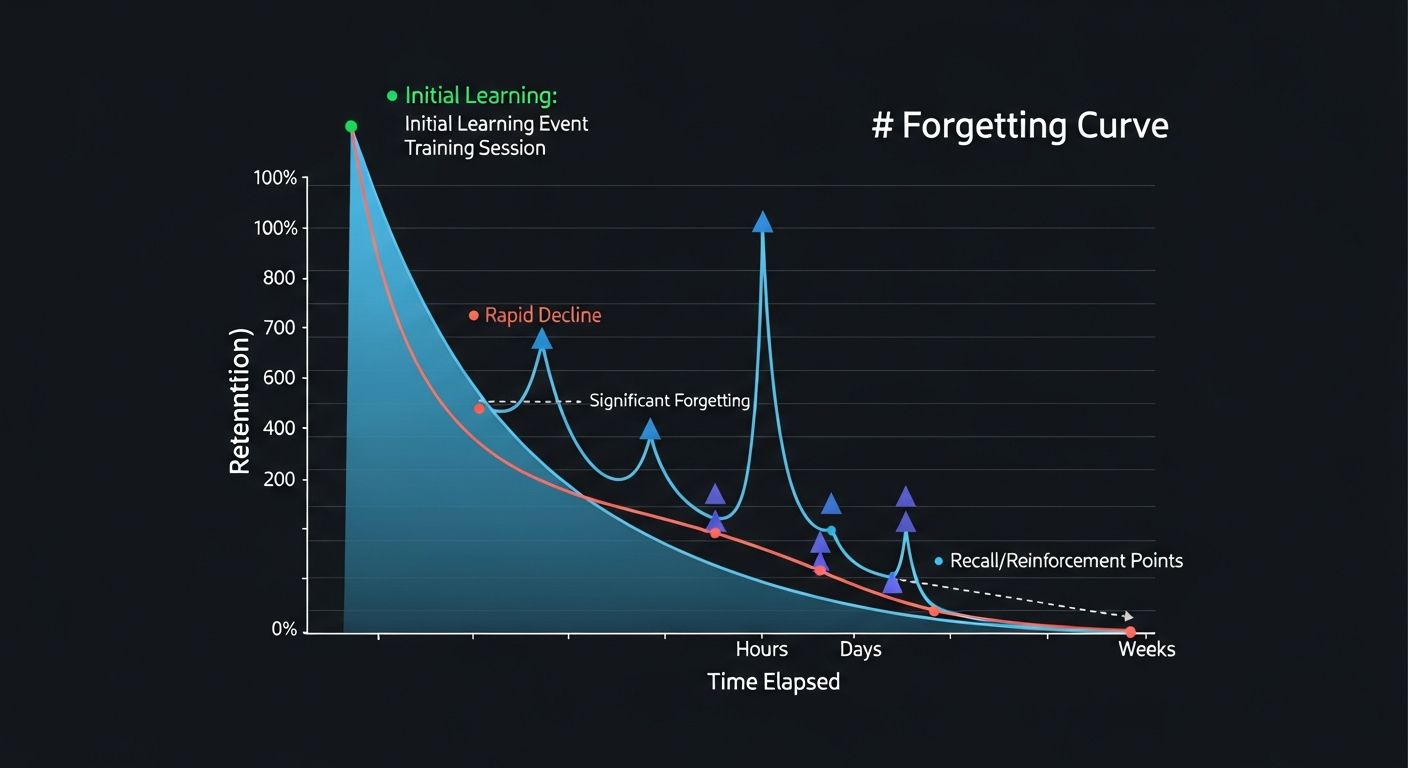
First articulated by German psychologist Hermann Ebbinghaus in 1885, the Forgetting Curve illustrates the rate at which newly acquired information is lost over time if there's no attempt to retain it. Ebbinghaus's research famously showed that within just an hour, people forget about 50% of new information, and within a day, that number can climb to 70%. After a month, nearly 80% of what was initially learned might be gone. For businesses across industries, where knowledge retention directly impacts performance, compliance, safety, and profitability, understanding and actively combating this natural human tendency is paramount.
The Tangible Impact of Knowledge Decay Across Industries
The implications of the Forgetting Curve are not abstract; they manifest as real-world challenges and significant costs. Let's explore how different sectors grapple with this phenomenon:
In Finance and Banking: The Cost of Compliance Missteps
Example: A new fraud detection protocol is introduced to banking employees. Initial training covers complex scenarios and preventative measures. Without regular reinforcement, tellers might forget subtle red flags, leading to undetected fraudulent transactions or incorrect customer advice.
Impact: Financial penalties, reputational damage, customer churn, and significant losses from undetected fraud.
In Insurance: Errors in Policy Interpretation and Claims Processing
Example: Insurance adjusters receive comprehensive training on updated policy clauses and claims procedures. Weeks later, dealing with high volumes of claims, they might revert to old habits or misinterpret nuanced policy details, resulting in incorrect payouts or frustrated customers.
Impact: Financial liabilities from incorrect claim settlements, customer dissatisfaction, increased call center volume, and potential regulatory scrutiny.
In Healthcare: Risks to Patient Safety and Quality of Care
Example: Nurses are trained on new infection control guidelines or critical equipment operation. If this knowledge isn't consistently reinforced, lapses in procedure can occur, leading to hospital-acquired infections or adverse patient events.
Impact: Compromised patient safety, legal repercussions, reduced quality of care, and damage to the institution's reputation.
In Pharmaceutical: Regulatory Non-Compliance and Product Efficacy
Example: Sales representatives learn intricate details about new drug formulations, indications, and potential side effects. If they forget key compliance parameters or efficacy data, they could misrepresent information to doctors, violating strict pharmaceutical regulations.
Impact: Severe regulatory fines, loss of market trust, and potential legal action.
In Mining and Oil & Gas: Safety Hazards and Operational Inefficiency
Example: Mine workers or rig operators undergo rigorous safety training on emergency protocols and equipment handling. If critical steps are forgotten in a high-stress situation or during routine maintenance, it can lead to catastrophic accidents or equipment failure.
Impact: Worker injuries or fatalities, environmental disasters, extensive equipment damage, and operational shutdowns.
In Retail: Lost Sales and Subpar Customer Experiences
Example: Retail associates are trained on new product features, inventory systems, or promotional offers. If they forget product specifics or how to navigate the POS system efficiently, customer inquiries go unanswered, or sales opportunities are missed.
Impact: Decreased sales, customer dissatisfaction, reduced brand loyalty, and increased staff turnover.
Strategies to Flatten the Forgetting Curve with Modern Learning & Development
The good news is that the Forgetting Curve is not an insurmountable barrier. Proactive L&D strategies, especially those powered by innovative technology, can significantly combat knowledge decay and ensure long-term retention.
1. Microlearning and Spaced Repetition
Instead of lengthy, one-off training sessions, MaxLearn Microlearning Platform breaks down complex topics into bite-sized, easily digestible modules. These short bursts of information, delivered at strategic intervals (spaced repetition), significantly enhance retention. Regular, brief refreshers prevent knowledge from plummeting down the curve.
2. Gamification for Engagement and Reinforcement
Transforming learning into an engaging experience is a powerful antidote to forgetting. A Gamified LMS uses elements like points, badges, leaderboards, and interactive challenges to motivate learners. This not only makes learning enjoyable but also encourages repeated engagement with the material, reinforcing memory pathways.
3. Personalized and Adaptive Learning Paths
Every learner is unique. Adaptive Learning systems leverage data to tailor content, pace, and difficulty to individual needs. By focusing on areas where an employee struggles and skipping what they already know, learning becomes more efficient and effective, strengthening weak points before they lead to significant knowledge gaps.
4. Leveraging Advanced Authoring Tools
Creating effective, engaging learning content quickly and at scale is crucial. An AI Powered Authoring Tool streamlines content creation, allowing L&D teams to rapidly develop and deploy fresh, relevant microlearning modules, quizzes, and simulations. This agility ensures that training can keep pace with evolving industry demands and reinforce critical knowledge precisely when needed.
5. Prioritizing Risk-Focused Training
Not all information is equally critical. For industries like Mining, Oil & Gas, Healthcare, and Finance, certain knowledge directly pertains to safety, compliance, or high-stakes operational procedures. Risk-focused Training identifies and prioritizes these essential areas, ensuring that the most vital information receives robust, continuous reinforcement to mitigate potential hazards.
Answering Key Questions on Knowledge Retention Technology
How can intelligent systems precisely identify individual knowledge gaps within a large workforce?
Modern learning platforms utilize sophisticated algorithms to track learner performance across various modules, assessments, and interactions. By analyzing response times, common errors, and successful completions, these systems can pinpoint specific areas where an individual or a group of employees might be struggling. This data-driven approach allows for targeted interventions, delivering personalized remedial content or practice exercises precisely where they are needed most, rather than a one-size-fits-all approach.
What are the most effective technological approaches for ensuring long-term knowledge retention?
The most impactful technological approaches combine several strategies. These include spaced repetition systems that automatically schedule reviews of critical information at optimal intervals, Gamified LMS platforms that boost engagement and voluntary practice through challenges and rewards, and real-time performance analytics that allow managers to identify and address emerging knowledge deficiencies. The integration of these elements within a cohesive platform creates a continuous learning loop that actively combats forgetting.
Can advanced learning technology personalize training at scale across large organizations?
Absolutely. While traditional training struggles with personalization for vast numbers of employees, advanced learning technology excels at it. Through Adaptive Learning algorithms, platforms can dynamically adjust learning paths, recommend resources, and even modify content difficulty based on each employee's unique learning pace, pre-existing knowledge, and performance data. This ensures that every individual, whether in a retail branch, a pharmaceutical lab, or a remote mining site, receives a learning experience tailored to their specific needs, making effective, personalized training a reality for thousands.
Conclusion
The Forgetting Curve is an inherent aspect of human memory, but its impact on business performance doesn't have to be. By understanding its mechanics and strategically deploying modern L&D solutions – particularly those leveraging microlearning, gamification, and advanced technology – organizations can transform knowledge retention from a challenge into a competitive advantage. Proactive, intelligent learning strategies are no longer a luxury but a necessity for ensuring that employees across every industry are equipped with the knowledge they need to succeed, comply, and innovate.
.jpg)


