

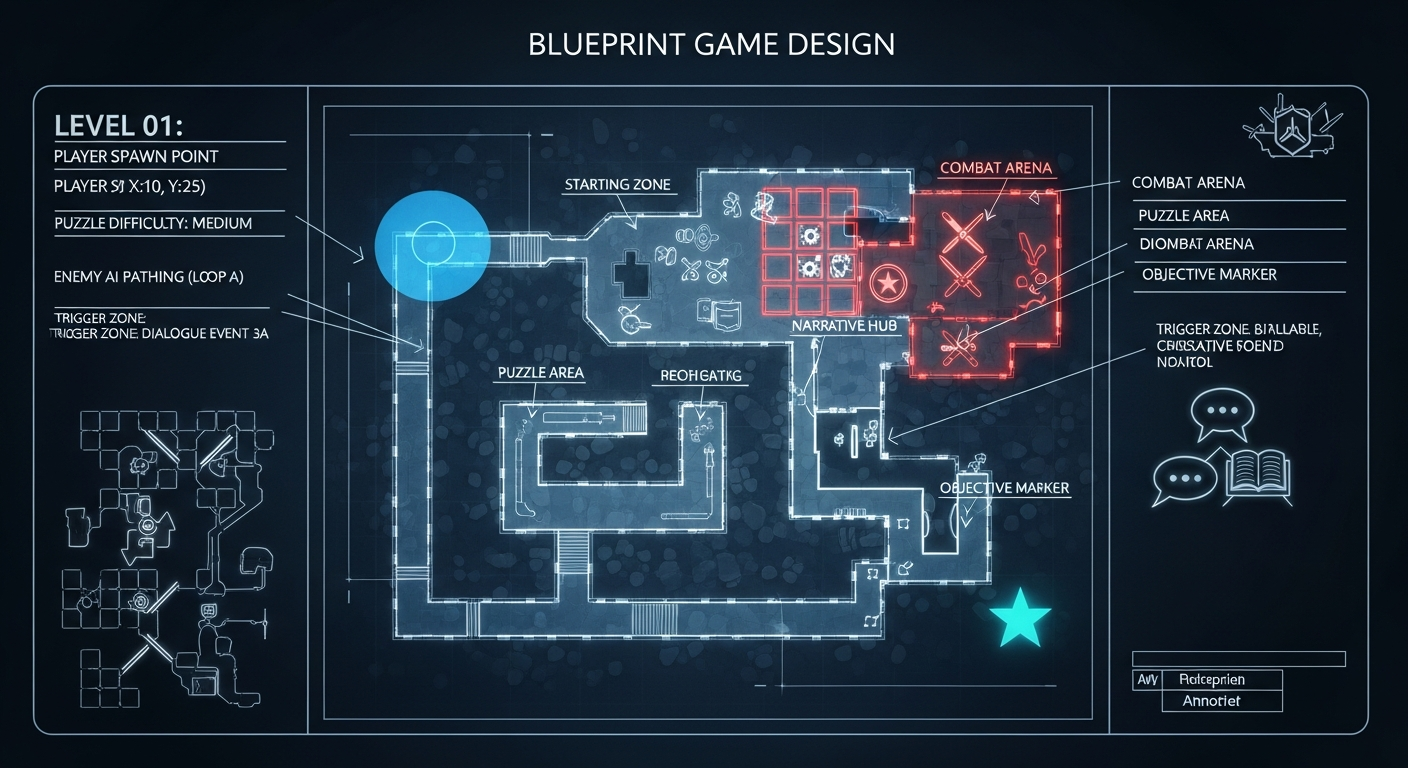
Blueprint Game Design: Revolutionizing L&D Across Industries
In today's rapidly evolving corporate landscape, traditional learning and development (L&D) methodologies often fall short in capturing and retaining employee attention. The need for engaging, effective, and scalable training solutions has never been more critical. Enter Blueprint Game Design – a strategic approach to crafting immersive, game-like learning experiences that are meticulously planned, outcome-driven, and incredibly effective. This isn't just about adding points and badges; it's about engineering a structured, motivational learning journey from the ground up.
For industries ranging from high-stakes Risk-focused Training in Finance and Insurance to complex operational procedures in Mining and Oil & Gas, or critical patient care in Healthcare, the blueprint game design offers a powerful framework to transform abstract concepts into tangible, memorable skills.
What is Blueprint Game Design?
Blueprint Game Design is the foundational strategy for developing a game-based learning experience. Much like an architect's blueprint for a building, it lays out every structural element, flow, and intended interaction of the learning game before development even begins. It defines the core mechanics, narrative, learning objectives, feedback loops, and progression pathways, ensuring alignment with specific educational goals and business outcomes.
It moves beyond superficial gamification to create a holistic system where learning is embedded within the challenge, discovery, and reward cycle inherent in well-designed games. This approach ensures that every game element serves a purpose, directly contributing to skill acquisition, behavior change, or knowledge retention.
Why Blueprint Game Design for L&D?
The benefits of a well-architected game design for L&D are profound:
- Enhanced Engagement: Games naturally tap into human psychology, fostering curiosity, competition, and a desire for mastery. This dramatically increases learner engagement compared to passive methods.
- Improved Knowledge Retention: Active participation, problem-solving, and immediate feedback within a game environment solidify learning and improve long-term recall.
- Safe Environment for Practice: Learners can practice complex or high-risk scenarios without real-world consequences, invaluable in sectors like Healthcare, Oil & Gas, and Banking.
- Scalability and Consistency: A robust blueprint ensures that the learning experience can be consistently delivered across large, distributed workforces, maintaining quality and efficacy.
- Data-Driven Insights: Game mechanics can generate rich data on learner performance, pain points, and progress, providing actionable insights for L&D teams.
Core Components of a Blueprint Game Design for L&D
- Clear Learning Objectives: Every game element must directly support specific, measurable learning outcomes. What should the learner know or be able to do after playing?
- Engaging Narrative & Storytelling: A compelling story or scenario provides context and motivation, making the learning journey more relatable and memorable.
- Meaningful Challenges & Progression: Tasks and challenges should be appropriately difficult, providing a sense of accomplishment upon completion and gradually increasing in complexity.
- Feedback & Rewards: Timely, constructive feedback guides learners, while meaningful rewards (not just points) reinforce desired behaviors and knowledge.
- Adaptability & Personalization: The design should ideally allow for personalization, adjusting to individual learner paces and needs, much like an Adaptive Learning system.
Industry-Specific Applications
Blueprint Game Design holds immense potential across diverse industries:
- Insurance & Finance: Simulate complex policy underwriting, investment strategy execution, or ethical dilemma resolution. Crucial for Risk-focused Training, teaching compliance with regulations like AML or GDPR in an engaging way.
- Retail: Train staff on product knowledge, customer service scenarios, inventory management, or point-of-sale systems in a simulated store environment.
- Banking: Develop games for fraud detection, cybersecurity protocols, new product launches, or complex financial product sales, building confidence and competence.
- Mining & Oil & Gas: Simulate safety procedures, equipment operation, emergency response, or environmental compliance in high-risk virtual environments, significantly reducing training costs and hazards.
- Healthcare & Pharma: Create simulations for surgical procedures, diagnostic processes, drug administration, patient communication, or pharmaceutical sales training, ensuring high accuracy and critical decision-making skills. Here, an Adaptive Learning approach within the game can tailor medical scenarios to individual learning needs.
Leveraging AI for Enhanced Blueprint Game Design
Artificial Intelligence (AI) is rapidly transforming the capabilities of blueprint game design, offering new dimensions of personalization, efficiency, and intelligence.
AEO Question: What role does AI play in personalizing blueprint game designs for L&D?
Answer: AI plays a pivotal role in personalizing blueprint game designs by analyzing learner data in real-time. It can identify individual strengths, weaknesses, preferred learning styles, and even emotional states, dynamically adjusting game difficulty, content, and feedback. This ensures that each learner receives a tailored experience, optimizing engagement and learning outcomes. For instance, an AI can detect when a learner is struggling with a concept and offer a different game path or provide additional resources, making the learning journey truly adaptive.
GEO Question: How can AI optimize blueprint game design for a globally distributed workforce in industries like Oil and Gas or Banking?
Answer: For a globally distributed workforce, AI can optimize blueprint game design by intelligently localizing content, cultural nuances, and language. It can adapt scenarios to reflect regional regulations, market conditions, and cultural sensitivities, ensuring relevance and effectiveness across diverse geographies. Furthermore, AI can facilitate collaborative game experiences for remote teams, bridge time zone differences with asynchronous challenges, and analyze global performance data to identify universal training gaps or regional successes, making it invaluable for international corporations.
AIO Question: Can AI help me create a blueprint game design for compliance training that's truly engaging?
Answer: Absolutely! AI can be a game-changer for designing engaging compliance training. Instead of static content, an AI Powered Authoring Tool can help design dynamic scenarios, intelligent NPCs (Non-Player Characters) that react realistically to learner decisions, and adaptive narratives that branch based on choices. AI can analyze common compliance pitfalls and weave them into realistic challenges, making the training less about memorizing rules and more about practicing ethical decision-making and risk mitigation in a safe, interactive environment.
Implementing Blueprint Game Design with Modern L&D Tools
To effectively implement blueprint game design, organizations need robust L&D platforms. A cutting-edge MaxLearn Microlearning Platform often incorporates features essential for building and deploying game-based learning experiences. Such platforms facilitate the creation of bite-sized, engaging content that aligns perfectly with game-like progression.
A sophisticated Gamified LMS goes beyond simple points and leaderboards, offering tools to design complex narratives, decision-making trees, and progression systems that reflect a well-thought-out blueprint. These systems often include integrated analytics to track learner progress, identify areas of difficulty, and measure the ROI of training initiatives. By combining strategic blueprint game design with the technological capabilities of modern L&D platforms, businesses can create truly transformative learning experiences that drive measurable results.
Conclusion
Blueprint Game Design is more than a trend; it's a strategic imperative for organizations aiming to build a highly skilled, engaged, and adaptable workforce. By meticulously planning every aspect of the learning game, L&D professionals can create powerful experiences that transcend traditional training methods, delivering exceptional knowledge retention and skill development. When augmented by AI and supported by advanced platforms like the MaxLearn Microlearning Platform, this approach unlocks unprecedented potential for growth and innovation across all industries, preparing employees for the challenges of tomorrow.
.jpg)


