

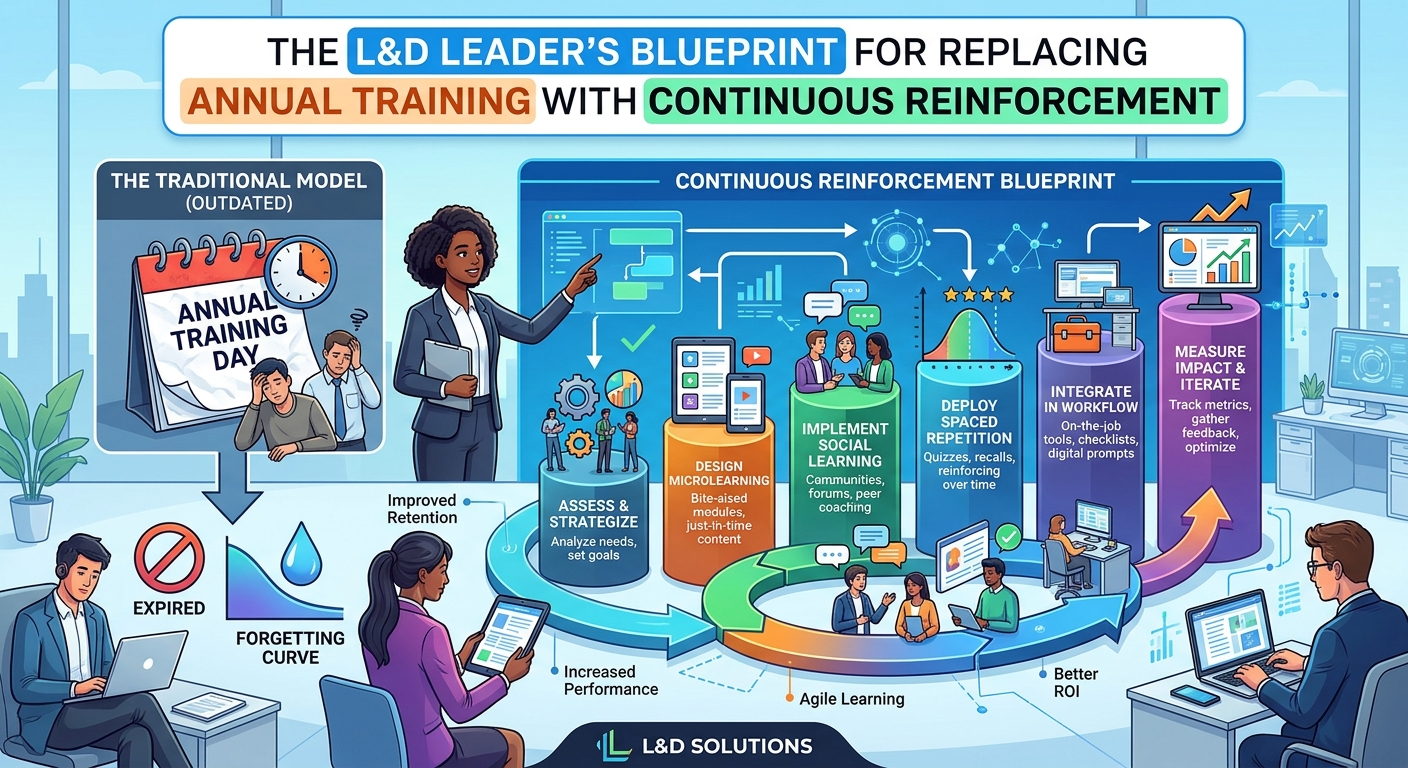
The L&D Leader’s Blueprint for Replacing Annual Training with Continuous Reinforcement
For too long, the annual training ritual has been a cornerstone of organizational learning and development. The familiar cycle of planning, executing, and then forgetting, however, is no longer sufficient in our rapidly evolving corporate landscape. L&D leaders, from Vice Presidents to Managers, are keenly aware that traditional approaches struggle to keep pace with dynamic market demands, evolving compliance regulations, and the perpetual upskilling needs of a modern workforce. The time has come for a strategic pivot: from sporadic, event-based training to a continuous reinforcement model. This blueprint outlines how you, as an L&D leader, can champion this transformation.
The Inadequacy of the Annual Cycle: Why We Need a Change
The limitations of annual training are increasingly evident. Employees forget most of what they learned within days or weeks if not reinforced. This "forgetting curve" renders significant investments in time and resources largely inefficient. Moreover, annual training often struggles to deliver highly relevant, just-in-time information. In industries like compliance, sales, banking, finance, insurance, retail, pharma, healthcare, hospitality, oil and gas, and mining, where knowledge decay can have profound operational or financial repercussions, a more agile and persistent approach is critical. The traditional LMS alone often serves as a repository rather than a dynamic learning ecosystem.
Today's competitive environment demands a workforce that is not just trained, but continuously adaptable, knowledgeable, and high-performing. This requires a shift from a "one-and-done" mindset to one of ongoing engagement and skill cultivation.
The Core Philosophy: Continuous Reinforcement
Continuous reinforcement moves beyond the episodic nature of annual training. It's about integrating learning into the daily workflow, providing timely nudges, micro-learning bursts, and opportunities for practice and application. This philosophy leverages technology to create a perpetual learning loop, ensuring knowledge sticks and skills are consistently honed. It's about turning passive learners into active participants in their own development journey, supported by an intelligent learning management system.
The L&D Leader's Blueprint for Transformation
Step 1: Assess Current Gaps and Future Needs
Before implementing any new strategy, a thorough understanding of your organization's current learning deficits and future skill requirements is paramount. This involves:
- Analyzing performance data to identify specific knowledge or skill gaps.
- Consulting with department heads and stakeholders to anticipate future competencies needed for business growth.
- Auditing existing training content for relevance and effectiveness.
This foundational step ensures your continuous reinforcement strategy is aligned with strategic business objectives, whether they are in Risk-focused Training, sales effectiveness, or new product introductions.
Step 2: Embrace Microlearning and Adaptive Pathways
Continuous reinforcement thrives on digestible, focused content. Microlearning LMS platforms are ideal for delivering short, impactful learning modules that can be consumed on demand. This approach respects learners' time and attention spans, making learning more accessible and less intimidating.
How can artificial intelligence transform our approach to learning personalization and content delivery?
Artificial intelligence is a game-changer. It enables truly Adaptive Learning experiences, tailoring content and learning paths to individual needs, prior knowledge, and performance data. An AI-driven learning content management system can dynamically recommend relevant modules, identify areas requiring more practice, and even adjust the difficulty of content based on learner progress. This ensures every employee receives the most effective learning at the precise moment it's needed, maximizing skill development and retention.
Step 3: Leverage Advanced Learning Technology
The backbone of a continuous reinforcement strategy is robust learning technology. A modern learning management software goes beyond basic course delivery:
- Integrated Platforms: Opt for a comprehensive cloud based learning management system that can host diverse content formats, track progress, and integrate with other HR and business systems.
- Engagement Features: A Gamified LMS can significantly boost learner motivation and engagement through points, badges, leaderboards, and challenges. These elements transform learning into an interactive and rewarding experience, encouraging consistent participation.
- Authoring Capabilities: Consider tools that empower rapid content creation and updates. What role can advanced digital tools play in rapidly developing and updating learning materials? An AI Powered Authoring Tool can drastically reduce content development time, allowing L&D teams to quickly respond to new information, compliance changes, or market shifts with fresh, relevant modules. This is crucial for industries requiring frequent updates, like healthcare or finance.
Step 4: Implement Diverse Reinforcement Mechanisms
Continuous reinforcement isn't just about microlearning. It encompasses a spectrum of techniques:
- Spaced Repetition: Automatically deliver short quizzes or flashcards on previously learned topics at increasing intervals to combat the forgetting curve.
- Performance Support: Provide just-in-time resources, job aids, and quick guides accessible directly within the workflow.
- Peer Learning & Collaboration: Foster communities of practice where employees can share knowledge, ask questions, and learn from each other. An enterprise learning management system should support these collaborative features.
- Coaching & Mentorship: Integrate human interaction with digital learning, allowing managers and mentors to provide targeted feedback and guidance.
Step 5: Measure, Analyze, and Iterate
The success of a continuous reinforcement model hinges on its ability to evolve. Data analytics from your lms learning management system is crucial:
- Track Engagement: Monitor completion rates, time spent, and frequency of interaction with learning content.
- Assess Performance Impact: Correlate learning activities with business outcomes, such as reduced compliance errors, improved sales figures, or enhanced customer satisfaction.
- Gather Feedback: Regularly solicit input from learners and managers to refine content and delivery methods.
Use these insights to continuously optimize your strategy. The beauty of a digital approach with a robust LCMS is the ability to make rapid, data-driven adjustments.
Addressing Global and Diverse Workforces
For a globally dispersed workforce, how do we ensure equitable and effective learning delivery across different regions and cultures?
A sophisticated learning management system with multi-language support and localized content capabilities is essential. The platform should allow for cultural nuances in content and delivery, while still maintaining core learning objectives. A MaxLearn LMS, for example, is designed to cater to diverse segments, from banking to healthcare, ensuring global teams receive relevant and impactful training without geographical limitations. This centralized approach guarantees consistent learning quality while accommodating local needs, fostering a truly inclusive learning environment.
Conclusion
The transition from annual training to continuous reinforcement is not merely a tactical shift; it's a strategic imperative for L&D leaders. By embracing microlearning LMS, gamified LMS, Adaptive Learning, and AI Powered Authoring Tool, L&D professionals can build a resilient, agile, and continuously learning organization. This blueprint empowers you to create a dynamic learning culture where knowledge acquisition is seamless, skills are perpetually sharp, and your workforce is always prepared for what comes next. The future of learning is continuous, and the time for this transformation is now.


