

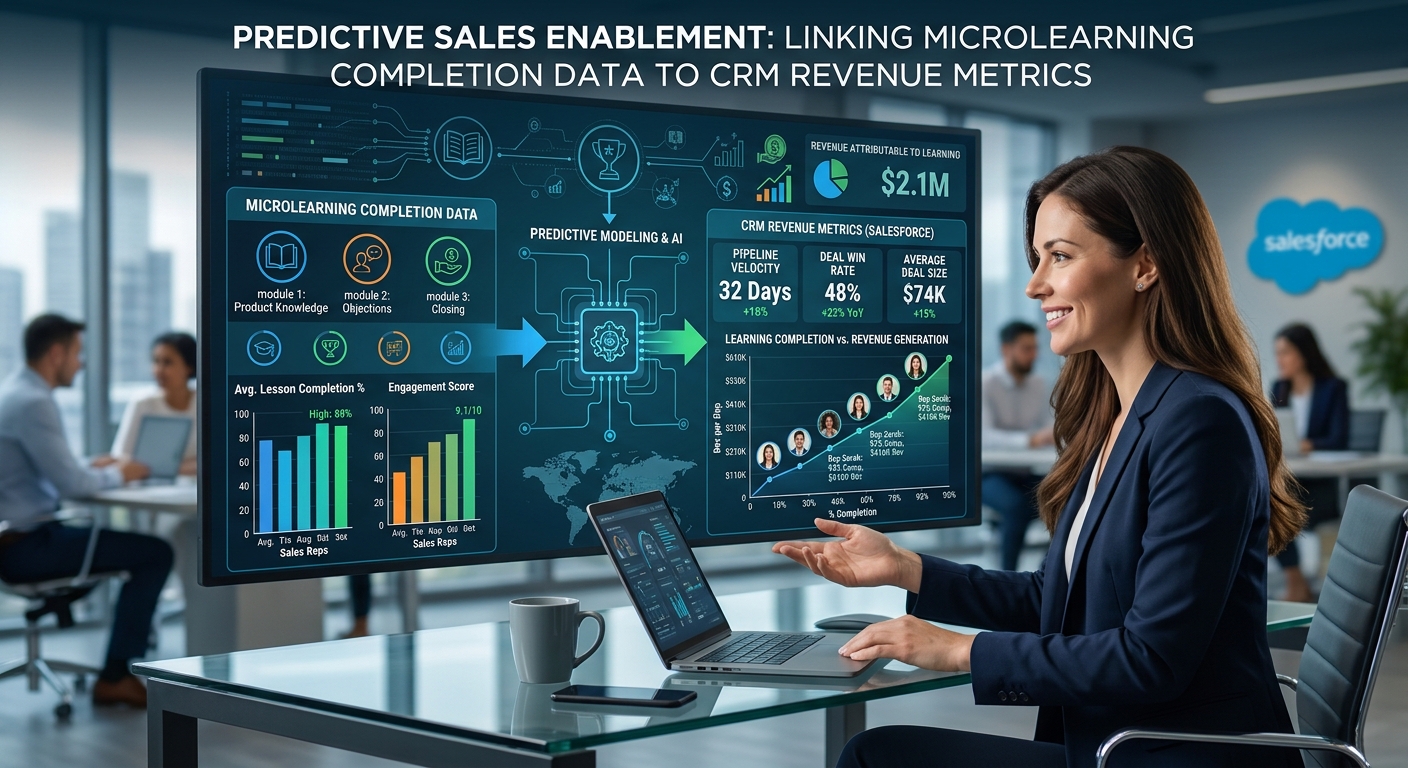
Predictive Sales Enablement: Linking Microlearning Completion Data to CRM Revenue Metrics
For too long, Learning & Development (L&D) leaders have grappled with a perennial challenge: quantifying the direct impact of training on the bottom line. In the high-stakes world of sales, this challenge intensifies. Sales enablement programs are often substantial investments, yet connecting a sales representative's completion of a learning module to a tangible increase in revenue has remained an elusive goal. However, with advancements in data analytics and intelligent learning platforms, the era of guesswork is rapidly receding. Welcome to the world of predictive sales enablement, where microlearning completion data is directly linked to CRM revenue metrics, transforming L&D into a verifiable profit driver.
This article is for forward-thinking Vice Presidents, Directors, and Senior Managers of L&D across industries like Compliance, Sales, Banking, Finance, Insurance, Retail, Pharma, Healthcare, Hospitality, Oil and Gas, and Mining. It explores how leveraging sophisticated learning management solutions can empower your sales teams, optimize training investments, and ultimately, elevate your organization's financial performance.
The Disconnect: Training vs. Tangible Impact
Historically, sales training has been viewed as a necessary expenditure, a checkbox activity with qualitative rather than quantitative benefits. L&D departments invest heavily in sales skills training, product knowledge modules, and compliance updates, yet proving the direct correlation between a new course and a closed deal has been difficult. Metrics often stop at "completion rates" or "satisfaction scores," leaving a critical gap in understanding actual business impact. This leaves many L&D leaders struggling to articulate the true ROI of their initiatives to the executive board.
The traditional LMS or learning content management system often operates in a silo, disconnected from the very systems that track sales performance. Without a clear bridge between training data and sales outcomes, L&D’s strategic value in driving revenue growth remains understated.
Enter Predictive Sales Enablement
Predictive sales enablement is a strategic approach that uses data analytics to anticipate future sales performance and proactively deliver targeted training and resources. It moves beyond reactive training to a proactive model, identifying skill gaps before they impact revenue and prescribing the exact learning interventions needed. The core innovation lies in its ability to connect two previously disparate datasets: microlearning completion data from your learning management system (LMS) and revenue-generating activities tracked within your Customer Relationship Management (CRM) system.
The Role of Microlearning in Sales Agility
Sales professionals operate in a fast-paced environment where time is a precious commodity. Traditional long-form training courses often disrupt their workflow, leading to low engagement and retention. This is where microlearning shines. Delivered in bite-sized, focused modules, microlearning offers immediate relevance and applicability, making it ideal for sales enablement. It allows reps to quickly acquire or refresh specific skills, product knowledge, or compliance updates exactly when they need them.
- Instant Accessibility: Sales reps can access critical information on demand, often from their mobile devices, fitting seamlessly into their busy schedules.
- Enhanced Retention: Shorter, focused bursts of information are easier to digest and remember, leading to better knowledge application.
- Targeted Learning: Addresses specific skill gaps or product updates without overwhelming learners with irrelevant content.
- Higher Engagement: Modern Gamified LMS platforms make microlearning interactive and fun, boosting participation.
- Agility: Rapidly deploy new training content in response to market changes, new products, or evolving sales strategies.
Bridging the Gap: Connecting Microlearning to CRM
The true power of predictive sales enablement emerges when your cloud based learning management system integrates seamlessly with your CRM. This integration creates a holistic view of each sales rep's learning journey and its direct impact on their performance. When a sales professional completes a microlearning module on, for instance, a new product feature or an advanced negotiation technique, that completion data is automatically recorded and linked to their profile in the CRM.
This data can then be analyzed alongside their sales activities, such as lead conversion rates, deal velocity, average deal size, win rates, and ultimately, revenue generated. This vital connection forms the backbone of a robust enterprise learning management strategy.
Unlocking Insights: From Completion Data to Revenue Growth
Once microlearning completion data is mapped to CRM metrics, a wealth of actionable insights becomes available to L&D and sales leadership. This is where learning management software truly demonstrates its strategic value.
- Correlation Analysis: Identify direct correlations between specific microlearning completions and improved sales metrics. For example, do reps who complete a "Handling Objections" module see a higher win rate for complex deals?
- Predictive Analytics: Use historical data to predict which reps might struggle with certain product lines or sales stages, allowing L&D to proactively assign targeted microlearning paths.
- Personalized Learning Paths: Leverage Adaptive Learning algorithms to recommend personalized microlearning based on individual performance data and identified skill gaps.
- Content Optimization: Determine which microlearning modules are most effective in driving desired sales outcomes, enabling L&D to continuously refine and optimize content using an AI Powered Authoring Tool.
- ROI Calculation: Finally, L&D can calculate the direct ROI of specific training initiatives by comparing the revenue generated by trained reps versus a control group or pre-training performance.
Practical Implementation Strategies
For L&D leaders looking to implement predictive sales enablement, several key steps are crucial:
- Integrate Your Systems: Ensure seamless integration between your chosen Microlearning LMS (like MaxLearn LMS) and your CRM. This is foundational.
- Define Key Metrics: Work with sales leadership to identify the critical CRM metrics that define sales success for your organization (e.g., lead-to-opportunity conversion, average deal size, sales cycle length).
- Map Learning to Outcomes: Clearly define the intended sales outcomes for each microlearning module. How will completing "Product X Features" impact specific sales conversations or close rates?
- Start Small, Scale Up: Begin with a pilot program focusing on a specific team or product line to gather data and refine your approach before a company-wide rollout.
- Continuous Analysis: Regularly analyze the integrated data to identify trends, adapt training strategies, and report on measurable improvements.
AI-Driven Insights for Future-Proofing Sales
The future of predictive sales enablement is increasingly intertwined with artificial intelligence. Imagine an intelligent LCMS that doesn't just track completions but actively suggests the next best microlearning module for a rep based on their real-time sales pipeline and even sentiment analysis from their calls.
What advanced technologies are transforming sales training globally? Intelligent platforms that use machine learning to analyze vast datasets from an lms learning management system and CRM are at the forefront. They can pinpoint nuanced patterns that humans might miss, offering unparalleled insights into sales effectiveness. How can we predict which sales reps need targeted support to close more deals? AI algorithms can analyze historical performance, training history, and current pipeline data to flag reps at risk of underperforming, automatically assigning relevant microlearning interventions.
What innovative learning platforms are leading the charge in sales force effectiveness? Platforms integrating AI, Gamified LMS features, and Adaptive Learning methodologies are paving the way. They create dynamic, responsive learning environments that evolve with the salesperson's needs and the market's demands.
Industry-Specific Applications
The principles of predictive sales enablement are universally applicable. In Banking and Finance, for example, linking compliance microlearning completion to reduced audit flags or increased sales of complex financial products (while adhering to regulations) demonstrates tangible value. In Pharma and Healthcare, ensuring reps are current on new drug data or device protocols via microlearning can directly impact successful product adoption and patient outcomes. For Compliance-heavy sectors and those like Oil and Gas or Mining, Risk-focused Training delivered via microlearning, tied to reduced incidents or improved safety records, proves invaluable. In Retail and Hospitality, training on new promotions or customer service techniques can be directly correlated with increased average transaction values or customer satisfaction scores.
The Future of Sales Enablement: A Strategic Imperative
The integration of microlearning completion data with CRM revenue metrics is no longer a luxury; it’s a strategic imperative for any organization serious about maximizing sales performance and demonstrating the tangible value of L&D. By adopting a truly connected and predictive approach, L&D leaders can move beyond being cost centers to become undeniable drivers of revenue and business growth.
Embrace the power of data-driven learning. Invest in a robust Microlearning LMS that integrates seamlessly with your sales ecosystem, and transform your sales enablement from an expense into a powerful, quantifiable engine for success. The future of sales is intelligent, personalized, and deeply connected to learning, making MaxLearn LMS a pivotal tool for your organization's growth.


