

How Vygotsky’s Theory of Learning Shapes Next-Gen Microlearning
In the dynamic landscape of corporate learning and development, the quest for efficient, effective, and engaging training solutions is relentless. L&D leaders, from VPs to senior managers, are constantly seeking innovative methodologies to upskill their workforce, ensure compliance, and drive performance across diverse sectors like Sales, Banking, Pharma, and Hospitality. While cutting-edge technology often takes center stage, the foundational principles of how humans learn remain timeless. One such cornerstone is Lev Vygotsky’s sociocultural theory of learning, a framework now profoundly influencing the design of next-generation microlearning experiences.
Microlearning, characterized by its bite-sized, focused, and on-demand content, has already proven its mettle in boosting knowledge retention and application. But how does a theory developed nearly a century ago by a Soviet psychologist connect with this modern, agile approach? The answer lies in Vygotsky’s core tenets: the critical role of social interaction, the concept of the More Knowledgeable Other (MKO), and the transformative power of the Zone of Proximal Development (ZPD). Understanding this synergy is crucial for crafting truly impactful learning programs, especially when leveraging a robust Microlearning LMS.
Vygotsky's Lens: The Bedrock of Modern Learning
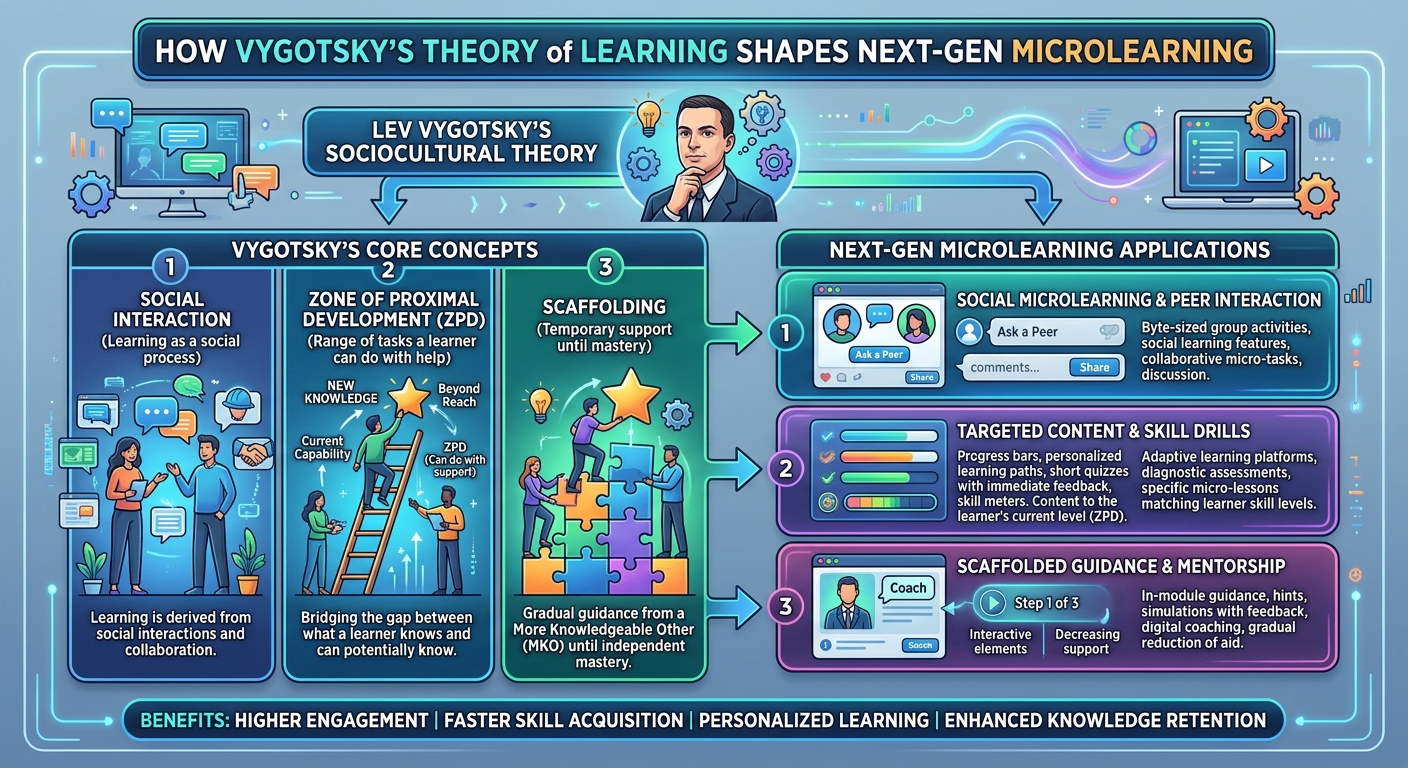
Vygotsky argued that learning is not an isolated, individual process but deeply embedded in social and cultural contexts. His theory emphasizes three key components:
-
Social Interaction: Learning primarily occurs through interactions with others. Collaboration, discussion, and shared problem-solving are paramount to cognitive development.
-
More Knowledgeable Other (MKO): This refers to anyone (a teacher, peer, mentor, or even a technological tool) who has a better understanding or higher ability level than the learner regarding a specific task, concept, or process. The MKO guides the learner towards mastery.
-
Zone of Proximal Development (ZPD): The ZPD is the crucial space between what a learner can accomplish independently and what they can achieve with guidance and collaboration from an MKO. Effective learning happens within this zone, where challenges are just beyond current capabilities but achievable with support.
These principles, though conceptualized in a different era, align perfectly with the demands of today's fast-paced corporate environment. They advocate for learning that is contextual, collaborative, and designed to stretch capabilities – exactly what a modern workforce needs to thrive.
Microlearning: The Agile Answer to Modern L&D Challenges
The contemporary workplace is characterized by information overload, shrinking attention spans, and a constant need for upskilling. Traditional long-form training often struggles to keep pace. This is where microlearning steps in:
-
Efficiency: Delivers precise information exactly when and where it's needed.
-
Engagement: Short, focused modules are less daunting and more digestible, leading to higher completion rates.
-
Retention: Spaced repetition and targeted practice inherent in microlearning boost long-term memory.
-
Flexibility: Accessible on multiple devices, allowing learning to fit into busy schedules.
Pairing microlearning with Vygotsky's insights transforms it from a mere delivery mechanism into a powerful pedagogical tool.
Shaping Next-Gen Microlearning with Vygotsky's Vision
1. Fostering Social Interaction and Collaboration
Vygotsky's emphasis on social learning finds a natural home in microlearning. While often seen as individual, next-gen microlearning platforms integrate social features:
-
Discussion forums and chat functionalities embedded within bite-sized modules.
-
Peer-to-peer coaching and feedback loops after completing a short lesson or quiz.
-
Collaborative challenges or group projects broken down into micro-tasks, encouraging shared problem-solving.
This approach transforms compliance training into a shared understanding, sales coaching into collective strategy, and financial literacy into peer-supported growth.
2. The Evolving Role of the More Knowledgeable Other (MKO)
In a Vygotskian microlearning framework, the MKO is multifaceted:
-
Human Experts: Team leaders, senior colleagues, or subject matter experts who provide contextual guidance after a micro-lesson.
-
AI as an MKO: Advanced algorithms within an AI Powered Authoring Tool can analyze learner performance, identify knowledge gaps, and suggest the next best micro-module or resource. This personalized guidance acts as a digital MKO, adapting to individual needs.
-
Gamified Elements: Leaderboards and peer recognition in a Gamified LMS can incentivize learners to seek out and become MKO for others, fostering a culture of continuous learning.
This dynamic MKO support ensures learners are always guided towards the correct understanding, whether in complex financial regulations or critical healthcare protocols.
3. Personalizing the Zone of Proximal Development (ZPD)
The ZPD is where true learning transformation occurs. Microlearning, especially when powered by intelligent systems, is uniquely positioned to optimize this zone:
How can advanced algorithms personalize the learning journey to keep employees within their optimal growth zone?
Modern learning management systems utilize machine learning to analyze a learner's prior knowledge, performance data, and learning style. This data-driven approach allows the system to present micro-modules that are challenging enough to stimulate growth but not so difficult as to cause frustration, dynamically adjusting the content and sequence. This Adaptive Learning capability ensures each employee, from new hires in retail to seasoned managers in oil and gas, receives content perfectly calibrated for their ZPD.
What benefits does this offer to diverse industries like manufacturing or customer service?
For industries like manufacturing, it means highly specific, step-by-step micro-instructions delivered right on the factory floor, ensuring mastery of a new process without overwhelming the learner. For customer service, it could be scenario-based micro-simulations that slowly increase in complexity, improving soft skills and problem-solving within the safe space of their ZPD.
Can intelligent tools effectively identify learner gaps and recommend the precise micro-content needed to bridge them?
Absolutely. Modern analytics within learning platforms can pinpoint exactly where a learner struggles, sometimes even before the learner consciously recognizes it. It then intelligently suggests relevant micro-lessons, quizzes, or resources from the learning content management system to target those specific gaps, acting as a highly efficient tutor. This is particularly valuable for Risk-focused Training in sectors like banking or insurance, where precise knowledge application is critical.
Industry-Specific Impact and the MaxLearn Advantage
The Vygotskian approach to microlearning is not merely theoretical; its impact is tangible across all segments and industries:
-
Compliance: Socially reinforced micro-modules ensure collective understanding of complex regulations, reducing organizational risk.
-
Sales: Bite-sized training on product features or sales techniques, coupled with peer feedback, drives immediate performance improvements.
-
Banking & Finance: Adaptive microlearning ensures mastery of critical financial instruments and regulatory updates, personalized to each role.
-
Healthcare & Pharma: Short, accessible modules on new procedures or drug information, supported by expert guidance, enhance patient safety and product knowledge.
-
Retail & Hospitality: Quick training refreshers on customer service protocols or new product launches, bolstered by peer interactions, create a more cohesive and skilled workforce.
-
Oil & Gas / Mining: Safety-critical training delivered in digestible chunks, often with AI-driven adaptive paths, ensures high-stakes compliance and operational excellence.
Implementing such advanced learning strategies requires a robust enterprise learning management solution. A cutting-edge Microlearning LMS can provide the infrastructure to host, deliver, track, and analyze Vygotskian-inspired microlearning content, ensuring that your organization's investment in development truly translates into growth and expertise. Look for a learning management system that not only supports microlearning but also integrates AI, social features, and adaptive paths, fostering a culture of continuous learning.
Conclusion
Lev Vygotsky’s sociocultural theory provides a powerful, enduring framework for understanding how individuals learn best: through guided social interaction within their ZPD. When synergized with the agility and accessibility of microlearning, and supercharged by advanced AI capabilities, it creates a next-generation learning experience that is not only efficient but deeply transformative. For L&D leaders looking to equip their workforce with critical skills and knowledge in an ever-evolving world, embracing Vygotsky’s vision within your microlearning strategy is not just an option, it's a strategic imperative for sustainable growth and competitive advantage.


