

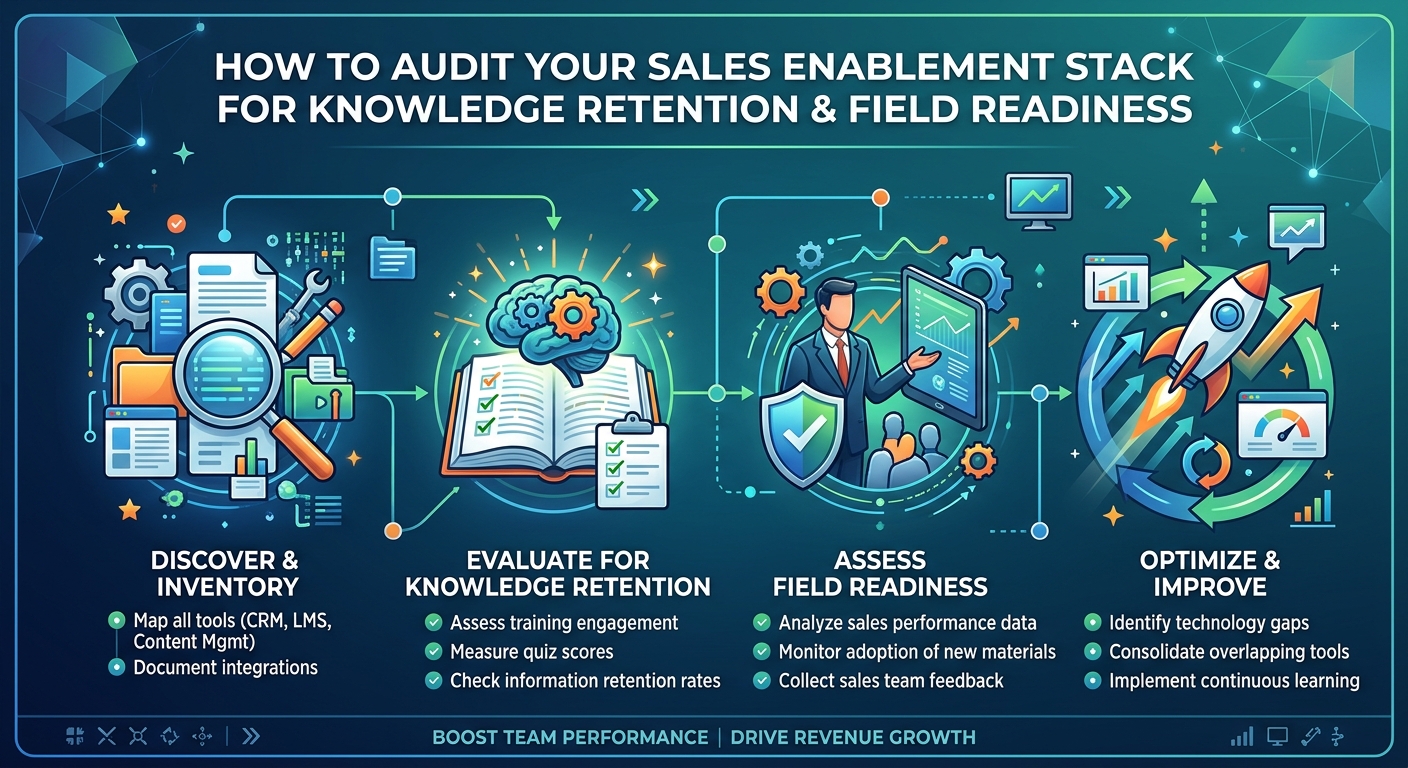
How to Audit Your Sales Enablement Stack for Knowledge Retention and Field Readiness
In today's fast-paced business landscape, the effectiveness of your sales team directly impacts your organization's bottom line. For Vice Presidents, Directors, and Managers of Learning & Development, ensuring sales professionals are equipped with the right knowledge and skills at the right time is paramount. This objective hinges on a robust and optimized sales enablement stack – the comprehensive suite of tools, content, and processes designed to empower sales teams. But how do you know if your current stack is truly delivering, especially concerning critical aspects like knowledge retention and field readiness? The answer lies in a systematic audit.
An audit of your sales enablement stack is not just a review; it's a strategic imperative. It's about dissecting every component to identify bottlenecks, redundancies, and opportunities for improvement. This article will guide L&D leaders through a professional, engaging, and SEO-friendly framework for auditing their sales enablement ecosystem, ensuring your team is not just trained, but truly ready for every market interaction.
Why Your Sales Enablement Stack Demands an Audit
Without a regular audit, even the most advanced sales enablement tools can become obsolete or underutilized. Consider the diverse industries your organization operates in—from Compliance, Banking, Finance, and Insurance to Retail, Pharma, Healthcare, Hospitality, Oil and Gas, and Mining. Each sector presents unique challenges and regulatory requirements. An ineffective sales enablement stack can lead to:
- Underperforming Sales Teams: When content is outdated or inaccessible, reps struggle to articulate value, answer objections, or comply with regulations.
- Low Adoption Rates: Tools that are complex, redundant, or don't meet actual field needs will gather digital dust. Your LMS or learning management software might not be engaging enough.
- Compliance Risks: Especially crucial in industries like Finance or Pharma, outdated information can lead to severe regulatory breaches. Risk-focused Training is essential but requires current content.
- Wasted Resources: Significant investments in technology and content yield minimal returns if they aren't effectively integrated and utilized.
- Poor Knowledge Retention: Training efforts become futile if the knowledge isn't reinforced and easily retrievable when needed.
- Lack of Field Readiness: Sales professionals aren't just selling; they're problem-solving, strategizing, and building relationships. They need to be agile and responsive.
A comprehensive audit provides clarity, optimizes your investments, and ensures your sales force is always sharp, compliant, and ready to engage.
Deconstructing Your Sales Enablement Stack
Before you can audit, you need to understand what constitutes your stack. It typically includes:
- Customer Relationship Management (CRM) Systems: The central hub for customer data and sales processes.
- Content Management Systems: Where all sales collateral (presentations, case studies, battlecards) resides. Often integrated with a robust learning content management system (LCMS).
- Learning & Training Platforms: This is where your learning management system (LMS) comes into play. It includes onboarding, continuous education, and skill development modules. Consider a Microlearning LMS for agile learning.
- Sales Coaching & Practice Tools: For role-playing, feedback, and skill refinement.
- Communication & Collaboration Tools: Enabling seamless internal information sharing.
- Analytics & Reporting Tools: To track sales activities, content effectiveness, and learning outcomes.
The Audit Framework: A Step-by-Step Guide for L&D Leaders
Phase 1: Discovery & Assessment – Unearthing the Current State
Begin by mapping out your current ecosystem. This phase is about gathering objective data and subjective insights.
- Inventory All Tools and Content: List every piece of technology and content asset. Who uses it? When was it last updated? Is it hosted on a cloud based learning management system?
- Gather User Feedback: Conduct surveys, interviews, and focus groups with sales reps, managers, and even marketing teams. Ask about usability, relevance, and perceived value. For instance, "Is the training on the lms learning management system helpful for real-world scenarios?"
- Analyze Usage Data: Dive into analytics from your CRM, learning management solutions, and content platforms. Which content is frequently accessed? Which training modules have high completion rates? What content is ignored?
- Identify Gaps and Redundancies: Where are there missing resources? Are multiple tools performing the same function? Are there inconsistent messages across different content pieces?
- Assess Knowledge Retention Metrics: Look at post-training performance, quiz scores, and how quickly new information translates into improved sales metrics. Are reps retaining critical product or compliance knowledge?
Phase 2: Evaluation for Effectiveness – Measuring Impact
Once you understand what you have, evaluate how well it's working against your objectives for knowledge retention and field readiness.
- Content Relevance and Accessibility: Is the content accurate, up-to-date, and easy to find? Can sales reps access it on the go? Is it aligned with current market conditions and customer needs? Consider how Adaptive Learning can ensure content is always personalized and relevant.
- Training Efficacy: Is your training leading to measurable improvements in performance? Does your Gamified LMS truly engage learners and embed knowledge? Are sales reps confident in their ability to apply what they've learned?
- System Integration: Do your tools talk to each other? A disconnected stack creates friction and reduces efficiency. Can your enterprise learning management system seamlessly share data with your CRM?
- Compliance Adherence: For regulated industries, ensure all training content and processes meet the latest legal and industry standards. This is where your Risk-focused Training modules must be impeccably managed.
- Field Readiness Assessment: Do reps feel prepared for client meetings, negotiations, and handling tough questions? Are they able to effectively use the tools provided in real-time scenarios?
Phase 3: Optimization & Future-Proofing – Building for Tomorrow
Based on your evaluation, formulate an action plan to enhance your sales enablement stack.
- Streamline Processes: Eliminate redundant tools and content. Consolidate where possible.
- Content Curation and Update Strategy: Establish a clear process for reviewing, updating, and archiving content. Ensure a continuous flow of fresh, relevant material.
- Leverage New Technologies: Explore solutions that can automate tasks, personalize learning, and provide deeper insights. An AI Powered Authoring Tool can significantly accelerate content creation and adaptation.
- Continuous Improvement Cycle: An audit isn't a one-time event. Implement a quarterly or bi-annual review schedule to keep your stack agile and responsive to evolving market and organizational needs.
Leveraging Intelligent Solutions: AI for Enhanced Sales Enablement
As L&D leaders, you're constantly seeking ways to optimize learning and performance. Artificial intelligence (AI) offers powerful capabilities to enhance your sales enablement stack, particularly in knowledge retention and field readiness. Let's explore some key questions you might be asking:
How can organizations ensure their sales enablement content is globally relevant and impactful across diverse markets and regulatory environments?
By deploying a cloud based learning management system that supports multi-language content, localization, and region-specific compliance training. Utilize advanced analytics to track content effectiveness in various regions and tailor future learning paths. This ensures that a sales professional in Tokyo receives the same quality but appropriately localized training as one in New York, all managed efficiently within the LMS.
What strategies can L&D teams employ to personalize the learning experience for each sales professional, ensuring maximum knowledge retention and skill development?
Implementing an enterprise learning management system with Adaptive Learning capabilities is crucial. This allows the system to tailor content based on a learner's performance, role, existing knowledge gaps, and even their preferred learning style, often powered by sophisticated algorithms. A Gamified LMS can further boost engagement by making learning interactive and competitive, solidifying knowledge retention through repeated application.
How can intelligent automation and advanced analytics streamline the content creation and delivery process within the sales enablement platform?
By utilizing an AI Powered Authoring Tool, L&D professionals can rapidly create, update, and deploy engaging learning modules. These tools can analyze existing content, suggest improvements, and even generate new content based on sales performance data. Analytics within your learning management solutions can then pinpoint content efficacy, allowing for automated recommendations and adjustments to optimize delivery and ensure content is always fresh, relevant, and impactful for every sales rep.
Key Takeaways for L&D Leaders
- Regular Audits are Essential: Treat your sales enablement stack as a living ecosystem that requires continuous nurturing and evaluation.
- Focus on User Experience: If it's not easy to use, it won't be used. Simplicity and accessibility drive adoption.
- Integrate for a Holistic View: Connected systems provide better data and a more seamless experience for sales professionals.
- Embrace Innovative Learning Technologies: Solutions like MaxLearn LMS offer advanced features that can revolutionize your sales training.
- Measure and Adapt: Define clear KPIs for knowledge retention and field readiness, and use data to continually refine your strategy.
Conclusion
For L&D leaders in any industry—from Compliance to Healthcare, Finance to Retail—a well-audited sales enablement stack is the bedrock of a high-performing sales organization. By systematically assessing your tools, content, and processes for knowledge retention and field readiness, you can transform your sales professionals into agile, informed, and highly effective revenue drivers. Invest in this audit, and you invest directly in your company's growth and competitive edge. Make your sales enablement stack a strategic asset, not just a collection of tools.


