

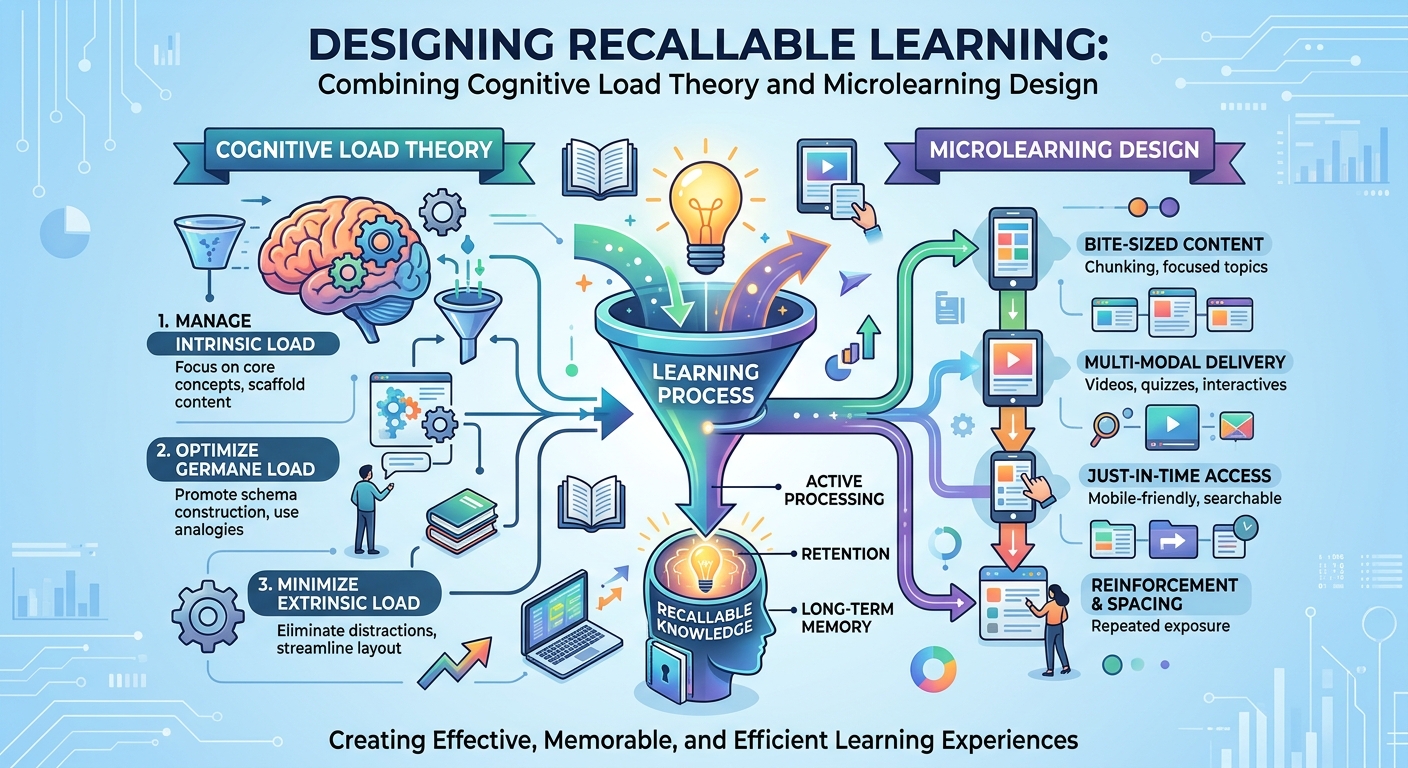
Designing Recallable Learning: Combining Cognitive Load Theory and Microlearning Design
As Vice Presidents, Directors, and Senior Managers in Learning & Development, you are acutely aware of the constant challenge: how do we ensure that training truly sticks? In an era of rapid change and information overload, merely delivering content isn't enough. Our goal must be to design learning experiences that are not only engaging but also deeply recallable, translating directly into improved performance and tangible business outcomes. This article delves into a powerful synergy that promises to achieve precisely that: the strategic combination of Cognitive Load Theory and microlearning design.
The Imperative of Recallable Learning
In industries ranging from Compliance and Sales to Banking, Healthcare, and Pharma, the stakes of ineffective training are incredibly high. From regulatory non-compliance to missed sales targets or critical errors in patient care, the cost of forgetting is prohibitive. Traditional long-form courses often overwhelm learners, leading to low retention rates and a perception that training is a check-the-box exercise rather than a vital investment. To overcome this, we must deliberately design for recall, ensuring that essential knowledge and skills are readily accessible when needed most.
Understanding Cognitive Load Theory (CLT)
Cognitive Load Theory, developed by educational psychologist John Sweller, offers profound insights into how our working memory processes information. Working memory has a limited capacity, and when overloaded, learning efficiency plummets. CLT identifies three types of cognitive load:
- Intrinsic Load: This is the inherent difficulty of the subject matter itself. A complex topic like quantum physics will naturally have a higher intrinsic load than basic arithmetic. While we can't change the complexity of the subject, we can manage how it's presented.
- Extraneous Load: This refers to the mental effort imposed by poorly designed instructional materials. Distracting visuals, confusing navigation, irrelevant information, or overly complex language all contribute to extraneous load, diverting valuable working memory away from actual learning.
- Germane Load: This is the desirable mental effort learners expend on processing and understanding new information, building connections, and forming schemas – essentially, the work involved in *real learning*. Our goal is to minimize extraneous load and optimize germane load.
For L&D professionals, understanding these loads is foundational. It guides us in creating environments where learners can focus their mental energy on what truly matters, fostering deeper comprehension and retention.
The Power of Microlearning Design
Microlearning, at its core, is about delivering learning content in small, focused bursts. These bite-sized modules, typically 2-10 minutes long, are designed to address specific learning objectives. Delivered through an efficient Microlearning LMS, it capitalizes on several psychological principles:
- Reduced Overwhelm: Small chunks of information are less daunting and easier to process.
- Increased Engagement: Shorter modules maintain attention, especially for busy professionals.
- Flexibility and Accessibility: Learners can access content anytime, anywhere, on any device, fitting learning into their workflow.
- Targeted Learning: Each module addresses a single concept, making it easy to find and review specific information.
A modern learning management system provides the framework for delivering such flexible content, ensuring that a high-quality learning management system is more than just a repository but a dynamic learning environment. The right learning content management system (LCMS) is crucial for organizing and distributing these compact modules effectively.
The Synergy: How CLT and Microlearning Design Create Recallable Learning
The true power emerges when Cognitive Load Theory and microlearning design are combined. Microlearning becomes the ideal vehicle for applying CLT principles, leading to significantly enhanced recall:
1. Minimizing Intrinsic Load Through Chunking
Microlearning naturally addresses intrinsic load by breaking down complex topics into digestible segments. Instead of a single long course on "Advanced Sales Techniques," you might have micro-modules on "Opening Calls Effectively," "Handling Objections," and "Closing Strategies." Each module tackles a manageable piece of the puzzle, making the overall learning journey less intimidating.
2. Eliminating Extraneous Load with Focused Design
Because microlearning modules are short, they demand extreme focus in their design. This forces creators to strip away all unnecessary information, visuals, or navigation, thereby reducing extraneous load. Every element must serve a clear purpose, ensuring learners' mental energy is directed toward the core concept. Utilizing an AI Powered Authoring Tool can further streamline this process, helping create clean, focused content efficiently.
3. Optimizing Germane Load for Deeper Processing
With intrinsic and extraneous loads managed, learners have more cognitive capacity for germane load – the deep processing that leads to recall. Microlearning facilitates this through:
- Active Learning Elements: Short quizzes, simulations, drag-and-drop exercises, or quick reflections immediately after a module reinforce learning and encourage active retrieval. A Gamified LMS can supercharge this engagement.
- Spaced Repetition: Microlearning is perfect for spaced repetition, where learners revisit key concepts at increasing intervals. This strengthens memory traces without overwhelming working memory.
- Contextual Relevance: By delivering micro-content "just-in-time" – precisely when a learner needs a piece of information for a task – we enhance its relevance and integration into existing knowledge structures.
- Adaptive Learning Paths: An advanced learning management software can personalize the learning journey, ensuring learners only receive content relevant to their specific needs and existing knowledge, further optimizing germane load.
Implementing Recallable Learning in Practice
For L&D leaders across industries like Oil and Gas, Mining, Hospitality, and Retail, adopting this combined strategy requires the right tools and a shift in mindset:
- Invest in a Capable LMS: An enterprise learning management solution like MaxLearn LMS is essential. Look for a cloud based learning management system that supports microlearning delivery, robust analytics, and personalized learning paths. This kind of lms learning management system ensures scalability and accessibility.
- Content Strategy Shift: Move away from monolithic courses. Deconstruct existing content into micro-modules, focusing on single learning objectives.
- Embrace Interactivity: Short, interactive elements within or immediately after each module are crucial for engagement and recall.
- Leverage Data: Use the analytics from your learning management solutions to identify knowledge gaps and tailor future microlearning interventions. For example, in Compliance, this data can inform targeted Risk-focused Training, mitigating potential vulnerabilities.
- Reinforcement: Integrate follow-up quizzes, scenarios, or job aids linked to micro-modules to reinforce learning over time.
Frequently Asked Questions About Smart Learning Solutions
How can intelligent algorithms improve how employees remember information?
Intelligent algorithms within a learning platform can significantly boost retention by analyzing learner performance, identifying specific knowledge gaps, and automatically recommending relevant microlearning modules for review. This personalized, "just-in-time" reinforcement, often employing spaced repetition techniques, optimizes the delivery of content when a learner is most receptive, strengthening memory traces and improving long-term recall.
What are the common applications of smart technology in corporate education across different regions?
Globally, smart technology is transforming corporate education through personalized learning paths, automated content curation, and data-driven insights. In North America, there's a strong focus on enhancing sales and compliance training. European companies often leverage it for language and soft skills development. In Asia-Pacific, it's widely used for upskilling in technology and digital literacy, while in emerging markets, it's key for scalable foundational training. Across all regions, the goal is to make learning more efficient, accessible, and impactful, often through a robust LMS.
How do sophisticated digital assistants help tailor learning experiences for individual users?
Sophisticated digital assistants personalize learning by adapting the content's difficulty, pace, and format based on an individual's progress, learning style, and specific role requirements. They can recommend specific micro-modules, provide immediate feedback, answer questions, and even simulate real-world scenarios. This adaptive approach ensures that each learner receives the most relevant and challenging content without being overwhelmed, making the learning journey more efficient and engaging for everyone.
Conclusion
For L&D leaders committed to driving real business impact, the fusion of Cognitive Load Theory and microlearning design is not just a theoretical concept – it's a strategic imperative. By understanding how our brains learn and designing content in alignment with these principles, we can move beyond simply delivering training to truly fostering recallable learning. Embrace this powerful combination, empower your teams with the right tools like MaxLearn LMS, and transform your organization's learning landscape into one where knowledge isn't just acquired but deeply embedded and readily applied.


