

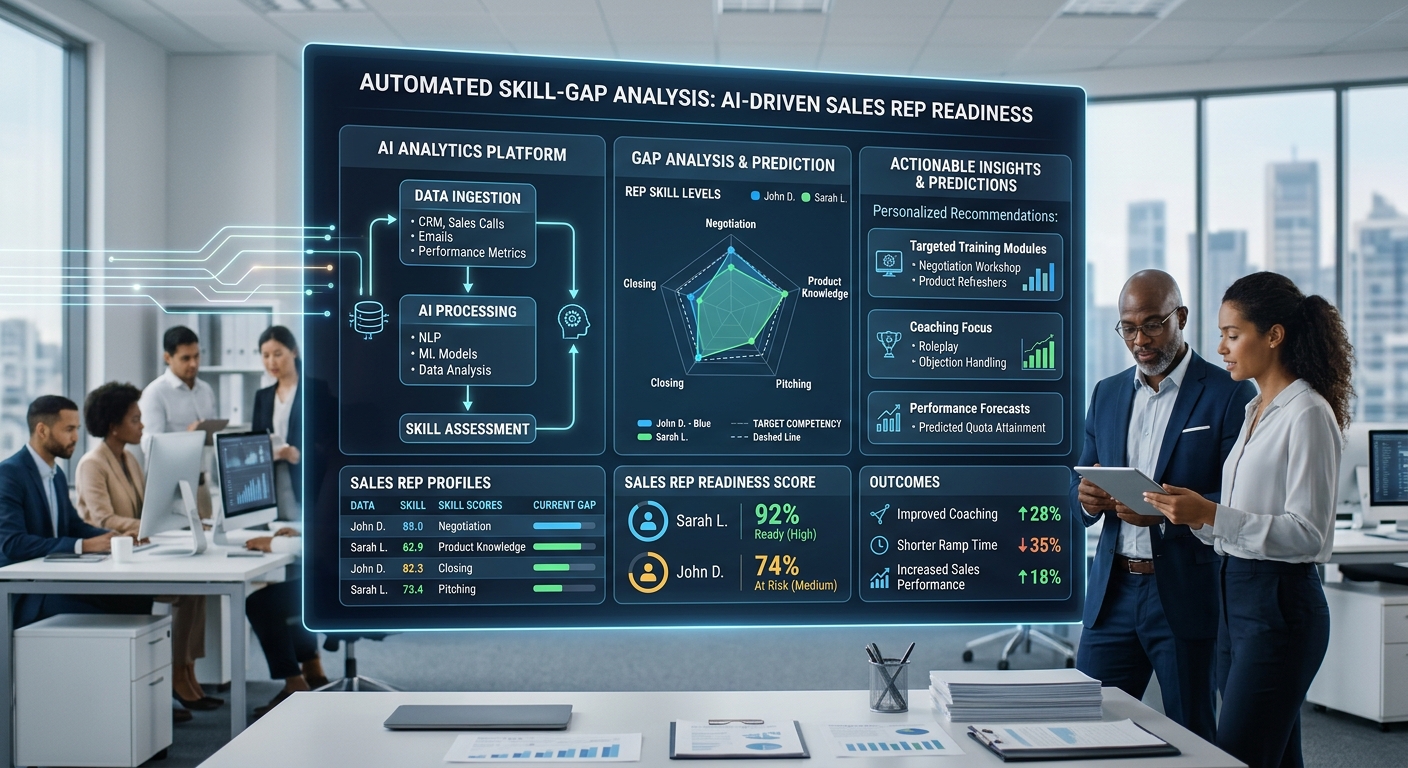
Automated Skill-Gap Analysis: Using AI Analytics to Predict Sales Rep Readiness
In today's dynamic business landscape, a high-performing sales team is the lifeblood of any organization. For Vice Presidents, Directors, and Managers of Learning & Development across industries like Compliance, Sales, Banking, Finance, Insurance, Retail, Pharma, Healthcare, Hospitality, Oil and Gas, and Mining, ensuring sales readiness isn't just a goal—it's a strategic imperative. Traditional methods of identifying skill gaps often fall short, relying on subjective assessments or retrospective performance data. What if you could proactively identify potential skill deficiencies and predict sales rep readiness before they impact the bottom line? Enter Automated Skill-Gap Analysis, powered by sophisticated AI analytics.
This article explores how artificial intelligence is transforming the way L&D leaders approach sales training, enabling unprecedented precision, personalization, and foresight in preparing sales teams for success.
The Imperative for Precision in Sales Readiness
Sales professionals operate in an environment of constant change—new products, evolving market conditions, stricter compliance regulations, and increasingly informed customers. For an insurance sales representative, understanding complex policy changes is paramount; for a pharmaceutical rep, staying abreast of clinical trial data is crucial; and for a banking associate, mastery of new financial products is non-negotiable. The stakes are high: missed quotas, regulatory non-compliance, reputational damage, and lost market share.
Ensuring every sales rep is not just trained, but truly ready, is a continuous challenge. L&D teams are tasked with bridging knowledge and skill gaps efficiently and effectively. This requires a profound understanding of individual and team capabilities, aligned with current and future business needs. The limitations of manual processes in achieving this level of precision are becoming increasingly evident.
Beyond Traditional Methods: The AI Revolution in Skill-Gap Analysis
Historically, skill-gap analysis involved a combination of manager observations, self-assessments, performance reviews, and sporadic training needs analyses. While valuable, these methods are often time-consuming, prone to human bias, and inherently reactive. They tell you where gaps existed in the past, but rarely predict where they will emerge in the future.
Artificial intelligence, however, offers a paradigm shift. By leveraging vast datasets and advanced algorithms, AI analytics can move beyond surface-level observations to identify deep-seated patterns and predictive indicators of sales performance and readiness. It's about moving from 'what happened?' to 'what will happen?' and 'what needs to be done about it?'.
How AI Predicts Sales Rep Readiness
AI's predictive power stems from its ability to analyze diverse, seemingly unrelated data points at scale. For sales readiness, this includes:
- CRM Data: Sales cycle length, conversion rates, deal size, customer engagement patterns, lost deals analysis.
- Call & Communication Logs: Analysis of language, tone, frequency of customer interactions, adherence to sales scripts (where applicable).
- Training & Development History: Completion rates, assessment scores, module engagement, specific competencies acquired through an enterprise learning management or a learning content management system.
- Product Knowledge Assessments: Performance on quizzes, simulations, and certifications.
- Market Trends & Competitor Analysis: External factors influencing sales success.
- Customer Feedback: Satisfaction scores, survey responses, complaints.
By correlating these data points, AI can construct a comprehensive profile for each sales rep. It can then identify specific skills, knowledge areas, or behavioral traits that are strong predictors of high performance or, conversely, indicators of potential underperformance. For instance, AI might reveal that reps who complete specific Microlearning LMS modules on competitive product differentiation consistently outperform those who don't, especially in regions with intense market competition.
Key Benefits of Automated Skill-Gap Analysis for L&D Leaders
Implementing AI-driven skill-gap analysis offers transformative advantages for L&D professionals aiming to build an agile, high-performing sales force:
- Unmatched Efficiency and Accuracy: Automate the laborious process of data collection and analysis, freeing up L&D teams to focus on strategy and content creation. AI eliminates human bias, providing objective, data-driven insights.
- Personalized Training Paths: AI identifies precise skill deficits at the individual level, enabling the creation of hyper-personalized development plans. This moves beyond one-size-fits-all training to truly targeted interventions. For example, AI can recommend specific content delivery through Adaptive Learning paths, ensuring relevance and efficacy.
- Proactive Intervention: Predict potential performance issues weeks or months in advance, allowing L&D to deploy preemptive training and coaching, rather than reacting to declining sales figures.
- Optimized Resource Allocation: Focus training budgets and resources precisely where they are needed most, maximizing the return on investment in a learning management system.
- Improved ROI on Training Investments: By directly linking training interventions to measurable improvements in sales performance and readiness, L&D can clearly demonstrate the value of their programs to senior leadership.
AI-Powered Training Solutions for Sales Teams
The insights generated by AI analytics are invaluable for shaping effective learning strategies. An AI Powered Authoring Tool, integrated with a robust learning management software, can then rapidly create and deploy highly relevant training content. This ensures that the learning content management system delivers precisely what sales reps need, when they need it.
Consider the benefits of a Gamified LMS for sales teams, which can leverage AI insights to recommend challenges and rewards tailored to an individual's development needs, fostering engagement and competition. In sectors like Finance or Pharma, where compliance is critical, AI can also guide the implementation of Risk-focused Training, ensuring reps are proficient in areas with high potential for non-compliance or error, directly impacting business growth and integrity.
Addressing Common Concerns
As L&D leaders consider integrating advanced analytics, several questions often arise:
Question: How does intelligent technology ensure the relevance of sales training for diverse product lines and changing market dynamics?
Answer: By continuously ingesting and analyzing real-time data from CRM systems, sales performance metrics, and even external market indicators, AI identifies patterns and shifts. It can detect, for example, that a new product launch requires a specific skill set, or that an emerging competitor necessitates updated messaging. This continuous feedback loop ensures that the learning management solutions provided are always aligned with the most current business needs, even adapting to subtle nuances across different product categories.
Question: Can AI-driven insights adapt to regional market differences or evolving product lines for a globally distributed sales force?
Answer: Absolutely. Modern AI platforms are designed to handle geographical segmentation. By integrating location-specific sales data, regional compliance requirements (crucial in industries like Banking or Healthcare), and local market trends, AI can pinpoint skill gaps unique to different territories or demographics. Similarly, as new products are introduced or existing ones evolve, the algorithms update their understanding of necessary competencies, ensuring that a global or regional sales team remains consistently ready, regardless of their specific market conditions or product focus.
Question: What impact does automated analytics have on individual sales representative development and career progression?
Answer: The impact is profoundly positive. Intelligent automation provides each sales rep with a clear, objective understanding of their strengths and areas for development. This fosters a culture of continuous learning and growth. By recommending specific learning modules or coaching interventions through an advanced cloud based learning management system, AI helps reps improve targeted skills, leading to better performance, higher job satisfaction, and clearer pathways for career advancement within the organization. It transforms development from a generic requirement into a highly personal and impactful journey.
Implementing AI for Your Sales Readiness Strategy
For L&D leaders, embarking on an AI-driven skill-gap analysis journey involves several key steps:
- Data Integration: Work with IT and sales operations to integrate relevant data sources into a unified analytics platform.
- Define Readiness Metrics: Clearly articulate what "sales readiness" means for your organization, including specific KPIs and desired competencies.
- Pilot Programs: Start with a pilot group or a specific sales division to refine the AI models and demonstrate early successes.
- Continuous Iteration: AI models improve with more data. Regularly review and adjust your analytics strategy based on performance outcomes and feedback.
- Choose the Right Platform: Select a partner with expertise in AI analytics and a robust lms learning management system capable of supporting your needs, like MaxLearn LMS.
Embracing AI in your L&D strategy isn't just about adopting new technology; it's about fundamentally rethinking how you empower your sales force. It's about moving from reactive training to proactive readiness, from generic content to hyper-personalized development, and from guesswork to data-driven certainty.
The future of sales readiness is intelligent, predictive, and personalized. By leveraging AI analytics for automated skill-gap analysis, L&D leaders can confidently build and maintain a sales team that is not just prepared for today's challenges but is actively ready for tomorrow's opportunities.


