

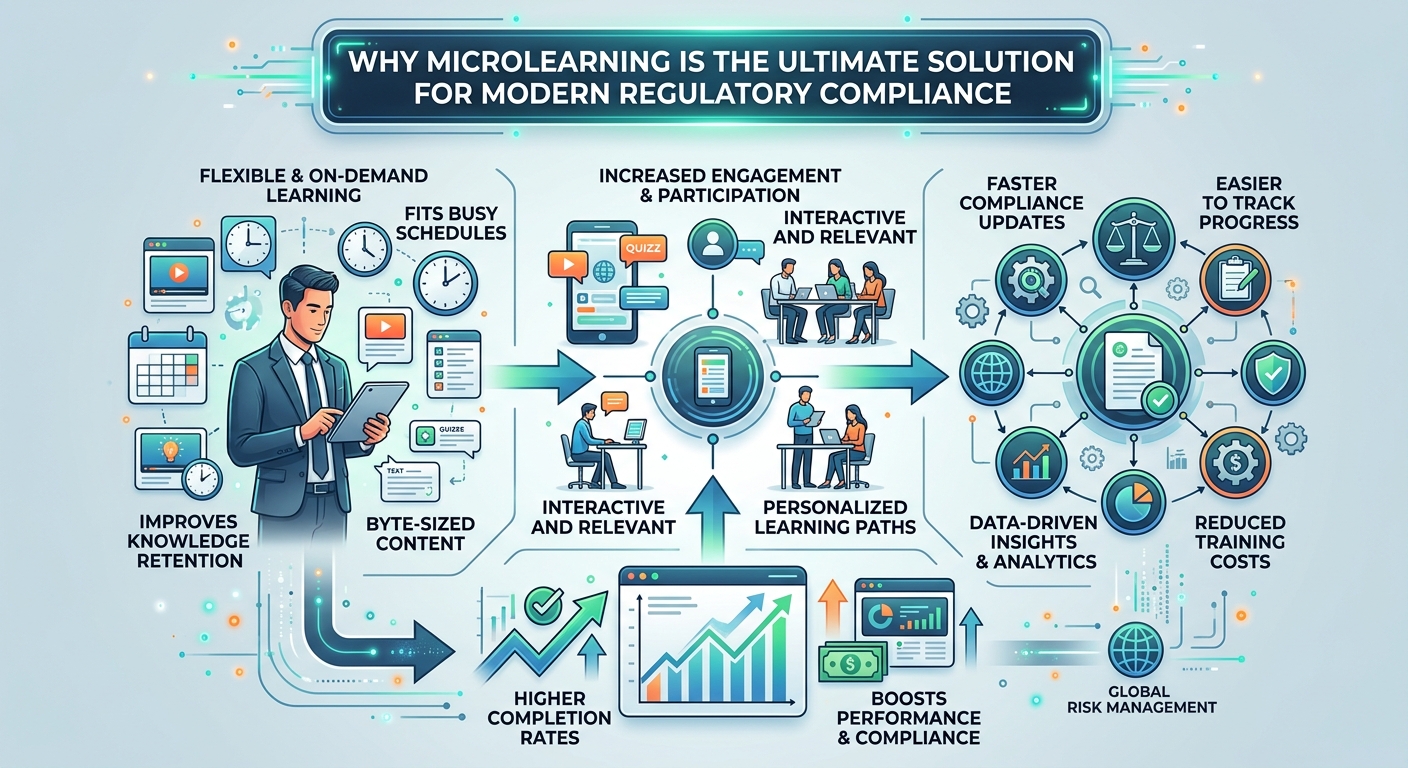
Why Microlearning is the Ultimate Solution for Modern Regulatory Compliance
In today's fast-paced corporate world, staying ahead of an ever-evolving regulatory landscape isn't just a best practice—it's a critical imperative. For Vice Presidents, Directors, and Senior Managers in Learning & Development, the challenge of ensuring a fully compliant workforce across diverse industries like banking, finance, healthcare, and manufacturing is monumental. Traditional, lengthy training modules often fall short, struggling to keep pace with changes and failing to engage employees effectively. This is where microlearning emerges not just as an alternative, but as the ultimate solution for modern regulatory compliance.
The sheer volume and complexity of regulations, coupled with the global reach of many organizations, demand a more agile, engaging, and efficient approach to corporate training. How can your organization ensure employees grasp critical compliance information, retain it, and apply it consistently, all while minimizing disruption to their workflow? The answer lies in the strategic implementation of microlearning, powered by advanced learning management solutions.
The Compliance Conundrum: A Modern Challenge
Regulatory compliance is a moving target. New laws, industry standards, and internal policies emerge constantly, creating a significant burden on businesses. From GDPR in retail and finance to HIPAA in healthcare, and environmental regulations in oil and gas, the potential for non-compliance carries severe consequences: hefty fines, legal penalties, reputational damage, and loss of consumer trust. Traditional compliance training, often delivered in annual, lengthy classroom sessions or monotonous e-learning modules, simply isn't equipped to handle this dynamic environment.
Why Traditional Compliance Training Fails
- Information Overload: Bombarding employees with hours of content leads to cognitive overload and poor retention.
- Lack of Engagement: Monolithic courses are often generic, dull, and fail to capture learner attention.
- Outdated Content: The slow development and deployment cycle of traditional training means content can be obsolete before it's even delivered.
- Disruption to Workflow: Pulling employees away for long training sessions impacts productivity and morale.
- Difficulty in Tracking and Proving Efficacy: Measuring the true impact and comprehension from generic, long-form content is challenging.
Microlearning to the Rescue: A Paradigm Shift
Microlearning breaks down complex compliance topics into short, focused, bite-sized modules—typically 3-10 minutes long. These easily digestible units can be accessed on demand, anytime, anywhere, and on any device. This approach aligns perfectly with the modern learner's preference for quick, relevant, and engaging content, transforming compliance training from a dreaded chore into an accessible, continuous learning experience. It's a fundamental shift from "event-based" training to "just-in-time" learning, crucial for sectors like pharma, mining, and insurance where precision and up-to-date knowledge are paramount.
Key Benefits of Microlearning for Regulatory Compliance
Microlearning's impact on regulatory compliance is multifaceted, offering compelling advantages for L&D leaders seeking to optimize their training strategies.
-
Enhanced Retention and Engagement: By focusing on one concept at a time, microlearning improves comprehension and recall. Short bursts of engaging content prevent cognitive fatigue and hold learner attention more effectively than lengthy courses. How does this approach ensure maximum engagement and knowledge retention for diverse learners across different roles and departments? The targeted nature of Microlearning LMS content makes it inherently more relevant, boosting learner motivation and memory consolidation.
-
Agility in a Dynamic Landscape: When regulations change, microlearning modules can be updated or created rapidly, ensuring your workforce is always operating with the most current information. This agility is invaluable in industries like finance and healthcare, where regulatory shifts are frequent. The ability to deploy Adaptive Learning paths ensures that training content evolves with both regulations and individual learner needs.
-
Personalization and Relevance: Microlearning allows for highly personalized learning paths. Employees receive only the compliance training relevant to their specific role, department, and geographic location, making the learning experience more meaningful and efficient. How can this training methodology be effectively scaled and customized for different regional regulations and cultural contexts within a global enterprise? By focusing on Risk-focused Training, organizations can prioritize critical areas of compliance that directly impact an employee's daily tasks, reducing irrelevant content and maximizing impact.
-
Cost-Effectiveness and Scalability: Developing microlearning modules is often faster and less resource-intensive than creating full-length courses. This reduces development costs and speeds up deployment across large, distributed workforces. For an enterprise learning management system, especially a cloud based learning management system, the scalability of microlearning is unparalleled, allowing global organizations to reach thousands of employees efficiently.
-
Improved Employee Morale and Productivity: Employees appreciate training that respects their time and intelligence. Microlearning integrates seamlessly into their workflow, minimizing disruption and fostering a culture of continuous learning rather than compliance as a burden. This leads to higher job satisfaction and improved overall productivity.
Leveraging Technology: The Role of an Advanced Learning Platform
While microlearning is a powerful methodology, its full potential is unlocked when integrated with a robust learning management system (LMS). A modern Gamified LMS provides the infrastructure to host, deliver, track, and report on microlearning content efficiently. Features such as detailed analytics, automated reminders, and customizable dashboards ensure that L&D teams have a clear overview of compliance status across the organization.
In what ways can advanced technological solutions, including intelligent automation, optimize the creation, delivery, and assessment of microlearning content for compliance? An AI Powered Authoring Tool, for instance, can significantly speed up content creation, transforming existing documents or even video transcripts into ready-to-deploy microlearning modules. Furthermore, intelligent systems within a comprehensive learning content management system (LCMS) can recommend relevant modules based on an employee's role, performance, and previous compliance history, creating a truly personalized learning journey. The right learning management software serves as the backbone, enabling seamless deployment and management of all your compliance learning initiatives.
Implementing Microlearning for Compliance: Best Practices
- Conduct a Needs Analysis: Identify specific compliance areas and roles that require training.
- Break Down Complex Topics: Deconstruct lengthy regulations into smaller, manageable learning objectives.
- Utilize Diverse Formats: Employ videos, interactive quizzes, infographics, simulations, and scenarios to keep content engaging.
- Integrate with an LMS: Use a powerful LMS like MaxLearn LMS to deliver, track, and manage all microlearning initiatives.
- Provide Regular Refreshers: Implement spaced repetition through microlearning to reinforce knowledge over time.
- Measure and Iterate: Leverage analytics from your learning management system to assess effectiveness and continuously refine content.
Real-World Impact Across Industries
Across various industries, microlearning is proving its worth. In banking and finance, employees can quickly access updates on anti-money laundering (AML) regulations or new fraud detection protocols without lengthy disruptions. Healthcare professionals can stay current with patient privacy laws (like HIPAA) or new drug administration guidelines through short, accessible modules. Retail workers can rapidly learn about new product safety standards or data privacy policies relevant to customer interactions. Even in industries like oil and gas or mining, critical safety compliance training can be delivered in focused, impactful segments, ensuring adherence to rigorous operational standards.
An advanced learning management system (lms learning management system) empowers these organizations to implement robust, continuous compliance training that is both effective and efficient. By choosing a comprehensive MaxLearn LMS, L&D leaders can confidently navigate the complexities of modern compliance, turning potential risks into opportunities for operational excellence.
Conclusion
The imperative for modern regulatory compliance calls for a modern solution. Microlearning, supported by cutting-edge learning management solutions and a powerful LMS, offers unparalleled benefits in terms of engagement, retention, agility, and cost-effectiveness. For Vice Presidents, Directors, and Managers of L&D, embracing microlearning isn't just about meeting compliance requirements; it's about fostering a culture of continuous learning, reducing organizational risk, and enhancing overall business performance in an increasingly complex world. Take the leap and transform your compliance training with the ultimate microlearning advantage.
.jpg)


