

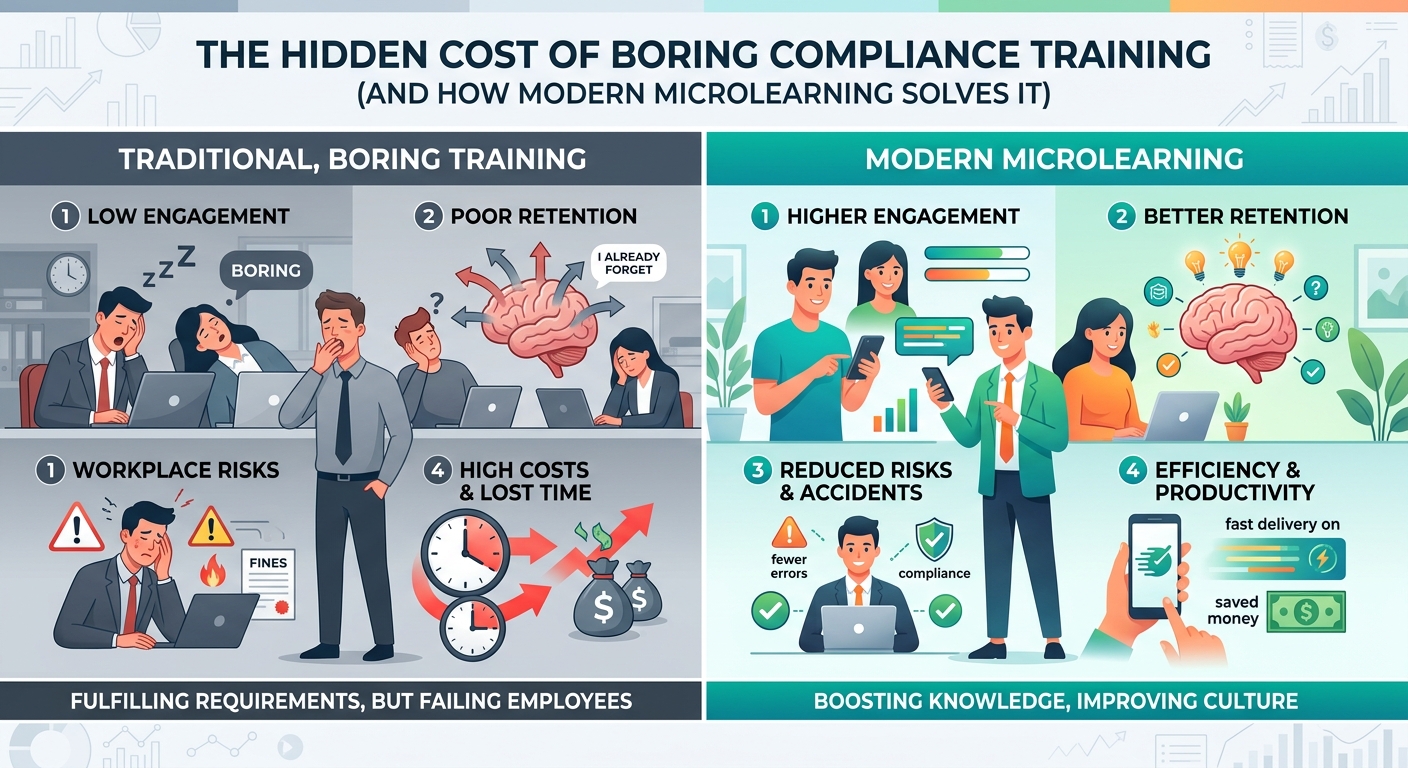
The Hidden Cost of Boring Compliance Training (And How Modern Microlearning Solves It)
For too long, compliance training has been viewed as a necessary evil – a box-ticking exercise rather than a strategic imperative. As leaders in Learning & Development, you understand the critical importance of ensuring your workforce adheres to regulations, industry standards, and internal policies. Yet, the traditional approach to compliance education often leads to disengagement, poor retention, and ultimately, a failure to mitigate risk effectively. This isn't just an inconvenience; it represents a significant, often hidden, cost to your organization.
The time has come to challenge the status quo. In an era where information is abundant and attention spans are fleeting, outdated compliance training modules are not just ineffective; they're actively detrimental. This article will delve into the true, often unseen, expenses associated with lackluster compliance programs and reveal how modern microlearning, powered by advanced Microlearning LMS platforms, offers a transformative solution.
The High Cost of Ineffective Compliance Training
When employees tune out during mandatory training, the repercussions ripple far beyond a bored glance at the clock. The costs are multifaceted, impacting everything from your bottom line to your organizational culture.
Direct Costs: Visible & Tangible
- Time and Resource Drain: Hours spent in lengthy, irrelevant sessions are hours lost from productive work. This translates directly to reduced output, project delays, and the need for additional resources to compensate for lost time. Investing in a robust LMS or learning content management system should streamline these processes, not compound them.
- Training Development & Delivery: Creating and delivering traditional, monolithic courses is expensive. From instructor fees to venue costs, and the development of dense materials, the upfront investment can be substantial, often without commensurate returns.
- Audit Failures & Fines: This is perhaps the most glaring direct cost. If employees aren't absorbing and applying compliance knowledge, your organization is vulnerable to regulatory breaches, leading to hefty fines, penalties, and costly legal battles.
Indirect & Hidden Costs: The Silent Erosion
- Employee Disengagement & Morale: Repetitive, uninspired training modules breed resentment and apathy. Employees view it as a chore, impacting overall job satisfaction and engagement with learning initiatives.
- Productivity Loss: Disengaged employees are less productive. Furthermore, when compliance knowledge isn't internalized, mistakes happen, requiring corrective actions, rework, and potential operational disruptions. This is a core challenge that any effective learning management software should address.
- Knowledge Decay & Application Gap: Long training sessions lead to information overload, with most knowledge forgotten shortly after the session ends. The crucial gap between knowing and doing widens, leaving your organization exposed.
- Reputational Damage: Compliance failures, especially in sectors like Banking, Finance, and Pharma, can severely damage public trust and brand reputation, impacting customer loyalty and investor confidence.
- Talent Turnover: A culture that fosters boring, mandatory training can contribute to employee dissatisfaction, particularly among top talent who seek engaging and meaningful development opportunities.
Why Traditional Methods Fail
The core problem with conventional compliance training lies in its design – or lack thereof. It often treats adults like passive recipients of information, ignoring fundamental principles of adult learning and modern pedagogical approaches. Hour-long videos, dense PowerPoint presentations, and yearly refresher courses simply don't align with how people learn, retain information, or apply it in dynamic work environments. This is where a modern learning management system offers a superior alternative, moving beyond mere content delivery to foster true engagement.
Information overload, lack of interactivity, and a one-size-fits-all approach are culprits. Without context, relevance, and opportunities for practical application, even critical compliance information becomes background noise. Organizations need a more agile LCMS that enables rapid content creation and deployment, ensuring information is always current and impactful.
Microlearning: The Modern Solution for Compliance
Enter microlearning – a paradigm shift that recognizes the value of bite-sized, focused, and easily digestible learning modules. This approach is perfectly suited for complex and constantly evolving compliance landscapes, especially when delivered through an advanced lms learning management system.
What is Microlearning?
Microlearning breaks down complex topics into short, engaging bursts of content, typically 2-7 minutes long. These modules can take various forms – short videos, interactive quizzes, infographics, simulations, or quick scenario-based challenges. They are designed to be consumed on-demand, whenever and wherever the learner needs them, often via a cloud based learning management system.
Key Benefits for Compliance Training
- Improved Engagement and Retention: Short, focused modules prevent cognitive overload, making learning less intimidating and more enjoyable. This leads to higher completion rates and better long-term retention of critical information. A Gamified LMS can further boost engagement, turning compliance into an interactive experience.
- Flexibility and Accessibility: Microlearning fits seamlessly into busy work schedules. Employees can access training on their desktop, tablet, or smartphone, reinforcing learning at the point of need. This on-demand access is a hallmark of effective enterprise learning management.
- Relevance and Personalization: With microlearning, content can be highly targeted. Instead of a generic module, an employee receives specific training relevant to their role, department, or recent compliance updates. This is where Adaptive Learning shines, tailoring the experience to individual needs.
- Faster Updates and Agility: Regulatory environments change rapidly. Microlearning modules are quicker and easier to update than lengthy courses, ensuring your compliance training is always current and accurate.
- Measurable Impact: Modern learning management solutions offer robust analytics, allowing L&D leaders to track engagement, completion rates, knowledge acquisition, and even behavioral changes, providing clear ROI for your training efforts.
Leveraging Advanced Technology for Compliance Excellence
The true power of microlearning is unleashed when paired with an advanced learning management system. Platforms like MaxLearn LMS provide the technological backbone to deliver, manage, and optimize microlearning for maximum impact.
AI's Role in Revolutionizing Compliance Training
Artificial intelligence is transforming how organizations approach compliance, making it smarter, more efficient, and incredibly personalized:
- Optimizing Content Creation and Relevance: How can intelligent systems ensure that compliance content is always fresh, relevant, and engaging for diverse audiences? AI-powered tools can analyze vast amounts of data, including regulatory changes, common compliance pitfalls, and employee performance, to automatically suggest or even generate highly targeted microlearning content. An AI Powered Authoring Tool can dramatically cut down development time while increasing content effectiveness.
- Contextual and Location-Specific Training: Can intelligent systems adapt training scenarios to be highly specific to an employee's role, operational context, or the particular risks they face daily? AI can leverage contextual data – such as an employee's geographic location, recent job tasks, or access permissions – to deliver just-in-time compliance reminders or relevant microlearning modules, ensuring the right information reaches the right person at the right moment. This is particularly vital for Risk-focused Training in high-stakes industries.
- Personalizing Learning Paths for Maximum Impact: How can AI personalize learning paths, identifying individual knowledge gaps and delivering just-in-time information to maximize retention and application? By analyzing individual learner performance, engagement patterns, and prior knowledge, AI can dynamically adjust the learning path, recommending specific microlearning modules to address weaknesses or deepen understanding, ensuring every employee receives the most impactful training experience. This approach drives true Adaptive Learning.
Implementing Modern Microlearning in Your Organization
Making the switch to a microlearning approach for compliance requires a strategic mindset and the right tools. Here’s how L&D leaders can spearhead this transformation:
- Assess Current Needs and Gaps: Identify which compliance areas are most critical, where knowledge gaps exist, and where traditional training is failing.
- Choose the Right Platform: Invest in a robust Microlearning LMS that supports diverse content formats, offers strong analytics, and integrates AI capabilities for personalization and efficiency. Look for a comprehensive learning management system that acts as an enterprise learning management solution.
- Develop a Content Strategy: Break down existing long-form content into bite-sized modules. Leverage an AI Powered Authoring Tool to accelerate this process. Focus on scenarios, case studies, and interactive elements. Consider a Learning content management system (LCMS) for efficient content creation and management.
- Embrace Gamification: Incorporate elements like points, badges, leaderboards, and challenges through a Gamified LMS to make compliance training more engaging and encourage healthy competition.
- Implement Adaptive Learning: Utilize the power of Adaptive Learning to tailor training paths to individual learner needs and performance, ensuring relevant and efficient learning.
- Focus on Risk-focused Training: Prioritize compliance areas with the highest risk exposure. Design Risk-focused Training modules that directly address these vulnerabilities with clear, actionable guidance.
- Monitor and Iterate: Continuously gather feedback and analyze data from your learning management software to refine your microlearning strategy, ensuring it remains effective and relevant.
Conclusion
The hidden costs of boring compliance training are too significant to ignore. From wasted time and reduced productivity to legal penalties and reputational damage, the price of inaction is high. Modern microlearning, supported by intelligent learning management solutions like MaxLearn LMS, offers a powerful antidote.
By transforming compliance from a mundane obligation into an engaging, personalized, and efficient learning experience, organizations can protect themselves from risk, empower their workforce, and foster a culture of continuous learning and adherence. It's time for L&D leaders to lead the charge, turning compliance from a hidden cost into a strategic advantage.
.jpg)


