

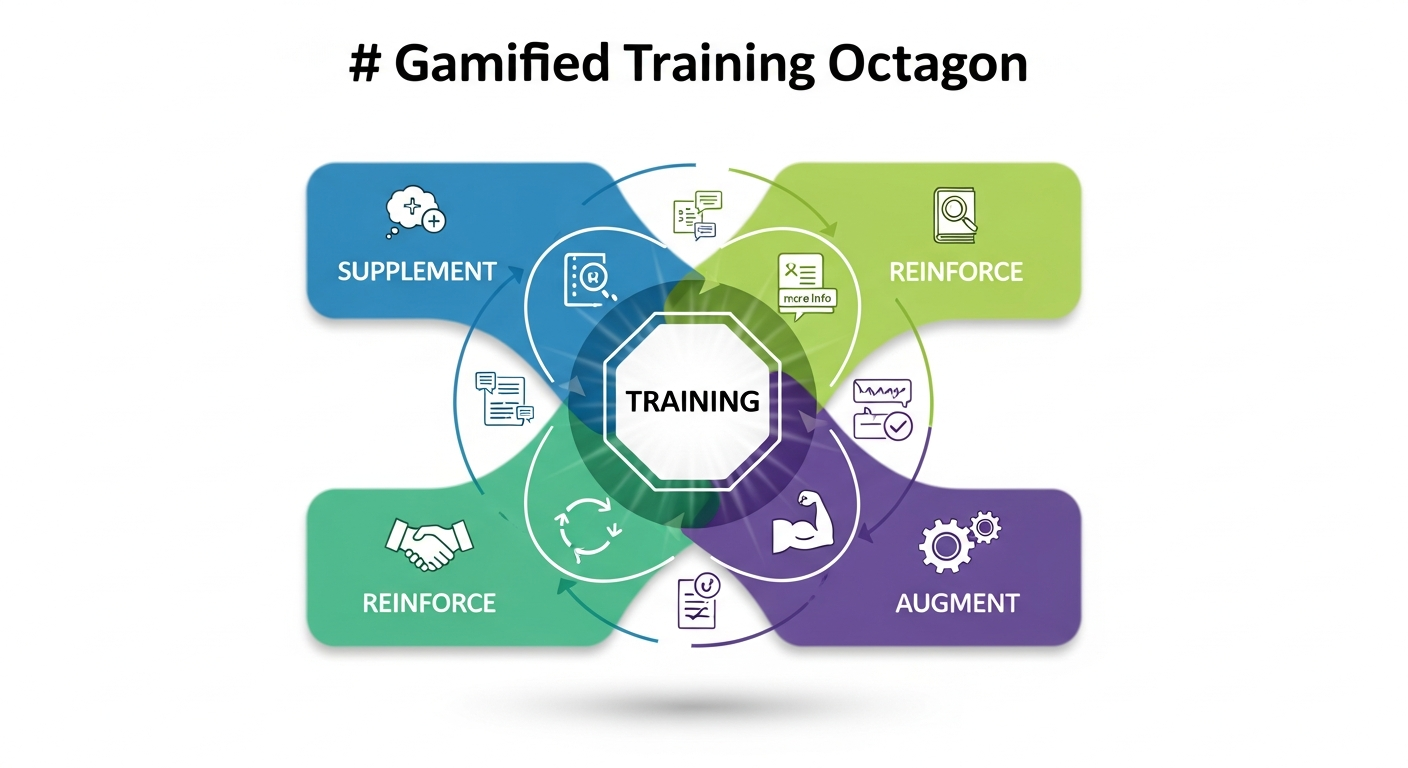
Four Ways Gamification Can Supplement, Reinforce, Augment, and Remediate Training
In today's dynamic corporate landscape, Vice Presidents, Directors, and Senior Managers of Learning & Development face the constant challenge of creating training programs that are not only effective but also engaging, memorable, and impactful. Traditional methods, while foundational, often fall short in capturing sustained employee attention and fostering deep learning retention. This is where gamification emerges as a powerful strategic tool, transforming the learning experience from a passive task into an active, enjoyable, and results-driven journey. Gamification, at its core, applies game-design elements and game principles in non-game contexts, leveraging innate human desires for achievement, competition, collaboration, and reward to drive desired behaviors. For L&D leaders, understanding how to strategically deploy gamification can unlock unprecedented potential in various aspects of corporate training, from compliance and sales to healthcare and finance. Let's explore four critical ways gamification can revolutionize your organization's learning strategy.
1. Supplementing Training: Enhancing Engagement and Participation
The initial hurdle in any training initiative is often engagement. How do you motivate busy professionals to not only attend but actively participate and invest themselves in the learning process? Gamification offers an elegant solution by making learning inherently more attractive and less like a chore. By integrating elements such as points, badges, leaderboards, and progress bars, gamification acts as a powerful supplement to existing training modules, injecting excitement and a sense of purpose. Imagine a new hire onboarding program where completing essential compliance modules earns "Explorer Badges," or a sales training program where mastering product knowledge unlocks "Expert Status." These simple additions significantly boost learner motivation, encouraging them to complete courses, explore additional resources, and engage with content they might otherwise skip.
For industries like retail, hospitality, or even complex sectors such as oil and gas, where foundational knowledge is paramount, gamified introductory modules can drastically improve initial participation rates. A well-designed Microlearning LMS, enhanced with game mechanics, can break down complex topics into bite-sized, interactive challenges, making the learning journey less daunting and more rewarding. This approach doesn't replace the core content; it elevates the delivery and perception of it, ensuring that learners are primed and eager for deeper dives. Leveraging a robust Gamified LMS means you're not just delivering content; you're cultivating an environment where learning is celebrated and participation is intrinsically motivated, leading to higher completion rates and a more positive learning culture across the enterprise.
2. Reinforcing Learning: Boosting Retention and Application
Even the most engaging training can fade from memory without proper reinforcement. The "forgetting curve" is a persistent challenge for L&D professionals, especially in knowledge-intensive industries like banking, finance, and pharma. Gamification provides an effective antidote by creating opportunities for repeated engagement with content in fun and challenging ways, thereby solidifying knowledge retention and promoting practical application.
Consider scenario-based games where employees practice decision-making under simulated real-world pressure, such as handling customer complaints in retail or identifying financial risks in banking. These interactive experiences allow learners to apply theoretical knowledge in a safe, consequence-free environment, reinforcing lessons learned. Quizzes designed as competitive challenges, complete with timed responses and immediate feedback, can significantly improve recall. Furthermore, spaced repetition techniques, naturally embedded within game mechanics, ensure that critical information is revisited at optimal intervals, transferring knowledge from short-term to long-term memory. An Adaptive Learning approach, guided by game theory, can present learners with challenges tailored to their individual performance, ensuring efficient and effective reinforcement. This continuous engagement transforms passive knowledge acquisition into active, sustained expertise, making the overall LMS a hub for continuous growth. Utilizing an lms learning management system that incorporates these reinforcement strategies ensures that the learning content management system effectively combats the forgetting curve, leading to better on-the-job performance and a truly educated workforce.
3. Augmenting Training: Expanding Capabilities and Personalization
Gamification's power extends beyond mere engagement and reinforcement; it can fundamentally augment and expand the capabilities of your training programs, introducing levels of personalization and sophistication previously unattainable. By leveraging advanced game mechanics, L&D can create rich, immersive learning experiences that simulate complex real-world scenarios, fostering deeper skill development and strategic thinking, particularly crucial in sectors like healthcare, mining, and oil and gas.
Think about virtual reality (VR) simulations for surgical training or operating heavy machinery, where gamified feedback loops and performance metrics guide learners through intricate procedures. These environments go beyond traditional classroom settings, providing experiential learning that builds muscle memory and critical judgment. Gamification can also drive personalized learning paths. As learners interact with game elements, data on their performance, preferences, and progress can be collected and analyzed. This data informs an enterprise learning management system, allowing it to adapt the learning journey in real-time, offering customized challenges, resources, and mentorship. An AI Powered Authoring Tool can further enhance this, helping instructional designers create branching narratives and adaptive game levels that respond to individual learner needs and skill gaps, making training highly relevant and impactful. This elevates a standard cloud based learning management system into a dynamic, proactive development platform, ensuring every employee receives optimal, tailored growth opportunities.
4. Remediating Gaps: Addressing Weaknesses and Improving Performance
Perhaps one of the most strategic applications of gamification lies in its ability to identify and effectively remediate knowledge and skill gaps. In large organizations, pinpointing individual deficiencies across a diverse workforce can be a monumental task. Gamification, however, provides a non-threatening, data-rich environment for diagnostic assessment and targeted intervention, a critical need for industries focusing on compliance and risk, such as banking, finance, and healthcare.
Through diagnostic games and adaptive challenges, an organization's learning management software can pinpoint exactly where a learner struggles. For example, a gamified compliance module can identify employees who consistently miss certain regulatory details, while a sales simulation might reveal weaknesses in objection handling. Once identified, the system can automatically assign personalized remedial pathways, presenting focused micro-lessons or practice challenges specifically designed to address those weaknesses. This turns remediation into a proactive, personalized process rather than a punitive one. Risk-focused Training, when gamified, becomes an active exercise in mitigation, allowing employees to fail safely and learn from mistakes without real-world consequences. This iterative feedback loop, inherent in good game design, transforms weaknesses into strengths, dramatically improving overall workforce competency. This proactive and data-driven approach positions the LCMS as an indispensable tool for continuous improvement and talent development.
Common Questions on Gamification and Future Learning Technologies
As L&D leaders consider integrating gamification, several strategic questions often arise regarding its implementation and impact.
How can intelligent automation optimize the learning journey for individual employees across diverse roles and skill sets?
Intelligent automation, leveraging data from gamified interactions, can analyze individual learning patterns, preferences, and performance within a learning management system. It can then dynamically personalize the curriculum, recommend specific game-based modules, or suggest remedial challenges tailored to each employee's unique needs. This ensures that a sales representative might receive different adaptive scenarios than a compliance officer, optimizing their specific learning trajectory for maximum relevance and impact.
What are the geographical and cultural considerations for deploying gamified training globally, ensuring local relevance and regulatory adherence?
When deploying gamified training across different regions, it's crucial to consider localization. This involves more than just language translation; it includes adapting game narratives, characters, and reward systems to resonate with local cultural norms and values. Furthermore, for industries like finance or pharma operating globally, the gamified content must be meticulously aligned with specific regional regulations and compliance standards, often requiring an adaptable learning content management system that can host localized versions of modules, ensuring both engagement and adherence.
How does gamification contribute to overall employee engagement and improve organizational learning outcomes in a rapidly evolving business landscape?
Gamification significantly boosts employee engagement by transforming learning into an interactive, motivating experience rather than a passive requirement. It taps into natural human drives for accomplishment and social connection, leading to higher course completion rates, deeper knowledge retention, and faster skill acquisition. In a rapidly changing business environment, this improved engagement directly translates to a more agile, adaptable workforce capable of quickly mastering new skills and information, thereby enhancing overall organizational performance and competitive advantage.
Conclusion
For L&D professionals, the strategic integration of gamification is no longer a novel experiment but a proven methodology for achieving superior training outcomes. By strategically leveraging gamification to supplement, reinforce, augment, and remediate training, organizations can foster a culture of continuous learning that is both effective and enjoyable. From boosting initial engagement and solidifying knowledge retention to personalizing development paths and efficiently closing skill gaps, the benefits are profound. Embracing a comprehensive learning management solutions strategy that includes advanced gamification features, such as those offered by MaxLearn LMS, empowers L&D leaders to create impactful programs that drive employee growth and contribute directly to organizational success. The future of corporate training is interactive, personalized, and, undeniably, gamified.
.jpg)