

How to Solve Knowledge Retention Gaps Using VARK and Microlearning
In today's dynamic corporate landscape, knowledge is power, but only if it's retained and readily accessible. For L&D Vice Presidents, Directors, and Managers across sectors like Compliance, Sales, Banking, Finance, Insurance, Retail, Pharma, Health Care, Hospitality, Oil and Gas, and Mining, the challenge of knowledge retention gaps is a persistent drain on efficiency and a significant business risk. Employees are constantly exposed to new information, regulations, products, and processes, yet traditional training methods often fall short in ensuring lasting recall and application. This article delves into how the strategic integration of the VARK learning styles model and microlearning, powered by an advanced LMS, can revolutionize your organization's approach to learning and development, closing those critical retention gaps for good.
Understanding the Pervasive Challenge of Knowledge Retention
The "forgetting curve" is a stark reality for L&D professionals. After just one hour, people typically forget 50% of new information, and within a week, that number can climb to 90%. In industries where precision and up-to-date knowledge are paramount – such as compliance training in banking or pharmaceutical sales – such gaps can lead to severe consequences:
- Compliance Breaches: In banking and finance, forgotten regulations can result in hefty fines.
- Reduced Sales Performance: Forgetting product features or sales techniques can lead to lost revenue in retail and sales.
- Operational Inefficiencies: In hospitality or oil and gas, misremembered procedures can cause safety hazards or operational slowdowns.
- Patient Safety Risks: In health care, inadequate knowledge retention directly impacts patient outcomes.
Combating this requires more than just delivering content; it demands a sophisticated learning management system that supports diverse learning needs and modern delivery formats. An effective learning management software is crucial for addressing these challenges head-on.
VARK: Tailoring Learning for Maximum Impact
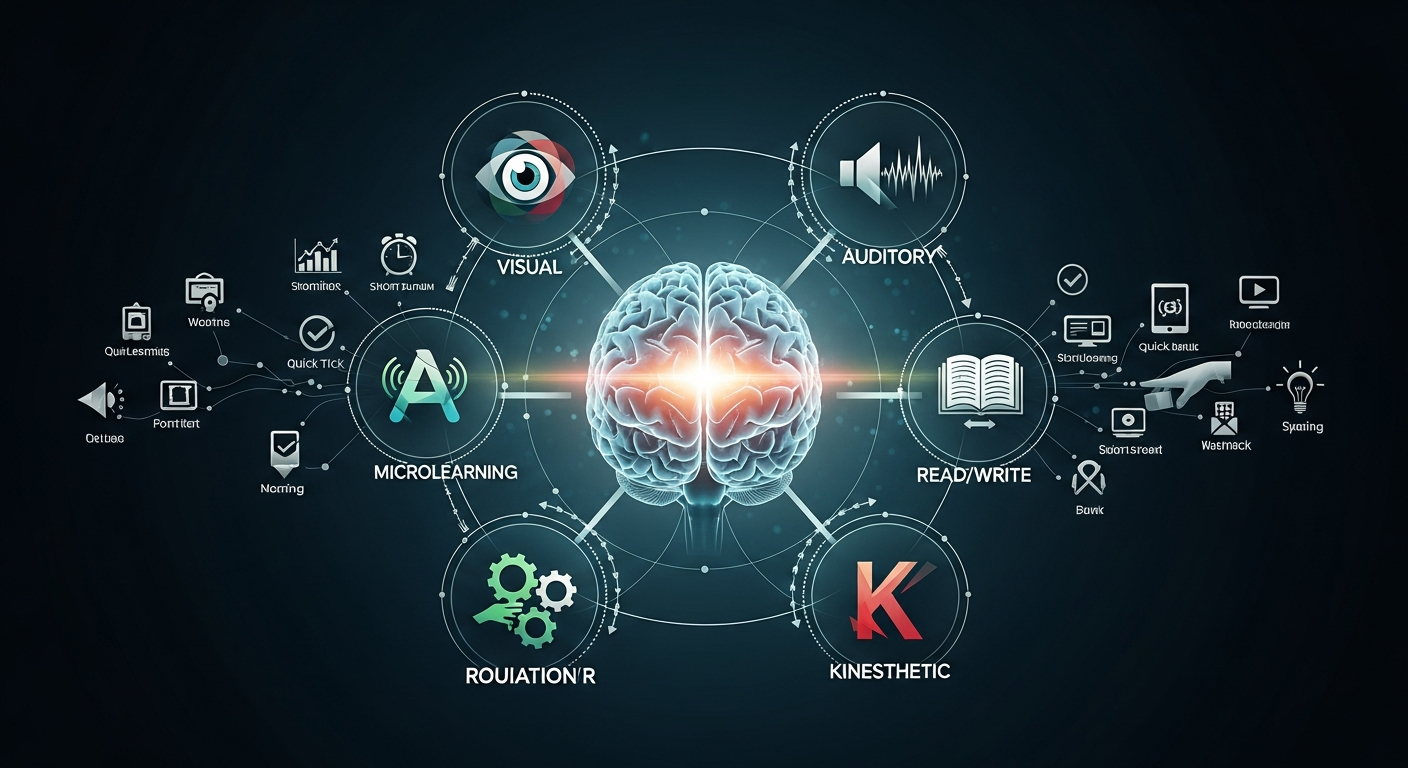
The VARK model categorizes learners into four primary styles: Visual, Auditory, Read/Write, and Kinesthetic. Recognizing and catering to these preferences is fundamental for enhancing engagement and, crucially, retention. An enterprise learning management system designed to accommodate VARK can transform how employees absorb information:
- Visual Learners: Benefit from infographics, charts, videos, and diagrams. Think complex process flows in manufacturing or anatomical charts in health care.
- Auditory Learners: Respond well to spoken information, such as podcasts, webinars, and discussions. Ideal for policy explanations in insurance or customer service scenarios in retail.
- Read/Write Learners: Thrive on text-based materials, including manuals, articles, and notes. Critical for detailed compliance documents or technical specifications in pharma.
- Kinesthetic Learners: Learn best through doing, hands-on activities, simulations, and role-playing. Essential for practical skills in hospitality, equipment operation in mining, or sales pitch practice.
Implementing an Adaptive Learning approach based on VARK profiles allows your learning management solutions to deliver personalized content, ensuring that each learner receives information in a format most conducive to their understanding and retention.
Microlearning: The Power of Bite-Sized Knowledge
Microlearning delivers short, focused bursts of information, typically 3-10 minutes in duration, designed to achieve a specific learning objective. This approach is perfectly suited for today's busy professionals who need to learn on the go and integrate learning into their workflow. The benefits for knowledge retention are profound:
- Reduced Cognitive Overload: Smaller chunks of information are easier to process and remember.
- Increased Engagement: Short modules are less daunting and more likely to be completed.
- Just-in-Time Learning: Employees can access relevant information precisely when they need it, reinforcing learned concepts immediately.
- Spaced Repetition: Microlearning facilitates repeated exposure to key information over time, solidifying memory.
For compliance, banking, and finance, microlearning modules can provide quick refreshers on regulations or anti-money laundering protocols. In sales and retail, they offer rapid updates on new products or seasonal promotions. For health care and pharma, short videos can explain new drug protocols or equipment operation. A dedicated Microlearning LMS becomes an indispensable tool for deploying such content effectively, especially if it's a cloud based learning management system that offers accessibility anywhere, anytime.
The Synergistic Power of VARK and Microlearning
Combining VARK and microlearning creates a potent strategy for closing retention gaps. Imagine a lms learning management system that, based on a learner's VARK preference, delivers tailored microlearning modules:
- A Visual learner receives an infographic on a new compliance policy (Banking), followed by a short video scenario.
- An Auditory learner gets a 5-minute podcast detailing changes to a product line (Retail), accompanied by an audio-based quiz.
- A Read/Write learner accesses a concise summary of new safety protocols (Oil and Gas), with a quick knowledge check featuring bullet points.
- A Kinesthetic learner engages with an interactive simulation for a customer service challenge (Hospitality) or a mini role-play exercise for a sales pitch (Sales). This is often enhanced by a Gamified LMS.
This integrated approach ensures that content is not only bite-sized and digestible but also presented in the most effective format for each individual, dramatically increasing the likelihood of retention and application. This is the hallmark of a truly advanced learning content management system.
Implementing VARK and Microlearning with Intelligent Technology
To successfully implement this powerful duo, a robust and intelligent LMS is essential. Look for platforms that offer:
- Personalization Capabilities: The ability to create learning paths based on VARK preferences, roles, and performance data.
- Diverse Content Support: Compatibility with various media types (video, audio, text, interactive simulations) for microlearning modules.
- Analytics and Reporting: Track learner engagement, completion rates, and knowledge retention scores to identify areas for improvement.
- Mobile Accessibility: Ensure learners can access microlearning content anytime, anywhere, on any device.
- Content Authoring Tools: Empower your L&D team to quickly create and adapt microlearning content. An AI Powered Authoring Tool can significantly streamline this process.
Platforms like MaxLearn LMS provide the comprehensive functionalities required to manage, deliver, and track such sophisticated learning strategies, acting as a true LCMS.
How can intelligent technologies enhance knowledge retention strategies?
Intelligent technologies, particularly those leveraging machine learning, significantly boost knowledge retention by enabling hyper-personalization, dynamic content adaptation, and predictive analytics. They can analyze learner performance, identify knowledge gaps in real-time, and automatically recommend targeted microlearning modules in the learner's preferred VARK style. For example, a system can detect if an employee is struggling with a specific compliance topic and immediately push a short, interactive video or a quick quiz to reinforce that concept. This proactive, data-driven approach ensures timely intervention and optimized learning paths for every individual.
Is this approach effective for globally distributed teams?
Absolutely. The combination of VARK and microlearning, delivered via a cloud based learning management system, is exceptionally effective for globally distributed teams. Microlearning's bite-sized nature means content is easily digestible across different time zones and work schedules. Furthermore, digital content can be readily localized and translated to cater to diverse linguistic and cultural backgrounds. The VARK model is universal; people worldwide learn differently. An intelligent learning management system can host and deliver content that respects these preferences, ensuring consistent, high-quality training and retention across all regions, from a single, centralized platform.
What is the measurable impact of improving knowledge retention on business outcomes?
The measurable impact of improved knowledge retention on business outcomes is substantial and far-reaching. Organizations see a direct correlation with increased productivity, reduced errors, and enhanced compliance adherence. For instance, in sales, better product knowledge translates to higher conversion rates and larger deal sizes. In compliance-heavy industries like banking or pharma, employees with strong retention lead to fewer regulatory violations and reduced financial penalties. Faster onboarding, improved decision-making, greater operational efficiency, and enhanced employee satisfaction are all direct benefits. Ultimately, robust knowledge retention directly mitigates business risks, fosters innovation, and contributes significantly to overall business growth, particularly through focused Risk-focused Training strategies.
Conclusion
For L&D leaders striving to elevate organizational performance and mitigate risks, solving knowledge retention gaps is a critical imperative. By embracing the VARK learning styles model in conjunction with microlearning, and leveraging a sophisticated learning management system, you can create a dynamic, personalized, and highly effective learning environment. This strategy ensures that your employees not only acquire essential knowledge but truly retain and apply it, driving success across all segments and industries, from ensuring compliance in finance to boosting sales in retail and enhancing safety in oil and gas. Invest in a modern LMS to transform your training and secure your organization's competitive edge.
.jpg)


