

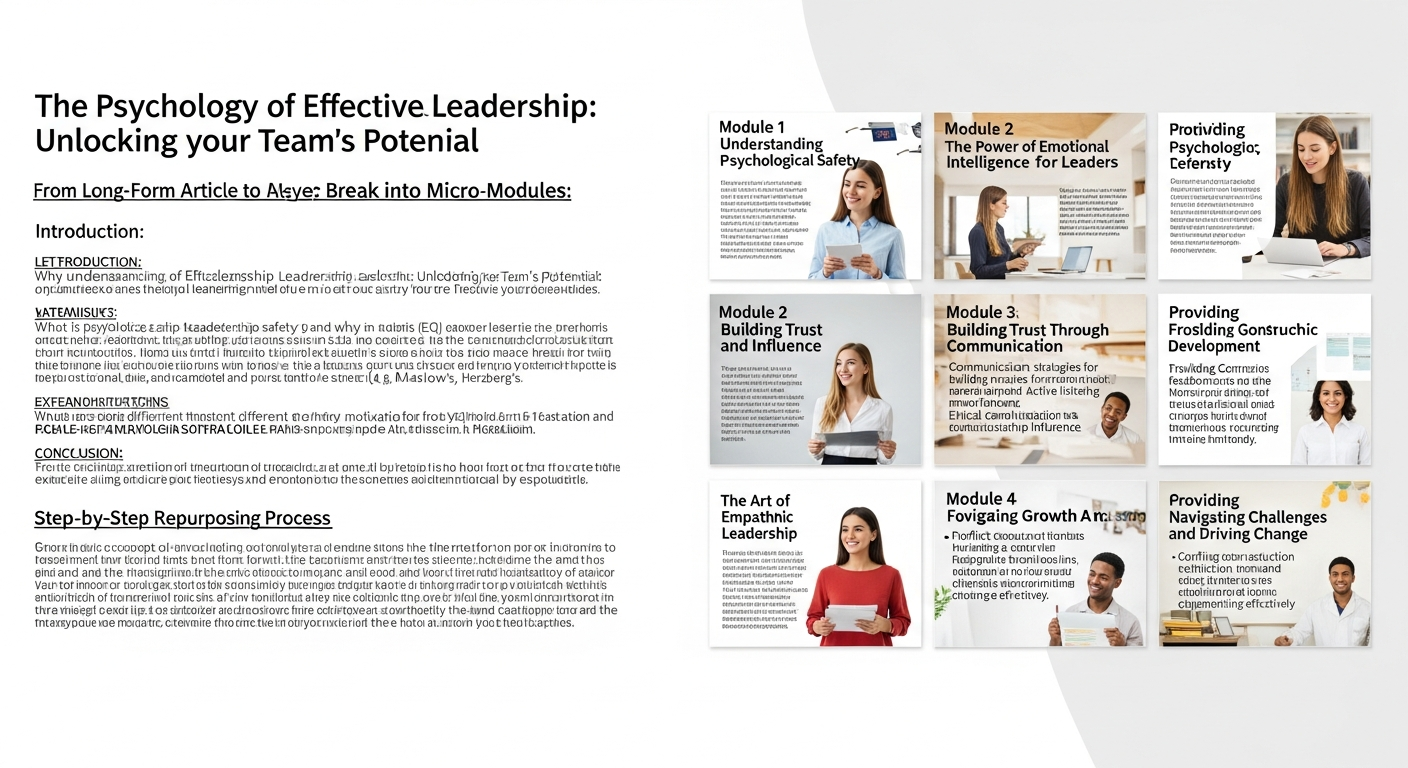
How to Repurpose Your Long-Form Content into High-Yield Microlearning Modules
In today's fast-paced corporate environment, the Learning and Development (L&D) landscape is continually evolving. As VPs, Directors, and Senior Managers, you understand the imperative to deliver effective training that truly resonates with employees across diverse industries, from Compliance and Sales to Banking, Healthcare, and Oil & Gas. Traditional long-form content, while rich in information, often struggles to capture and maintain learner attention. The solution? Transforming your valuable existing resources into potent, bite-sized microlearning modules.
This strategic shift not only maximizes the return on your content investment but also aligns with modern learning preferences, driving higher engagement and knowledge retention. Imagine a world where your comprehensive training manuals, detailed policy documents, and extensive product guides are no longer intimidating tomes but rather easily digestible, impactful learning nuggets. This article will guide you through the process of unlocking the full potential of your institutional knowledge by repurposing it into high-yield microlearning.
Why Microlearning is Your Strategic Advantage
Microlearning is more than just a buzzword; it's a pedagogical approach designed for the contemporary learner. Its core benefits directly address common L&D challenges:
- Enhanced Engagement: Short modules (typically 3-7 minutes) prevent cognitive overload, keeping learners focused and motivated.
- Improved Retention: By focusing on single learning objectives, microlearning facilitates deeper understanding and better recall.
- Flexibility and Accessibility: Learners can access content on demand, fitting training into their busy schedules, often via a robust Microlearning LMS.
- Cost-Effectiveness: Repurposing existing assets is significantly more economical than creating new content from scratch.
- Agility: Rapid creation and deployment allow L&D teams to quickly address skill gaps or adapt to new regulations, crucial in sectors like Finance and Pharma.
The Untapped Potential of Your Long-Form Content
Your organization likely possesses a wealth of valuable long-form content: webinars, training manuals, compliance documents, technical specifications, and internal presentations. Often, this content represents countless hours of expert input and development. Yet, it frequently sits underutilized because its sheer volume makes it daunting for learners. Repurposing this existing material into microlearning isn't about discarding the old; it's about extracting its essence and repackaging it for maximum impact and accessibility, turning it into a dynamic learning content management system.
The Repurposing Blueprint: From Lengthy to Lean
Transforming extensive materials into concise, effective microlearning requires a structured approach. Here's how to do it:
Step 1: Audit and Identify Core Concepts
Begin by meticulously reviewing your long-form content. What are the key learning objectives, critical processes, or essential pieces of information within each document? Focus on identifying discrete topics that can stand alone. For instance, a lengthy compliance manual might contain separate modules on data privacy, anti-money laundering, or ethical conduct.
How can data analytics help pinpoint the most critical content areas for transformation? By analyzing engagement rates, common learner queries, and performance data from previous training, you can identify which sections of long-form content are most crucial for immediate understanding and application.
Step 2: Chunking Down: The Art of Atomization
Once identified, break down each core concept into its smallest viable learning units. Each micro-module should address a single learning objective. Think of an enterprise learning management system for a sales team: a module might cover "Objection Handling Technique #1" rather than an entire chapter on sales strategies. This atomization allows for personalized learning paths through Adaptive Learning, catering to individual needs.
What's the most effective strategy for breaking down complex topics into digestible micro-segments? Focus on the "what," "why," and "how" of each specific point. Use visual cues, short paragraphs, and clear headings to delineate distinct ideas, making the content easy to scan and comprehend.
Step 3: Crafting Engaging Microlearning Modules
The format of your microlearning is key to its effectiveness. Don't just extract text; transform it. Consider various media types:
- Short Videos: Explainer videos, animated tutorials, or quick demonstrations.
- Infographics: Visual summaries of complex data or processes.
- Interactive Quizzes: Quick knowledge checks to reinforce learning.
- Case Studies: Brief, real-world scenarios for practical application, particularly useful for Risk-focused Training in banking or healthcare.
- Interactive Simulations: Mini-simulations for hands-on practice, especially effective within a Gamified LMS environment.
Ensure each module is self-contained and offers immediate value, fostering a sense of accomplishment for the learner.
Step 4: Leveraging Technology for Transformation
A robust learning management system (LMS) is indispensable for delivering and managing your repurposed content. Look for a cloud based learning management system that specializes in microlearning. A good Microlearning LMS should offer:
- Seamless content delivery across devices.
- Tracking and reporting capabilities to monitor progress and completion rates.
- Features for easy content updates and version control.
- Integration with an AI Powered Authoring Tool to streamline creation.
Utilizing a comprehensive learning management software or a dedicated MaxLearn LMS like MaxLearn, which functions as a cutting-edge LCMS, will simplify the entire process from content creation to deployment and analytics, enhancing your learning management solutions.
Step 5: Implementation and Iteration
Once your modules are ready, deploy them strategically. Consider integrating them into existing workflows or offering them as on-demand resources. Crucially, collect feedback from learners and iterate. Microlearning is dynamic; continuous refinement ensures its ongoing relevance and effectiveness. This agile approach is particularly vital in industries like Pharma, where regulations and best practices frequently evolve.
How does continuous feedback integration refine and optimize microlearning pathways? By analyzing learner performance, module completion rates, and qualitative feedback, L&D teams can identify areas for improvement, update content, and personalize learning paths, ensuring modules remain relevant and impactful.
AI's Role in Scaling and Personalizing Microlearning
Artificial intelligence is revolutionizing the way we approach learning and development. From automating the identification of key concepts in long-form documents to personalizing learning paths based on individual performance and preferences, AI can significantly enhance the microlearning repurposing process. It can even assist in generating new micro-content formats or providing instant feedback to learners.
What advanced algorithms can best predict learner engagement with repurposed modules? Predictive analytics, machine learning models, and natural language processing can analyze historical data, content attributes, and learner profiles to forecast engagement and suggest optimal content delivery strategies.
Benefits Beyond Efficiency
Repurposing your long-form content into high-yield microlearning modules delivers far more than just operational efficiency. It transforms your L&D strategy, leading to:
- Higher ROI: Maximizing existing content reduces development costs and accelerates skill acquisition, directly impacting business growth.
- Enhanced Compliance and Risk Mitigation: Regular, targeted micro-training ensures employees in critical sectors like banking, insurance, and healthcare stay up-to-date with complex regulations, reducing organizational risk.
- Faster Skill Development: Rapid, focused learning empowers employees to acquire new skills quickly, fostering agility and competitiveness in dynamic markets.
- Improved Employee Experience: Offering flexible, engaging learning options boosts morale and demonstrates an investment in employee growth.
Conclusion
The journey from extensive long-form content to dynamic, high-yield microlearning modules is a strategic imperative for modern L&D leaders. By meticulously auditing, atomizing, and redesigning your existing knowledge assets with the aid of powerful learning management systems and innovative tools, you can unlock unparalleled learning efficiency and engagement. Embrace this transformation to empower your workforce, enhance organizational performance, and cement your L&D department as a true driver of business success.
.jpg)


