

The Forgetting Curve Meaning: Reclaiming Knowledge in Corporate Learning
In the dynamic world of corporate learning and development, the goal is not just to deliver information but to ensure that knowledge is retained, applied, and ultimately transforms performance. Yet, a silent adversary constantly challenges this objective: the forgetting curve. For L&D Vice Presidents, Directors, and Senior Managers, understanding the profound implications of the forgetting curve meaning is crucial for designing effective, sustainable, and impactful training programs across all industries.
Imagine investing significant resources into a new sales enablement program, a critical compliance module, or an intricate financial regulation course. The initial engagement is high, and learners absorb the content. But weeks later, recall plummets, and the desired behavioral changes are elusive. This phenomenon is precisely what the forgetting curve describes, and confronting it head-on is key to maximizing your training ROI.
Understanding the Forgetting Curve Meaning
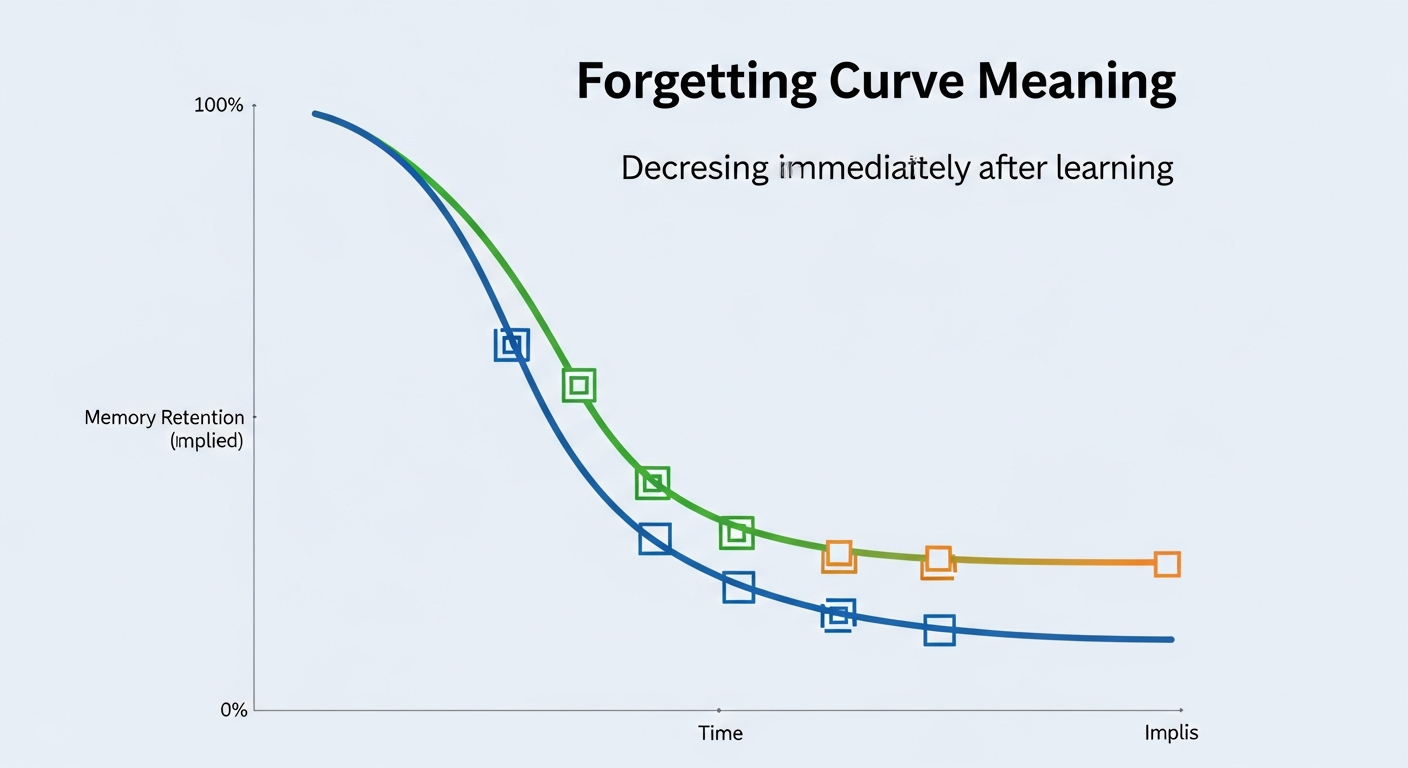
The concept of the forgetting curve originates from the pioneering work of German psychologist Hermann Ebbinghaus in the late 19th century. Through his experiments, Ebbinghaus discovered that within hours or days of learning new information, a significant portion is forgotten if not actively reinforced. His research graphically demonstrated that the rate of forgetting is sharpest immediately after learning, then gradually levels off. Without intervention, up to 70-80% of newly acquired information can be lost within a week.
For L&D professionals, the forgetting curve meaning translates into a stark reality: conventional, one-off training sessions are often inefficient. A single workshop, webinar, or lengthy e-learning course, no matter how well-designed, may not yield lasting results if follow-up and reinforcement strategies are absent. This has profound implications for every sector, from ensuring compliance in banking to maintaining safety protocols in oil and gas, or mastering product knowledge in retail.
The Business Impact Across Industries
The consequences of the forgetting curve are widespread and costly:
- Compliance: In Banking, Finance, and Pharma, forgetting critical regulations can lead to severe penalties, reputational damage, and operational failures. Regular, reinforced training is non-negotiable.
- Sales: Sales teams in any industry (Retail, Tech, Pharma) who forget product features, objection handling, or pitching techniques directly impact revenue and market share.
- Healthcare: Medical professionals forgetting procedures or drug interactions can have life-threatening consequences. Continuous learning and recall are paramount.
- Hospitality: Employee forgetting of service standards or safety protocols can lead to poor customer experiences and safety hazards.
- Oil & Gas/Mining: Forgetting safety procedures can result in accidents, injuries, and environmental disasters. High-stakes industries demand absolute knowledge retention.
In essence, the forgetting curve is a direct threat to operational efficiency, risk mitigation, and strategic growth across all segments.
Strategies to Combat the Forgetting Curve
Thankfully, the forgetting curve is not an insurmountable barrier. Modern L&D strategies, especially those empowered by technology, offer powerful ways to flatten it and ensure lasting knowledge retention:
- Spaced Repetition: This technique involves re-exposing learners to information at increasing intervals. By timing refreshers just before knowledge is likely to be forgotten, it reinforces memory and transfers information from short-term to long-term memory.
- Microlearning: Delivering learning content in short, focused bursts (2-5 minutes) makes it easier for learners to digest and retain. This approach aligns perfectly with modern attention spans and can be seamlessly integrated into daily workflows. Consider a comprehensive MaxLearn Microlearning Platform to implement this effectively.
- Active Recall: Instead of passively rereading, learners actively retrieve information from memory through quizzes, flashcards, or self-testing. This strengthens neural pathways and improves retention significantly.
- Contextual Learning: Providing training that is directly relevant to a learner's job role and can be immediately applied helps solidify understanding and memory.
- Gamification: Incorporating game-like elements such as points, badges, leaderboards, and challenges into training can boost engagement and motivation, encouraging repeated interaction with content. A Gamified LMS can transform monotonous training into an exciting learning journey.
- Adaptive Learning: This personalized approach adjusts the learning path based on an individual's performance, strengths, and weaknesses, ensuring that content is always challenging but not overwhelming. Explore how this methodology drives powerful microlearning in our blog on Adaptive Learning.
Leveraging Technology: The Role of Advanced Systems in Reinforcing Learning
The advent of sophisticated technological solutions has revolutionized our ability to fight the forgetting curve. Modern learning platforms, powered by data analytics and advanced algorithms, can personalize, predict, and prescribe learning pathways with unprecedented precision.
For instance, an AI Powered Authoring Tool allows L&D teams to create engaging, dynamic content that can be easily updated and delivered in microlearning formats. These tools can identify knowledge gaps based on learner performance, suggest relevant content for reinforcement, and even automate the scheduling of spaced repetition modules.
Furthermore, for high-stakes environments, intelligent systems can pinpoint areas where knowledge retention is critical for minimizing risks. This leads to more effective Risk-focused Training, ensuring that vital information, such as safety protocols in mining or compliance details in finance, is never forgotten.
Addressing Common Questions on Intelligent Learning Systems and Retention
As L&D leaders consider integrating more advanced solutions, several questions often arise regarding their impact on learning retention:
How can advanced algorithms help tailor learning paths to prevent knowledge decay?
Advanced algorithms analyze vast amounts of learner data, including performance on quizzes, time spent on modules, and interaction patterns. This data allows the system to identify specific concepts or skills where an individual might be struggling or excelling. Based on this understanding, the algorithms can dynamically adjust the learning path, recommending personalized refreshers, additional resources, or more challenging content. This ensures that each learner receives the precise intervention needed to reinforce memory where they are most vulnerable to forgetting, effectively creating a customized spaced repetition schedule for every user.
What role do machine learning systems play in optimizing the timing and frequency of training refreshers?
Machine learning systems are instrumental in perfecting the science of spaced repetition. Instead of a one-size-fits-all approach, these systems can learn from the collective performance of many learners, as well as individual progress, to predict the optimal moment to re-expose a learner to specific information. They consider factors like the complexity of the content, the learner's initial grasp, and their past retention rates. By intelligently scheduling reminders or brief review modules right before the information is likely to be forgotten, machine learning ensures maximum retention efficiency, minimizing the need for extensive retraining and maximizing learning longevity.
How can intelligent platforms ensure training effectiveness across diverse global teams and varying skill levels?
Intelligent learning platforms leverage their analytical capabilities to understand the diverse needs of a global workforce. They can segment learners by region, role, prior knowledge, and language, then adapt content delivery accordingly. For teams with varying skill levels, the platform can provide foundational modules for novices while offering advanced challenges for experienced professionals. Furthermore, by tracking engagement and performance across different demographics, these systems can identify content or delivery methods that resonate best with specific groups, allowing L&D teams to refine their strategies to ensure consistent and high-quality learning outcomes globally, regardless of initial skill disparity or cultural context.
Measuring Success: Metrics for Combating Forgetting
To truly understand the impact of your strategies against the forgetting curve, it's essential to measure success beyond completion rates:
- Performance Improvement: Track key performance indicators (KPIs) directly related to the training, such as sales figures, error rates, or compliance adherence.
- Knowledge Retention Scores: Implement post-training assessments at varying intervals (e.g., 1 week, 1 month, 3 months) to directly measure recall.
- Reduced Rework/Errors: Quantify the reduction in mistakes or the need for re-training due to better knowledge retention.
- Learner Engagement: Monitor participation in microlearning modules, spaced repetition quizzes, and voluntary access to learning resources.
Conclusion
The forgetting curve meaning is a critical consideration for any L&D leader striving to build a truly knowledgeable and high-performing workforce. By actively acknowledging its existence and proactively implementing evidence-based strategies, supported by advanced learning technologies, organizations can transform their training from a transient event into a continuous, reinforcing, and highly effective knowledge-building journey. Investing in solutions that combat forgetting is not just about improving training; it's about safeguarding institutional knowledge, driving performance, and securing a competitive edge in an ever-evolving market.
.jpg)


