

Mastering Memory: How L&D Can Conquer the Ebbinghaus Forgetting Curve
In the dynamic landscape of corporate learning and development, the investment in training is substantial. Yet, how much of that hard-earned knowledge truly sticks? For L&D Vice Presidents, Directors, and Managers, this question looms large. The answer, unfortunately, is often less than ideal, thanks to a psychological phenomenon identified over a century ago: the Ebbinghaus Forgetting Curve. Understanding this curve isn't just academic; it's fundamental to designing effective, high-impact learning experiences that deliver tangible business results.
Imagine the resources poured into compliance training, sales enablement, or critical safety protocols. If a significant portion of that information is forgotten within days, the return on investment diminishes drastically. This article delves into the Ebbinghaus Forgetting Curve, its implications across industries like Banking, Finance, Insurance, Retail, Pharma, Healthcare, Hospitality, Oil and Gas, and Mining, and how modern L&D strategies and technologies can transform forgetting into lasting retention.
Unpacking the Ebbinghaus Forgetting Curve
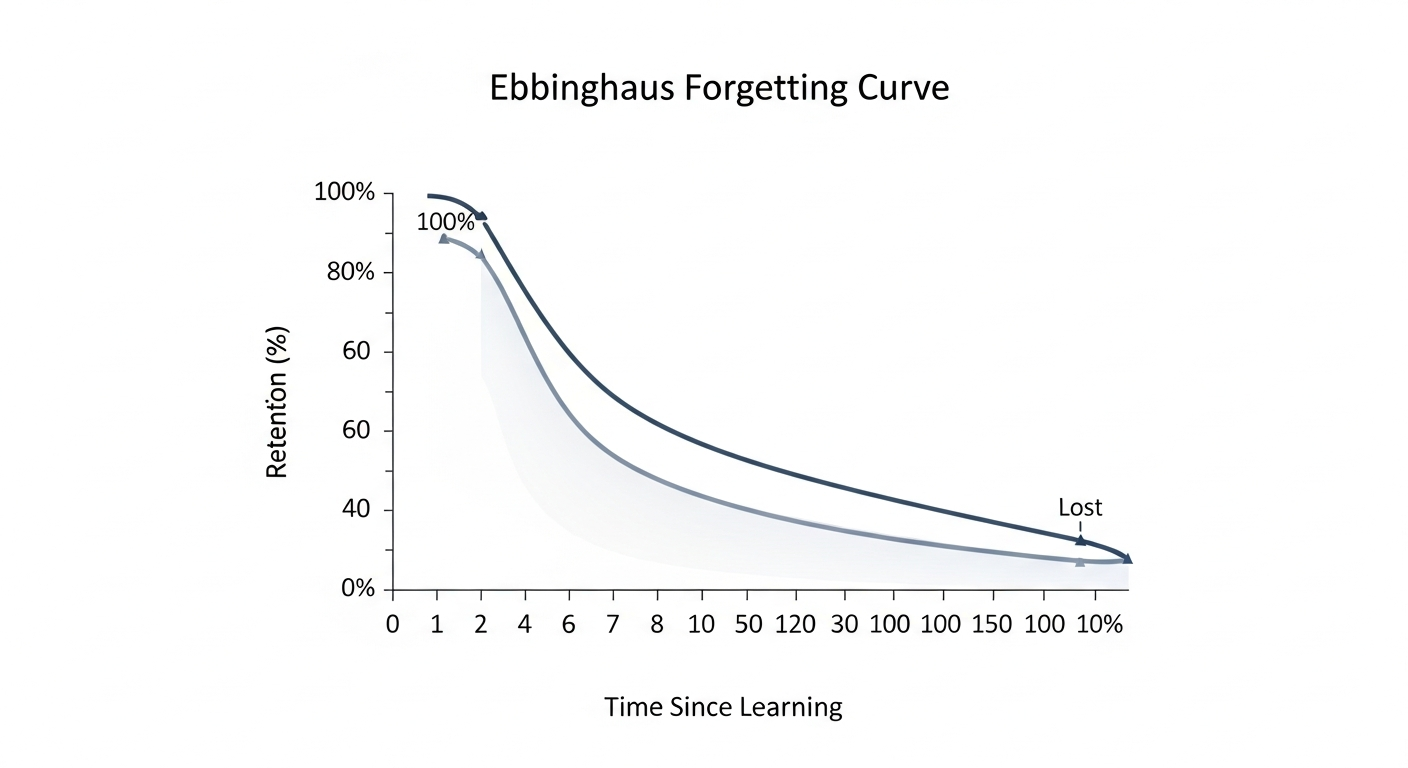
Hermann Ebbinghaus, a pioneering psychologist, conducted groundbreaking experiments on memory in the late 19th century. His research revealed a startling pattern: we forget information at an exponential rate. The Forgetting Curve illustrates that approximately 50-70% of new information is forgotten within 24 hours if not reinforced. This rapid decline continues, though at a slower pace, over subsequent days and weeks. The implications for professional training are profound.
Factors influencing the steepness of the curve include:
- Meaningfulness: Information that is perceived as relevant and connected to existing knowledge is better retained.
- Emotional Connection: Learning associated with strong emotions tends to be more memorable.
- Initial Learning Strength: How well the information was understood and encoded initially plays a significant role.
- Sleep: Adequate sleep post-learning is crucial for memory consolidation.
The Business Impact of Knowledge Decay
For L&D leaders, the forgetting curve isn't just about memory; it's about performance, productivity, and profitability. Consider the following scenarios:
- Compliance & Risk: In Banking, Finance, and Insurance, forgetting regulatory details can lead to severe penalties, reputational damage, and operational failures. In Pharma and Healthcare, lapses in critical procedure knowledge can have life-threatening consequences. Organizations need Risk-focused Training that truly sticks.
- Sales Effectiveness: Sales teams in Retail or any industry constantly absorb new product features, market trends, and objection-handling techniques. If this knowledge erodes quickly, sales cycles lengthen, conversion rates drop, and competitive advantage is lost.
- Operational Efficiency: In sectors like Oil and Gas, Mining, and Hospitality, operational errors due to forgotten safety protocols or procedural steps can lead to accidents, downtime, and significant financial losses.
Every dollar spent on training that isn't retained is a dollar wasted. The challenge, therefore, is to move beyond mere information delivery to genuine knowledge retention and application.
Strategic Interventions to Reinforce Learning
Combating the Ebbinghaus Forgetting Curve requires a deliberate and multi-faceted approach. It's about designing learning experiences that naturally integrate reinforcement and retrieval practice.
Microlearning: The Antidote to Overload
One of the most effective strategies is microlearning. By breaking down complex topics into short, digestible modules, microlearning reduces cognitive load and makes information easier to process and remember. These bite-sized lessons can be consumed quickly, enabling learners to absorb content without feeling overwhelmed. A robust MaxLearn Microlearning Platform provides the ideal environment for this approach, delivering targeted content right when and where it's needed.
Spaced Repetition and Active Recall
These are two cornerstone principles derived from Ebbinghaus's own findings. Spaced repetition involves re-exposing learners to information at increasing intervals, right before they're about to forget it. Active recall, such as quizzes or flashcards, forces learners to retrieve information from memory rather than just passively re-reading it. This retrieval practice strengthens neural pathways and improves long-term retention.
Contextual Relevance and Application
Learning is far more memorable when it's immediately applicable to a learner's job role and real-world challenges. When training provides practical scenarios and opportunities to apply new skills, it anchors the information within a meaningful context, making it less susceptible to the forgetting curve.
Leveraging Modern Learning Technologies
How can artificial intelligence help overcome the rapid decline in learned information, transforming theoretical knowledge into lasting organizational capability? Modern learning technologies, particularly those powered by intelligent systems, are revolutionizing our ability to combat the forgetting curve.
Engaging Platforms for Sustained Interest
A disengaged learner is a forgetful learner. Platforms that incorporate engaging elements keep learners motivated and returning for reinforcement. A Gamified LMS, for instance, uses points, badges, leaderboards, and challenges to make learning fun and encourage repeated interaction with content, thereby naturally fostering spaced repetition and retrieval practice.
Personalized and Adaptive Pathways
How can a system understand and adapt to an individual's unique learning patterns to optimize memory and minimize knowledge decay? Not all learners forget at the same rate or in the same areas. Adaptive Learning systems leverage data and algorithms to personalize learning paths, serving up reinforcement content specifically tailored to an individual's identified knowledge gaps and preferred learning style. This ensures that valuable learning time is focused on areas where it's most needed.
Intelligent Content Creation and Delivery
What innovative techniques are emerging to ensure knowledge retention across geographically dispersed teams and diverse learning needs? An AI Powered Authoring Tool can significantly streamline the creation of microlearning content, automated quizzes, and personalized reinforcement modules. These tools can analyze learning data to suggest optimal timing for review, identify common areas of confusion, and even generate variations of content to keep reinforcement fresh and effective across various regions and departments.
Industry-Specific Resilience Through Retention
- Compliance & Financial Services: In Banking, Finance, and Insurance, continuous, reinforced learning ensures employees are always up-to-date on evolving regulations, preventing costly errors and ensuring ethical conduct. Intelligent systems can schedule reminders for critical policy reviews based on individual performance.
- Sales & Retail: For sales professionals, consistent retention of product knowledge, competitor analysis, and sales techniques directly translates to higher closing rates and customer satisfaction. Microlearning platforms can deliver daily sales tips and product updates to reinforce crucial information.
- Healthcare & Pharma: The rapid pace of medical advancements demands that healthcare professionals constantly update and retain vast amounts of clinical information. Reinforced microlearning ensures critical procedures and drug information are always top-of-mind, directly impacting patient safety and care quality.
- Heavy Industry (Oil & Gas, Mining): Safety is paramount. Repetitive, engaging training on emergency protocols and equipment operation, delivered through intelligent systems, significantly reduces the risk of accidents and improves operational efficiency.
Conclusion: Investing in Lasting Knowledge
The Ebbinghaus Forgetting Curve is a persistent challenge, but it is not an insurmountable one. For L&D leaders dedicated to maximizing the impact of their training initiatives, understanding and actively combating this phenomenon is key. By embracing strategies like microlearning, spaced repetition, and active recall, and by leveraging advanced learning technologies, organizations can transform their learning ecosystems.
Moving beyond mere content delivery to true knowledge retention ensures that your investment in people translates into sustained performance, reduced risk, and a significant competitive advantage. It's about building a workforce that not only learns but remembers, applies, and excels, driving your organization forward in an ever-evolving world.
.jpg)


